
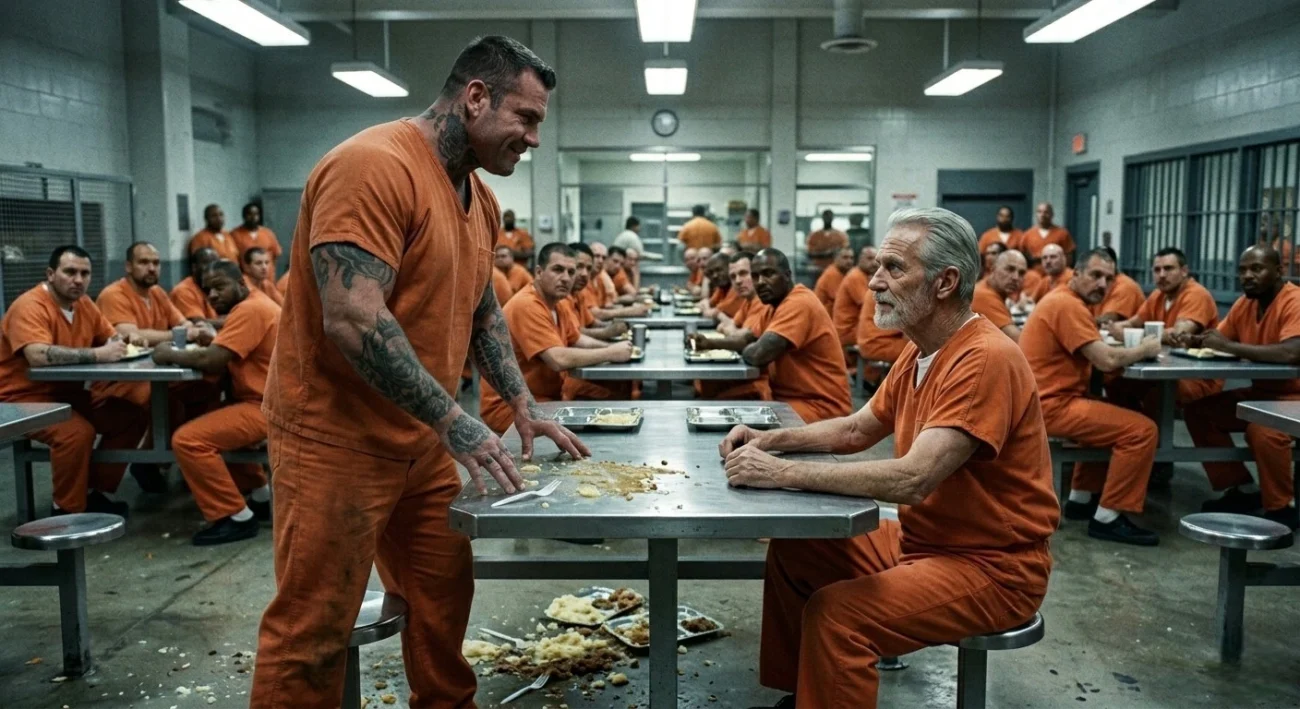
The cafeteria at Riverbend Correctional was loud in the way prisons are always loud — not wild, not free, but contained. Every sound bounced off concrete and steel, flattened by the low ceiling and the weight of hundreds of men eating without joy.
Walter Hayes didn’t notice the noise anymore.
He hadn’t for years.
He sat in the far corner, the same seat he’d claimed since his first week inside, over a decade ago. His tray held the usual: overcooked pork, mashed potatoes that had never seen a real potato, and a square of bread that could double as a doorstop. He ate slowly, not because the food deserved it, but because he had nowhere to be.
Time was the one thing Walter had mastered.
He was sixty-one. Most people looked at him and saw an old man — gray hair, trimmed beard, weathered hands, the kind of face that had stopped being angry a long time ago. What they missed were the eyes. Still. Cold. The kind of eyes that measured you before you opened your mouth.
He had been a lot of things before prison. None of them soft.
“New fish came in yesterday,” said a voice from two tables over.
Walter didn’t look up.
“Big one,” the voice continued. “Kane. Marcus Kane. Beat a man half to death outside a bar in Columbus. Other guy lost three teeth and an eye.”
Walter took a bite of bread.
“Word is he’s already claimed a cell block on D-wing,” the voice said. “Ran out the guy who had it.”
Walter said nothing.
He already knew. In a place this small, information moved faster than anything else.
The cafeteria doors slammed open at 12:14 — Walter noted it without looking at a clock, just as he noted everything — and the room’s hum dropped a half-note.
Not silence. Awareness.
Marcus Kane walked in the way men do when they’ve spent their whole lives taking up more space than they needed. Six-foot-three, maybe two-forty, arms like something industrial. The orange uniform looked wrong on him, like it was fighting to contain what was underneath. Tattoos ran up both sides of his neck, dark and angular, the kind earned in places worse than this.
Two men followed him, laughing just a beat late at a joke Walter didn’t hear.
Marcus scanned the room.
His eyes moved like a camera, assessing, categorizing. He passed over the gang clusters — too much friction for day one. He passed over the younger inmates — nothing to prove there. He passed over the guards — not yet.
Then his gaze stopped.
Walter.
Old. Alone. Still eating.
The easiest target in the room.
Marcus started walking.
Walter kept eating.
The boots echoed louder than they should have on concrete, the kind of sound a man makes when he wants you to hear him coming.
He stopped at Walter’s table.
The air held.
Marcus looked down at the old man’s tray. Then at Walter. Then back at the tray.
BANG.
His palm cracked against the metal hard enough to make three nearby inmates flinch. The tray flipped. Pork hit the floor. Potatoes smeared across the concrete. The bread slid under the bench and stopped against the wall.
The cafeteria went quieter than it had been in days.
Marcus smirked. “Oops.”
Walter didn’t move.
He stared at the empty space where his food had been. A long second passed. Two.
Then he raised his head.
Their eyes met — and something happened in Marcus’s chest that he wouldn’t have admitted to anyone. A small, cold thing. Like stepping into a room and feeling the temperature wrong.
Walter’s expression didn’t break. No rage. No fear. No trembling lip or clenched jaw.
Just that look. The kind that said: I’ve buried men more dangerous than you.
His lips moved into something that wasn’t a smile — sharper than that. Colder.
“You just made a big mistake,” he said.
His voice was low. Certain. Like a door closing.
Marcus blinked — once, involuntarily. Then he caught himself and rolled his shoulders back, broadening into his full size.
“Yeah?” he said, louder, playing to the room. “And what are you gonna do about it, old man?”
Walter looked at him for one more moment.
Then he stood up.
Slowly.
No aggression. No hurry. Just a man getting to his feet.
And he walked away.
That was it.
No words. No threats. No shaking fist.
Just the quiet exit of someone who had already decided what would happen next.
The cafeteria noise came back gradually — but thinner than before, like air let out of something.
Marcus forced a laugh. “That’s what I thought.”
His two guys echoed it, but weakly, like they were reading from a script they didn’t fully believe.
Because the room wasn’t looking at Marcus anymore.
It was watching Walter’s back as he walked out the door.
The night shift at Riverbend was different from the day.
Darker, obviously. But more than that — sound traveled differently at night. A whisper carried twenty feet. A footstep two cells down sounded close enough to touch. Every man in his bunk learned to tell the difference between a guard’s boots and another inmate’s.
Marcus lay on his back, staring at the ceiling.
He wasn’t scared.
He told himself that clearly, firmly, the way he told himself most things: as a command.
But the old man’s face kept surfacing. That stillness. That smirk. The way he’d said you just made a big mistake — not like a warning, but like a fact being recorded.
Marcus had been in county. He’d done a stretch in juvenile. He’d done eighteen months at Pickaway before the transfer. He knew how men acted when they were afraid of him. They got loud, or they got small.
That man had done neither.
“Forget it,” Marcus muttered to himself.
He closed his eyes.
Opened them again a minute later.
Just some old guy.
He turned onto his side, facing the wall.
In a cell on C-block, Walter Hayes sat on the edge of his mattress.
Hands resting on his knees.
Breathing slow.
He wasn’t angry. He hadn’t been truly angry in a long time. Anger was just fuel that burned you from the inside. Walter had learned to convert it into something else — something patient and cold and capable of waiting as long as it needed to.
He’d been waiting for eleven years.
A little longer wouldn’t kill him.
The lights flickered at 12:42 — Walter counted the seconds without blinking. The flicker lasted 1.8 seconds, the extra 0.3 that meant Rodriguez was on camera duty and had stepped away from his station.
A small window. But he’d learned to work with small windows.
He stood.
Moved to the cell door.
From under the mattress seam — a place he’d prepared six months ago, for a reason that hadn’t come up until now — he retrieved something small, flat, and metallic. The kind of thing that didn’t exist officially.
He inserted it into the lock mechanism.
Counted.
The bolt clicked back.
Marcus heard the sound before he saw anything.
Soft. Metal. Not the guards — they were louder, more regular.
He opened his eyes.
Darkness.
Then — a shape. Still. Positioned near the cell bars.
He sat up so fast his back cracked. “Who the hell—”
“Shhh.”
The voice dropped the word like a stone into still water. No heat. No aggression.
Calm.
Marcus’s vision adjusted. The shape resolved.
The old man.
Standing just outside the bars.
Watching him.
“How did you—” Marcus started, swinging his legs off the bunk.
But then the door clicked.
It swung open.
Marcus froze.
That wasn’t possible. That wasn’t — the cells were locked from the guard station, not from—
Walter stepped inside.
One step. Two.
He closed the door behind him. The latch engaged again.
Marcus stood up to his full height. In the dim light, the size difference was obvious and absolute. He had eight inches and a hundred pounds on the old man. His hands were already curling.
“You’ve got balls,” Marcus said. His voice had dropped, no longer playing to a crowd. “I’ll give you that.”
Walter didn’t answer right away. He just stood there in the center of the cell, hands loose at his sides, looking at Marcus the way a mechanic looks at an engine — not with anger, but with diagnostic certainty.
“You think this is some kind of game?” Marcus said.
“No,” Walter said. “I think this is necessary.”
Marcus moved.
He was fast for his size — always had been. The lunge crossed the cell in under a second, leading with his right shoulder, full weight behind it.
Walter wasn’t there.
He stepped — barely — to the left. A pivot, smooth as a closing door. One hand caught Marcus’s wrist at the apex of the lunge and redirected rather than resisted. The extra hundred pounds became a liability, not an asset. Marcus’s momentum carried him directly into the wall.
The impact was loud.
Marcus pushed off and spun, swinging wide.
Walter ducked, straightened, and drove two precise strikes into Marcus’s left side — ribs, just below the floating ones. Not wild swings. Not brawling. Each contact landed like punctuation. Measured. Final.
Marcus gasped and grabbed for him.
Walter stepped back, created space, let Marcus come again.
He came again.
The same thing happened.
Not fast in the way fights look in movies — explosive and dramatic. Fast in the way surgery is fast. Efficient. Without waste. Every movement had a specific target and a specific outcome.
Thirty seconds in, Marcus was breathing hard.
Sixty seconds in, he was favoring his left side.
Ninety seconds in, he was on the floor.
He hadn’t thrown a single punch that landed.
Not one.
He lay on his back, chest heaving, staring at the ceiling — the same ceiling he’d been staring at hours earlier, trying to convince himself there was nothing to worry about.
Walter stood over him.
Not breathing hard.
Not triumphant.
His expression was the same it had been in the cafeteria. The same it had been when his tray hit the floor. The same as when he walked away.
Unchanged.
He crouched slowly — not quickly, not dramatically — until his face was level with Marcus’s.
“You weren’t punished for the tray,” Walter said.
Marcus blinked. His lip was bleeding. He didn’t know when that had happened.
“That was an insult,” Walter continued. “And insults I’ve ignored before.”
He let that sit.
“You were punished for one thing.”
Marcus stared.
“Thinking there wouldn’t be consequences.”
Walter straightened. He moved to the cell door, disengaged the latch with the same quiet click, and stepped out.
He paused in the doorway — just for a moment.
“Don’t test the lesson,” he said.
And then he was gone.
The door settled shut.
The cell was quiet.
Marcus lay on the floor for a long time, listening to the sound of the prison breathing around him, until his ribs ached too much to stay still and he finally, slowly, pulled himself back onto the bunk.
He didn’t sleep again that night.
By 7 a.m., the story was everywhere.
Not told. Not announced.
Just known, the way things are known in closed places — through a look held a second too long, through the way a man’s posture changes when a name comes up, through the deliberate space that appears around certain people.
Marcus walked into the cafeteria at 7:23.
He moved differently than he had the day before. Still big. Still present. But something in the engine had changed. The performance was quieter. The scan of the room happened faster, less theatrical.
His eyes found the far corner.
Walter was already there.
Same seat. Same tray. Same measured, unhurried eating.
Like nothing had happened.
Like everything had happened.
Marcus got his food from the line. His two followers were behind him, chatting about something. He said nothing.
He sat down at a table near the center of the room.
Not the corner. Not near Walter.
Not because he was told to.
Because some lessons don’t need to be repeated.
One of his followers started to say something — some comment about the old man, the setup of a joke.
“Drop it,” Marcus said.
The follower dropped it.
At the far corner of the cafeteria, Walter Hayes took a slow bite of toast.
He didn’t look up.
He didn’t need to.
The corner was his, the quiet was his, the room understood what it understood — and the man who had arrived like a storm had learned, in the space of one night, that some silences have teeth.
Walter set down his cup.
Folded his hands.
And let the morning pass.
Original fictional stories. AI-assisted creative content.
