
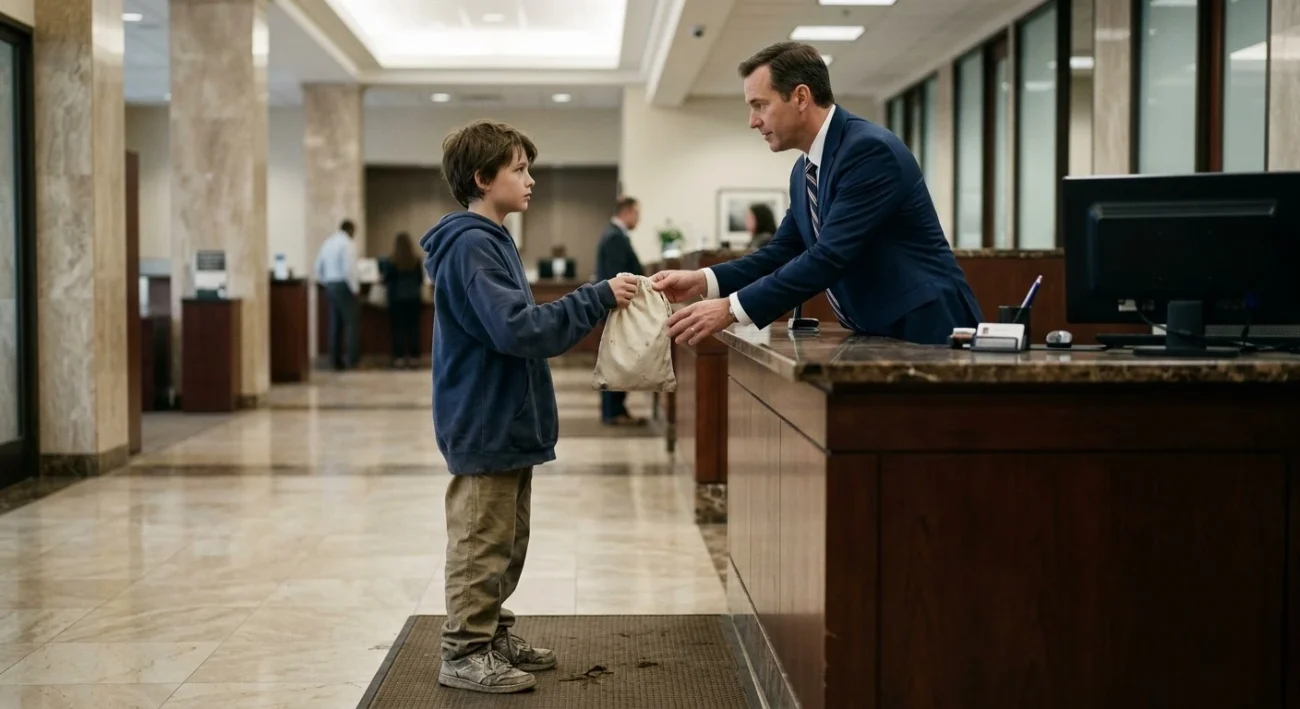
The security guard saw him first.
He was maybe twelve, maybe thirteen—hard to say, because hunger had a way of shaving years off a kid’s face while adding something older to his eyes. His jacket hung loose at the shoulders, two sizes too big, and his shoes were so worn the right sole had started to separate at the toe. He carried a faded cloth bag against his chest the way people carry things they can’t afford to lose.
“Hey.” The guard moved fast, planting himself in the boy’s path. “This isn’t a shelter, kid.”
A few customers looked up from the marble counter. One woman whispered something to her husband. A teller suppressed a smile. Then they all looked away, because that’s what polished lobbies trained people to do.
The boy didn’t argue. He didn’t flinch. He just stood there, breathing steady, eyes fixed on the corner office—glass walls, silver nameplate: MARTIN CALDWELL, BRANCH MANAGER.
Martin Caldwell had a gift for reading disturbances the way other men read weather. He stepped out of his office not because anyone called him, but because the shift in lobby energy had the particular flavor of a problem no one else wanted to own.
He was in his late forties, dressed sharply in the kind of suit that cost more than a car payment, carrying the calm authority of a man used to being obeyed. His eyes moved from the guard to the boy to the bag, and back again.
“What’s the problem?” he asked.
“Kid walked in,” the guard said. “Looking for change, maybe.”
Caldwell fixed a practiced smile on his face. “Son, if you need assistance, there are services nearby that can—”
The boy moved.
He walked to the counter with unhurried steps, set the bag down with both hands, and pulled the zipper open with the careful deliberateness of someone who had rehearsed the moment a hundred times. The top layer looked like clutter—loose papers, worn envelopes. Then the light caught something metallic.
Key fobs. Dozens of them. Black, identical, bundled tight with rubber bands.
Beside them sat a stack of documents sealed in clear plastic sleeves. And beneath that—Caldwell felt something cold press against the back of his ribs—a smaller bag stamped with the bank’s own internal transfer logo.
The room didn’t go silent all at once. It went silent in pieces. One teller stopped mid-keystroke. The guard leaned closer. A customer near the door stayed very still, phone half-raised.
Caldwell’s face went the color of old paper.
He reached for the top document. His hand hovered over it for a second, as though it might be hot. Then, in a voice so quiet no one else could hear him: “Everyone give us space. Emily—take the floor. No one comes to my office without my word.”
Emily, the head teller, looked from the bag to his face. She nodded once and moved. “Yes, Mr. Caldwell.”
He looked at the boy. “Come with me.”
Inside the office, Caldwell lowered the blinds with fingers that weren’t entirely steady.
“What’s your name?”
“Evan,” the boy said. “Evan Cross.”
The name hit Caldwell in the sternum.
He opened the top document anyway. Scanned it. Found the line he already knew was there: CROSS, DANIEL — PRIMARY SUSPECT (DECEASED).
He set it down and forced himself to look at the boy.
Evan Cross was watching him with eyes that had no business being that patient. There was something in him that wasn’t childhood anymore—not broken, not hardened, just compressed into a shape that small spaces create. Like a plant growing through a crack in concrete.
“Who told you to bring this here?” Caldwell said.
Evan pulled a prepaid phone from the bag. Cracked screen, no case. “A man called me on this. He said if I wanted answers about my dad, I should bring all of it here. He said you’d know what to do.” He paused. “He said you’d panic.”
Caldwell resisted the urge to confirm how accurate that was. “Did you recognize his voice?”
“No. But he knew my name. He knew our address.” Evan set the phone on the desk. “He called three times over two months. The last time he said if I didn’t come before Thursday, he’d find another way.”
Caldwell moved to the window, looked out through the slats. The lobby had returned to something resembling normal, but it was the kind of normal people perform when they’re actually watching.
“You understand what’s in that bag?” he said.
“The key fobs open safe-deposit boxes,” Evan said. “The man told me. He said they belong to people who don’t know their boxes were emptied.”
“How old are you?”
“Thirteen.”
Caldwell closed his eyes for exactly one second. Then: “Your mother—does she know you’re here?”
“She thinks I’m at school.” Evan’s voice didn’t waver. “She doesn’t know any of this. After my dad died, people started coming around. Asking questions. One night someone broke our back window. After that we moved twice.” He paused. “She thinks my dad just made mistakes. She thinks it’s over.”
“It’s not over,” Caldwell said.
“I know.”
Caldwell pulled out an old folder from the bottom of his filing cabinet. A folder he’d told himself he would never open again, tucked between obsolete compliance binders. He spread the contents across the desk beside Evan’s documents—layering old beside new, as if the two sets of paper were a conversation that had been interrupted six years ago and was only now resuming.
The facts assembled themselves into a story he’d always half-known.
Six years earlier, Hawthorne & Pike had experienced what corporate called “misallocated internal transfers”—a euphemism that covered approximately two million dollars quietly vanishing from dormant accounts over eighteen months. The kind of fraud that only works when someone with institutional access runs it and someone with authority chooses not to look too hard.
A contractor named Daniel Cross had found the trail. He’d compiled records. He’d brought them forward.
Then he was struck by a car in a parking garage at 11 PM on a Tuesday and died of blunt-force trauma to the head. Police ruled it a hit-and-run. The investigation closed quickly. Caldwell had countersigned the final paperwork because the regional director needed closure and the board needed reassurance.
He had told himself he’d had no choice.
He’d been lying.
Caldwell looked at the photograph Evan had pulled from the thick plastic sleeve. Caldwell himself, caught on a parking garage camera: coat collar up, looking over his shoulder, leaving at an odd hour. Not doing anything illegal in that image—just being present in a place that now felt incriminating by association.
“Your father wasn’t the thief,” Caldwell said. It wasn’t a question.
“No,” Evan said. “He found the thief.”
The words hung in the office like smoke after a fire.
Caldwell turned one final page. An audit summary from a regional compliance review, filed and never acted on. Names listed. Executives. Oversight officers. And at the bottom, highlighted in pale yellow:
MARCUS HALE — REGIONAL OVERSIGHT.
Marcus Hale. Who had climbed steadily since the case was buried. Who was now rumored to be on the shortlist for a senior executive position. Who had always moved through corporate life with the easy confidence of a man holding cards no one could see.
Caldwell set the paper down. He felt shame settle into his chest like ballast—not the fleeting kind that dissolves under distraction, but the dense, clarifying kind that makes a man suddenly, surgically aware of every choice that led him here.
“You’re not safe,” he said.
Evan looked up at him. “Neither are you.”
The phone on Caldwell’s desk rang.
The caller ID said: REGIONAL OFFICE — HALE, M.
Evan glanced at the screen. He didn’t say anything. He didn’t need to.
Caldwell answered. “Marcus.”
“Martin.” The voice was warm, unhurried, the kind of tone men practiced to disguise precision. “I’m in the area. Thought I’d stop by—need your office for a quick meeting. Ten minutes.”
“That’s… unexpected.”
A soft laugh. “I like surprises. See you soon.”
The line went dead.
Caldwell stood with the receiver still in his hand for a moment longer than was useful. Then he set it down, walked to the filing cabinet, and pulled out a small remote—standard branch panic hardware, the kind that sat in the drawer for years between mandatory safety reviews.
He looked at Evan. “We have about eight minutes.”
“What do we do?”
Caldwell picked up his personal phone and typed fast.
Emily — lock the back hallway. If Hale arrives, stall him. Call 911, ask for financial crimes. Tell them: internal fraud evidence in manager’s office. And keep the kid with you if he leaves my office. Don’t let anyone speak to him alone.
He hit send, then looked back at Evan. “Leave the keys in the bag. Put the phone back inside. If anyone asks you what’s in there, you don’t know.”
“But—”
“Evidence only works,” Caldwell said quietly, “if you’re alive to give it.”
Evan swallowed. His hands tightened once around the cloth bag, then released. He put the phone back inside.
Hale arrived in six minutes, not ten.
Caldwell was watching through the blind slats when the glass doors opened. Marcus Hale walked in wearing a suit that cost more than Caldwell’s own and moved through the lobby like he owned the square footage. He shook hands with the security guard. He smiled at two customers. He scanned the room the way a man scans a room when he’s already decided how the scene will end.
Emily intercepted him near the customer service desk. Caldwell watched her gesture toward a form on the counter—stalling, exactly as he’d asked. She was good at this. She’d been managing difficult customers for eleven years. She knew how to hold a line.
Hale smiled, nodded politely at whatever she said.
Then his gaze drifted—a single smooth movement—directly toward the office window.
Caldwell let the blind drop back into place. “He’s coming.”
Evan whispered, “What do I do?”
“Stay behind the desk. Don’t speak unless spoken to. Whatever you see, don’t react.”
He pressed the panic remote once—a silent alert, pinging the bank’s internal security monitors and simultaneously flagging the branch’s emergency contact log.
Then he opened the office door before Hale could knock.
“Marcus.” Caldwell stepped into the lobby, letting the door shut behind him. “Didn’t expect you today.”
Hale’s eyes moved past him into the glass office—quick, practiced, evaluating. He clapped Caldwell on the shoulder, too familiar, too heavy. “Martin. I heard there was some kind of disturbance in here earlier. A walk-in?”
“Misunderstanding,” Caldwell said. “It’s handled.”
“Handled how?”
“A kid came in off the street. We connected him to social services.”
Hale tilted his head. “A kid.”
“Yes.”
“Where is he now?”
“With Emily. She’s making calls.”
Hale’s smile held, but it had changed in some subtle way—the way ice holds its shape just before it starts to yield. “You’re softer than I remember, Martin.”
Caldwell matched his tone. “People change.”
“Sometimes,” Hale said, “they just pretend to.”
He angled his body toward the office door, trying to see through the glass. Caldwell shifted slightly, blocking the line of sight with his own shoulder.
Hale’s voice dropped, still pleasant, but edged with something cold running beneath it. “Corporate flagged an unusual access ping. Older deposit system—one of the legacy boxes. You wouldn’t know anything about that?”
“I haven’t accessed any legacy systems.”
“Good.” He let a beat pass. “Because if something from that old situation were to resurface—something that had been very carefully resolved—it would be inconvenient. For everyone who prefers their lives running smoothly.” He held Caldwell’s gaze. “You understand me.”
Caldwell understood perfectly. He’d been understanding Marcus Hale for six years and doing nothing about it.
In the distance, faint but unmistakable: sirens.
Hale’s eyes moved toward the windows. Just once. A flicker, then controlled again. But Caldwell saw it.
He leaned slightly closer. “I’m done playing it careful, Marcus.”
Hale’s expression hardened. “Then don’t.”
Caldwell inhaled once. Then he stepped back—deliberately, clearly—away from the office door and raised his voice just enough to carry across the lobby floor.
“Marcus Hale just asked me about unauthorized access to safe-deposit systems. I’ve already reported it.”
The room stopped.
A customer set her handbag down. A teller’s hands hovered over her keyboard without touching it. The security guard straightened. Emily, at the far end of the counter, didn’t move but her face went white.
Phones rose slowly around the lobby—not aggressive, not staged. Just the instinct of witnesses who understood they were watching something they might later be asked to describe.
Hale’s smile disappeared. “Martin.”
“I know what I should have done six years ago,” Caldwell said. His voice trembled, but it carried. “I’m doing it now.”
The glass doors opened.
Two uniformed officers walked through, followed by a third in plain clothes—mid-forties, dark jacket, the particular set of shoulders that belongs to someone who handles financial investigations and has long since stopped being surprised by human greed.
“Mr. Caldwell?” The plainclothes officer moved toward him. “We received a call.”
“Evidence is in my office.” Caldwell turned and opened the door. “And there’s a boy named Evan Cross who can tell you where it came from.”
Evan stepped out from behind Emily’s desk.
He was still holding the cloth bag against his chest—the same way he’d held it when he walked through the door forty minutes ago. Small, tense, still wearing the too-big jacket. But there was something different in his posture now. Not confidence exactly. More like the feeling of a person who has been carrying something unbearable for a very long time and has finally set it down in a place where other hands can hold it too.
Hale’s eyes snapped toward him.
Something moved across his face—not quite recognition, but the thing that comes before it. A calculation. A search for options.
He found none.
There were too many witnesses. Too many phones. Too many people who had laughed or looked away an hour ago and now stood perfectly still, watching.
The plainclothes officer stepped between Hale and the exit. “Mr. Hale. I’m going to need you to come with me.”
Hale straightened his jacket, his face settling back into something sculpted and smooth. He didn’t resist. He moved toward the officer with the measured dignity of a man who had survived tight corners before and had already begun calculating his next move.
As he passed Caldwell, he leaned close. Almost conversational. “This will get messy.”
Caldwell kept his voice low. “Good. Lies should be.”
In the weeks that followed, the Financial Crimes unit worked quietly and methodically through what Evan had carried into the branch.
The key fobs opened forty-three safe-deposit boxes at three Hawthorne & Pike locations. Every one of them had been accessed using override codes not assigned to any active employee. Every one of them belonged to dormant accounts. The withdrawals had been papered over through a cascade of internal memos, reclassified as “transfer reconciliation adjustments”—language designed to be understood by anyone looking closely and ignored by everyone else.
Daniel Cross had found this. He had mapped it. He had tried, through proper channels, to report it.
Three weeks after filing his first complaint, he was dead.
The bag Evan had carried wasn’t assembled by a stranger with a grudge. It had been put together over five years by a compliance officer inside Hawthorne & Pike’s own regional office—a man named Roy Ferris, who had been present at the original cover-up, who had stayed silent out of fear, and who had finally decided that guilt was heavier than self-preservation. He had chosen Evan as his messenger because Evan had the only reason in the world to make sure the bag reached the right person.
Ferris surrendered himself to investigators four days after Hale’s arrest. He gave a full statement. He named names.
Marcus Hale was charged on six counts: securities fraud, obstruction of justice, falsification of internal records, conspiracy, and two counts related to the suppression of a federal investigation. His attorney issued a statement. The board issued a statement. The bank’s PR team issued several statements. None of them helped.
The security guard who had snapped at Evan in the lobby was not charged with anything. He gave a brief statement to investigators, confirming what he’d seen. He went home that evening and apparently sat in his car in the driveway for forty minutes before going inside.
Caldwell was suspended pending investigation.
Six weeks later, he was reinstated—cleared of direct involvement in the fraud, though not of what the investigator’s report called “a pattern of passive compliance.” He accepted the designation. He didn’t argue it.
He visited Evan once, about three months later.
Evan and his mother had been moved to temporary housing under protection while statements were taken and proceedings began. The apartment was small and clean, with a window that looked onto a parking lot. His mother had made tea. She left them alone in the kitchen.
Caldwell set a blank notebook on the table—the only thing he’d brought.
“I should have listened to your father,” he said. “He came to me. Did you know that? Six years ago, before he went to compliance, he came to my office. He was careful about it. Professional. He asked me to look at some irregularities.” He paused. “I told him to follow procedure and let corporate handle it.”
Evan turned the notebook over in his hands without opening it. “Why?”
“Because I was afraid of Hale,” Caldwell said. “And I told myself that wasn’t the same as choosing him.”
Evan set the notebook down on the table. He looked at it for a moment, then up at Caldwell. “Will it matter? All of it—the case, the charges. Will it actually do anything?”
Caldwell nodded slowly. “The people whose boxes were emptied will be compensated. The cover-up is on record now. Hale is going to prison. And Ferris—the man who put the bag together—his testimony just helped the DA build cases against two other executives.” He folded his hands. “It already matters.”
Evan was quiet for a moment. Then, almost to himself: “They laughed at me. In the lobby. Before you came out.”
“I know,” Caldwell said. “I was watching.”
“Do you think they know what they almost helped hide?”
Caldwell thought about the tellers who had exchanged amused looks. The customers who had glanced away. The guard who had said this isn’t a shelter with such efficient authority.
“They know now,” he said. “They’ll remember you walking in for the rest of their lives. And some of them—” he paused—”some of them will make a different choice next time they see someone the room decides doesn’t belong.”
Evan picked up the notebook again. Ran his thumb along the cover.
“What’s this for?”
“I don’t know,” Caldwell admitted. “I thought you might want to write some things down. Or not. It was the only thing I could think to bring that wasn’t just an apology.”
Evan opened the first page. Blank. He looked at it the way you look at something you’re deciding what to do with.
Then he reached for a pen from the cup on the counter, clicked it once, and wrote something at the top of the first page.
He didn’t show it to Caldwell.
He didn’t need to.
Later, in the hallway, Evan’s mother pressed Caldwell’s hand briefly. She didn’t say much—just: “He was right about you.”
Caldwell wasn’t sure if that was a compliment or a careful way of saying the bar had been low.
He took it as both.
Outside, he sat in his car and watched the parking lot for a while. Ordinary. Quiet. The kind of afternoon that looked exactly like the kind of afternoon in which nothing had changed at all.
But something had.
A thirteen-year-old boy had walked into a bank with a bag of evidence and no plan except the raw, stubborn belief that the right person would eventually do the right thing if he just stood there long enough.
He hadn’t been wrong.
He’d just had to wait an extra six years for the right person to become that person.
Caldwell started the engine. He had a meeting at three o’clock—a routine compliance review, ironically enough. He would go. He would be thorough. He would flag the things that needed flagging.
Not because he had to.
Because a boy in a too-big jacket had walked into the room nobody wanted him in, and held his ground, and turned out to be the only honest exit any of them had left.
Original fictional stories. AI-assisted creative content.
