
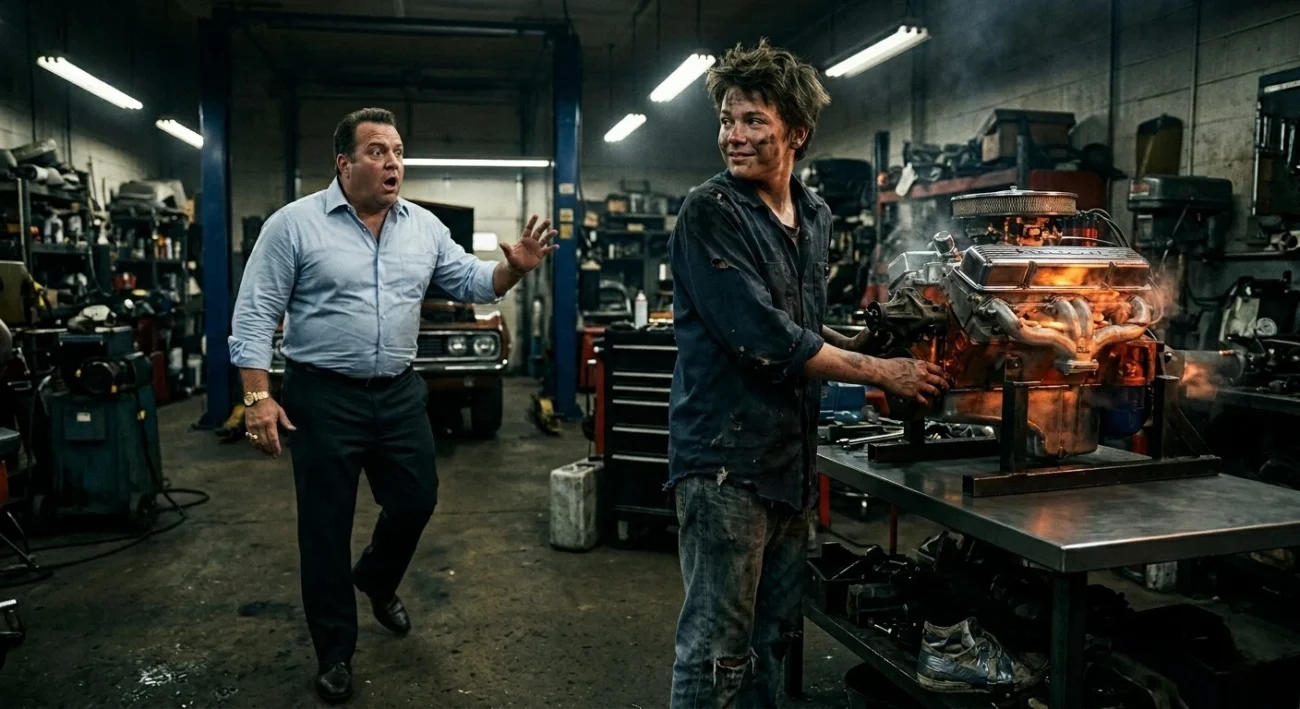
Esteban Morales laughed the way cruel men laugh — loud, loose, and meant to wound.
He stood in the center of the workshop, a gold ring cutting into his finger, and pointed at the dismantled engine on the main table like it was roadkill.
“Look at this,” he said, grinning at the other mechanics. “The garbage boy thinks he can fix what a twenty-year veteran couldn’t.”
The other men chuckled — not because it was funny, but because Esteban signed their paychecks.
Miguel stood five feet away, hands at his sides, jaw tight.
He was fourteen. His sneakers were wrapped in duct tape. His shirt had been washed so many times the color was gone, replaced by permanent stains of oil and time. He’d been sleeping in the alley behind this dealership for two weeks before Doña Patricia found him. For a month after that, he came here every morning at seven, offering to sweep, to fetch coffee, to clean tools — anything to stay close to the machines.
Every morning, Esteban told him to get out.
Today was different.
“Are you serious?” Miguel asked.
His voice didn’t shake. His knees did — but that was hidden under his jeans.
Esteban straightened his tie. He was the kind of man who wore a tie in a garage. “Completely serious. One week. You fix that engine, you get my office, my title, and my salary.” He paused for effect. “But when you fail — and you will fail — I never want to see your dirty face near my workshop again. Not on the sidewalk. Not across the street. Gone.”
The room went still.
Every mechanic, every janitor, every parts-runner stopped what they were doing.
Miguel looked at the engine. It belonged to an imported European sedan — a car worth more than a decade of Doña Patricia’s cleaning income. The shop’s best mechanic, a man with twenty years and calloused hands, had quit that morning after three days of failure. His exact words before walking out: mechanical brain death.
Miguel stared at the pile of metal.
He didn’t see junk. He saw a puzzle holding its breath.
“Deal,” he said.
Esteban walked away laughing.
He was still laughing at dinner that night.
Miguel went to the engine.
He didn’t touch it. Not that first night.
He just looked.
Under the orange security lights, the boy circled the workbench slowly, hands behind his back, eyes moving across every surface. He crouched. He stood. He tilted his head. He pressed his ear close — not to listen, just to be near. The mechanics who passed by on their way out thought he looked ridiculous.
“Kid. Go home,” one of them said.
“I don’t have one,” Miguel answered, and kept looking.
The second day, he read.
He had a cardboard box under Doña Patricia’s kitchen table stuffed with mechanical manuals he’d pulled from dumpsters. Engineering guides. Repair catalogs. A torn trade journal from 2007 he’d memorized entirely. He brought three of them to the workshop and sat on the floor with a flashlight.
None of the other mechanics spoke to him.
At midnight, one of them dropped a sandwich near his feet without making eye contact.
Miguel ate it on the floor and kept reading.
Day three.
Guadalupe — the workshop secretary, a woman in her fifties with a permanent coffee stain on her collar and twenty years of watching mediocre bosses come and go — walked up to Miguel and put a paper-wrapped sandwich in his hand.
“Eat,” she said. “A brain without fuel is just expensive decoration.”
Miguel looked up. “Mr. Esteban will —”
“Esteban couldn’t identify a spark plug if it bit him.” She glanced toward the office window. “He got that job because his father plays golf with the dealership lawyer. You got here because you wanted to.” She tapped the workbench. “That’s the difference. Now eat.”
Miguel ate.
He went back to the engine.
And that’s when he noticed the valve.
It was the intake manifold — third one from the left, coated in burned oil and carbon buildup. Every mechanic before him had cleaned around it, checking the obvious parts. Miguel cleaned it. Scrubbed it down to bare metal with a rag, then a toothbrush he’d found in a drawer.
The engraving was tiny. Punched by hand.
He almost missed it.
He held a magnifying glass he’d borrowed from the parts desk close to the metal. The letters sharpened slowly, like a word surfacing from underwater.
RM — Future Project 2009.
Miguel sat back on his stool.
He read it again. And again.
RM.
His heart moved before his mind caught up.
He’d seen those initials a hundred times. In the trade journal from 2007. In an engineering magazine he’d found waterlogged in a park trash bin. In a full-page profile he’d read so many times he could recite it.
Ricardo Morales. Engineer. Visionary. Dead at forty-one — a cardiac event, they said — before his most ambitious project was ever completed.
The man the automotive world still called twenty years ahead of his time.
Miguel stared at the engraving.
What is the signature of a dead genius doing inside this engine?
The rumor spread faster than Esteban expected.
By day four, three mechanics had told him the orphan kid was actually doing something. Not just cleaning. Diagnosing. The word used was “progress.”
Esteban went home that night and didn’t sleep.
He told himself it was nothing. A boy playing with parts. There was no way. He’d made the bet as a performance — a public humiliation with a clean exit. He’d done the math: no professional could fix that engine. What chance did a hungry teenager have?
None, he told himself.
But he started sweating anyway.
She arrived on day five without warning.
An elegant woman. Silver hair pulled back. Expensive coat worn like it meant nothing. She moved through the workshop slowly, the way people move when they’re not shopping — when they’re remembering.
Her name was Beatriz Castillo. Minority shareholder in the dealership. Sister-in-law of the owner. And widow of Ricardo Morales.
Nobody had called her. Nobody had told her what was happening.
She’d come because she sometimes did — to breathe the smell of engines, she’d once told Alejandro. To remember.
She stopped when she saw Miguel.
The boy was bent over the engine at a forty-five-degree angle, both hands inside the block, completely still. Eyes closed. Like he was listening to something nobody else could hear.
Beatriz raised one hand slowly to her lips.
“My God,” she whispered.
Guadalupe appeared at her elbow. “Mrs. Castillo?”
“Who is that boy?”
“His name is Miguel. He’s —”
“He reminds me of him.” Her voice fractured on the last word. “The posture. The stillness. Ricardo used to stand exactly like that when he was thinking. Like the whole world went quiet and there was only the machine.”
She walked toward him.
Miguel heard footsteps and straightened, ready to be told to leave.
“Don’t stop,” Beatriz said softly. “Please.”
He looked at her — at the silver hair, the careful eyes, the way she was studying him like she was solving something.
“You know this engine?” he asked.
“I know the man who built it.”
Silence.
“Ricardo Morales,” Miguel said.
She blinked. “You found the engraving.”
“Day three.”
She was quiet for a long moment. Then: “Come with me.”
She returned the next morning with a wooden case.
Mahogany. Velvet lining. Brass clasps worn smooth by years of handling.
She set it on the workbench in front of Miguel and opened it.
Inside: precision tools. Custom-fitted. The kind that didn’t come from any catalog. Each instrument sat in a shaped velvet recess, perfectly fitted, carrying the faint smell of machine oil and time.
“My husband made these himself,” Beatriz said quietly. “Ground the edges by hand. Calibrated every measurement personally.” She paused. “I’ve kept them for twelve years. Didn’t know what to do with them. Every engineer I offered them to felt wrong.” She looked at Miguel. “You feel right. I can’t explain it.”
She lifted a calibrated wrench and placed it in Miguel’s palm.
“Ricardo always said a tool is an extension of a mechanic’s soul.” She closed his fingers around the handle. “Use them. I think he would have wanted you to.”
Miguel held the wrench.
Something in him went very quiet.
With the right tools, he didn’t work.
He flowed.
By hour three with Ricardo’s instruments, he understood something that stopped him cold.
This engine wasn’t broken.
It had never been broken.
It was a prototype — a hybrid system built a decade before the technology existed to support it. The fuel-saving architecture, the regenerative compression cycle, the dual-ignition sequencing — it was all intentional. All correct. All operating exactly as designed.
The problem wasn’t failure. The problem was interference.
A previous mechanic — months ago, maybe longer — had looked at the unconventional layout and decided it was wrong. Had tried to “correct” it. Had forced standard-issue components into a system built to reject them. Had suffocated a masterpiece trying to make it ordinary.
Miguel sat back on his stool.
“You don’t need fixing,” he said to the engine. “You need to be freed.”
He picked up Ricardo’s wrench.
He got to work.
The night before the deadline, the workshop went dark.
Not a flicker. Not a surge. Total blackout — the kind that comes from a circuit breaker being shut off by hand.
Miguel stood in complete darkness for thirty seconds.
He’d been two hours from finished.
He could hear Esteban’s logic in the silence: No power, no tools, no lights. Clock runs out by morning. Bet’s over. Kid’s gone.
Miguel pulled out his phone. The battery was at six percent. He called the only number he could afford to call.
“Doña Patricia,” he said when she picked up. “I need candles.”
She arrived forty minutes later with every candle in the apartment. Guadalupe came with her — she’d been called without being asked — carrying two battery lanterns and a thermos of coffee.
Together, the three of them arranged the candles around the workbench.
Miguel looked at the lit circle of flame around the engine.
All right, he thought. Let’s finish this.
He worked through the night.
The candles threw long shadows. Ricardo’s tools moved through the light like they knew the way. Guadalupe and Doña Patricia sat on a bench near the wall, not speaking, not leaving.
By four in the morning, the last component was seated.
Miguel tightened the final bolt with Ricardo’s wrench.
He laid the tool down and sat on the floor with his back against the workbench.
He didn’t sleep. He just rested his eyes and waited for morning.
By eight a.m., the workshop was full.
Word had traveled in that invisible way workshop gossip always does. Every mechanic. Every sales rep. Every janitor. A cluster of delivery drivers who had no business being there. They all stood in a loose semicircle around the main table.
And at the back, standing with his arms folded and a tight smile that didn’t reach his eyes, was Esteban.
And at the front, having arrived twenty minutes ago without explanation, was Alejandro Castillo. The owner of the dealership. Ricardo Morales’s older brother. A man who said very little and noticed everything.
Beatriz stood beside him.
Miguel stood at the engine.
He looked terrible — dark circles, grease on his forehead, candle wax on his sleeve. His hands were steadier than anyone in the room.
“It’s ready,” he said.
His voice came out rougher than he intended. Too much smoke, too little sleep.
Esteban stepped forward from the back of the crowd. “Let’s see it then.”
There was something brittle in his voice. Forced confidence. The smile of a man who has gambled badly and is trying not to show it.
Miguel put his hand on the ignition key.
He looked at the engine one more time.
Thank you, he thought. He wasn’t sure who he was thinking it at.
He turned the key.
Two seconds of silence.
The kind of silence that fills a room.
Esteban opened his mouth.
The engine woke up.
Not a roar. Not a cough. A purr — deep, smooth, even, perfect. A sound like controlled power moving through a system that finally had room to breathe. Every cylinder firing in sequence. Every component doing exactly what Ricardo Morales had designed it to do a decade before the world was ready.
The diagnostic screen on the connected computer bloomed green.
Efficiency: 140%
Emissions: Near-zero
System status: Optimal
The room made a sound — not quite a gasp, not quite a cheer. Something in between.
“Impossible,” Esteban said.
The word came out small. He took a step backward. Then another.
“It’s not impossible.” Miguel kept his eyes on the engine. “It’s engineering. Someone tried to make it into something ordinary, and it resisted. Because it was never ordinary.” He turned to face Esteban for the first time. “This is a hybrid prototype. The fuel-saving systems are ten years ahead of current production. The previous mechanic didn’t fail because he was bad — he failed because he didn’t know what he was looking at.”
Alejandro Castillo stepped forward from the back of the crowd.
He moved through people without seeming to touch them, the way authority moves — quietly, inevitably. He reached the workbench and placed both hands on the engine block.
His face had gone pale.
“This design,” he said softly. “I know this architecture.” He touched the fuel rail. The intake. The dual-sequence ignition. “I’ve only ever seen this in one set of blueprints. Blueprints that were never released. Never published.”
“Alejandro.” Beatriz’s voice.
She moved to his side and pointed to the cleaned engraving on the intake valve.
He leaned close.
RM — Future Project 2009. For my son, wherever he may be.
The workshop went absolutely silent.
Alejandro stood up slowly.
He turned to Miguel.
For the first time, he really looked at him — not as a boy, not as a problem, not as the subject of a bet. He looked at the dark eyes. The line of the jaw. The shape of the hands wrapped around Ricardo’s wrench.
Ricardo’s wrench.
His voice, when it came, was barely above a whisper.
“What’s your full name?”
“Miguel. Miguel — I don’t have a second name. Doña Patricia gave me the first.”
“How old are you?”
“Fourteen.”
Alejandro closed his eyes.
“Ricardo would have been forty-six this year.” He opened his eyes. “He had a relationship. When he was thirty-one. It ended badly — fear, misunderstanding, she left the city. He spent the last fifteen years of his life trying to find the child she’d told him she’d lost.” His voice broke on the last word and he controlled it. “He never stopped believing.”
Beatriz was weeping silently.
“The engraving,” Alejandro said. “For my son, wherever he may be. He built that engine in 2009. He knew whoever found the signature — whoever understood it — might be —”
He couldn’t finish the sentence.
Three days later, a DNA test.
Three days after that, the results.
Miguel was Ricardo Morales’s son.
The workshop gathered again when Alejandro read the results aloud. Not to celebrate — that wasn’t what it felt like. It felt like a long-held breath finally leaving a room.
Guadalupe cried. Doña Patricia held her own hands together so tightly her knuckles went white. Two mechanics who hadn’t said a word to Miguel in seven days quietly shook his hand.
Esteban stood in the corner.
He was pale. Sweating. His gold ring caught the light when he raised his hand. “Alejandro, I want to —”
“I know what you want,” Alejandro said. He didn’t look at Esteban. He didn’t need to. “The bet was clear. The boy won. But I’m not giving a fourteen-year-old a management position.” He paused. “I’m firing you because you don’t have the dignity, the judgment, or the basic decency required to lead other people. You tried to humiliate someone with ten times your talent. Collect your things.”
Esteban’s mouth opened and closed.
“Today,” Alejandro said.
After Esteban left — quietly, quickly, without the gold ring looking quite so bright — Alejandro sat down with Miguel in the small office at the back of the workshop.
“I want to be honest with you,” Alejandro said. “I don’t know what you want. So I’m going to offer and you tell me.”
“Okay.”
“You’re my nephew. You’re Ricardo’s son. You’re entitled to whatever I can give you. A home. A real education. University. Resources. You never have to worry about money or food or —”
“I want the workshop,” Miguel said.
Alejandro stopped.
“Not to own it. Not to manage it.” Miguel chose his words carefully, the way someone does when the thing they’re saying matters. “I want to turn it into a school. Free. For kids like me — kids who can feel what’s wrong with a machine but no one’s ever given them a real tool.” He looked at the door to the workshop floor. “My father left knowledge behind. If I take that knowledge and just… get rich with it — that’s not what it was for. You don’t build a prototype that talks to the future just so one person can cash it in.”
Alejandro looked at him for a long time.
“Talent is everywhere,” Miguel said. “What’s missing is opportunity.”
It took four months.
The old workshop was renamed the Ricardo Morales Technical Training Center.
Tuition: zero. Requirements: show up, work hard, respect the tools.
Doña Patricia became what everyone started calling the madre de taller — the mother of the shop. She made sure every student ate before their first lesson. She knew every name within a week. She kept a jar of emergency money on the kitchen shelf for kids whose families went short.
Beatriz Castillo donated the full tool set — made copies of Ricardo’s custom instruments for the school, real working versions — and funded a scholarship for the top student each year to attend an accredited engineering program.
Alejandro put in the money and the legal structure and then stepped back and let Miguel run it.
And Miguel ran it the way Ricardo would have wanted.
Three years in, a frightened boy in patched clothes appeared at the workshop door. Thirteen years old. Shoes held together with electrical tape. Carrying nothing but a look Miguel recognized — that particular hunger that isn’t about food.
Miguel walked over.
He placed a hand on the boy’s shoulder.
He put Ricardo’s wrench — the original, the one Beatriz had placed in his palm — into the boy’s hand.
“Is it complicated?” the boy asked, staring at the disassembled engine on the table.
“It’s just a puzzle you haven’t solved yet,” Miguel said. “Listen to the machine. It’ll tell you what’s wrong.”
The day Esteban came back, it was raining.
He stood in the doorway in a jacket that no longer looked expensive, hat in hand — not literally, but close enough. He’d been fired from two jobs since the dealership. Word traveled in mechanical circles. He tried to sabotage a kid. He cut the power on a fourteen-year-old working by candlelight.
Nobody wanted that in their shop.
He asked for Guadalupe first. She let him in.
Miguel was in the middle of a lesson when Esteban appeared in the back of the room. He waited. He didn’t speak. He stood like a man who has run out of other options and arrived somewhere he should have come first.
When the lesson ended, Miguel walked over.
Esteban started with, “I know I don’t deserve —”
“Stop,” Miguel said. Not harshly. Just clearly. “We don’t do that here.”
He handed him a broom.
“First week, everyone sweeps. You learn the floor before you learn the engine. That’s the rule.”
Esteban looked at the broom.
Something crossed his face — the last of the gold-ring-in-a-garage version of himself, maybe. Then it passed.
He took the broom.
“Thank you,” he said quietly.
“You earned this spot,” Miguel said. “Now earn the next one.”
Years later, when people asked Miguel what his father had really left him, he didn’t say the engine.
He didn’t say the tools.
He said: a classroom.
And somewhere in the air above the Ricardo Morales Technical Training Center — in the exhaled breath of a hundred engines humming at exactly the right frequency — you could almost hear an engineer finally at rest.
Not because the work was done.
Because the work had found the right hands.
Original fictional stories. AI-assisted creative content.
