
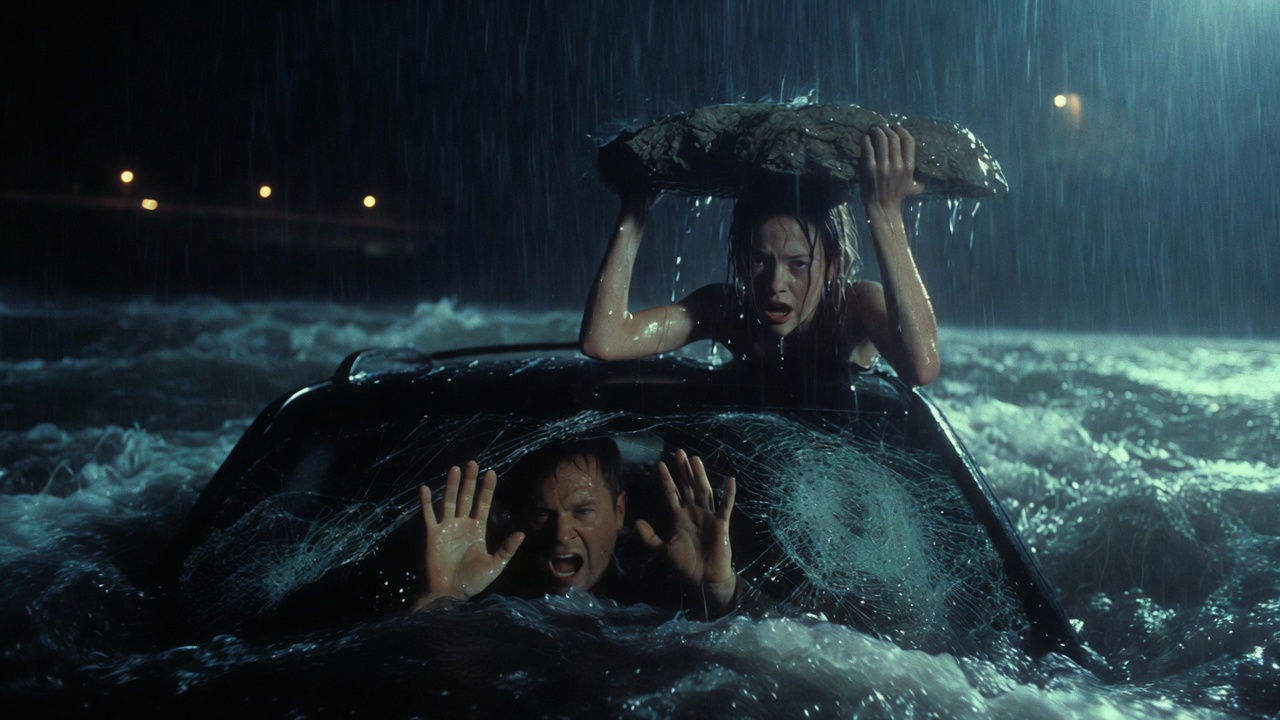
The wipers couldn’t keep up. Rain hammered the windshield in sheets so thick the highway looked like a river already. Daniel Torres pressed his jaw tight and gripped the leather wheel of his armored SUV, replaying the board meeting in his head—margins, acquisitions, the handshake with Victor that felt three seconds too long.
All he wanted was the quiet of his gated house. Clean sheets. A scotch. Silence.
But silence was waiting somewhere else tonight.
The wheel jerked left. Then right. The tires broke free of the road like the asphalt had liquefied under him. Daniel stomped the brake pedal. The ABS shuddered and screamed. The SUV kept sliding.
He saw the guardrail. The bend. The swollen black river churning below.
A single thought cracked through his mind before the crash: This doesn’t happen to men like me.
The collision was a muffled detonation. The SUV vaulted the rail, spinning. His stomach lurched. The world flipped. The seatbelt bit his ribs like a steel jaw.
Then came the water.
It hit the undercarriage first—a freezing shock that rocked the entire frame. The river flooded the cabin as if it had been summoned. Daniel clawed at the door handle. Stuck. He slammed his fists against the window. Then his elbow. Then pure terror.
Nothing.
The reinforced glass—the same glass that had protected him from carjackings and paparazzi—had become a coffin lid.
Water climbed his thighs. His waist. His chest.
He jabbed at the window controls. Dead. The dashboard flickered twice and went black. The air thinned. His lungs screamed.
“No—” he tried to say, but the river poured into his mouth instead.
Through rain-blurred dark he saw headlights pass on the bridge above. Silhouettes in cars that didn’t slow down. He kicked at the glass. Once. Twice. Ten times. The water touched his throat. His lips. His final gasps came out shattered, animal, desperate.
Then—a hand.
A small palm slapped the outside of the glass.
Daniel forced his eyes open underwater. A girl gripped the window frame. Rain and mud streaked her face. She couldn’t have been older than thirteen. Her arms were too thin. Her clothes were soaked rags. But there was zero fear in her expression.
Only decision.
She raised a rock—way too heavy for her frame—and brought it down on the corner of the window.
Once. Nothing.
Twice. A hairline crack.
Three times. The fracture spread like a vein across the glass.
Daniel pounded from the inside. She brought the rock down again. The crack widened. A section finally burst inward. Air rushed in like salvation.
The girl shoved her arm through the jagged opening and grabbed his jacket collar. Daniel tried to move, but his limbs were stone. She pulled—feet planted in the mud, shoulders locked, jaw clenched—a thirteen-year-old body running on something fiercer than muscle.
The current clawed at him. Darkness scraped the edges of his vision.
Then he was rising.
He spilled out of the vehicle like a broken thing. The river flung them both downstream before she fought toward shore. Her feet searched for anything solid. Mud. Rock. When they finally dragged themselves onto the bank, both were shaking, coughing, alive.
Daniel collapsed on his back. The girl tapped his cheek.
“Don’t close your eyes,” she ordered.
He coughed water and air in ragged bursts. Tears slipped—not from fear, but from the humiliation of weakness. Daniel Torres, who’d built a company from nothing, who’d dined with senators, who’d fired a hundred people without blinking—rescued by a child in the dark.
“Thank you,” he croaked.
“Save your strength,” she said flatly. “You’re weak.”
As the SUV sank beneath the surface, Daniel understood something brutal: without her, he would’ve died unseen.
He woke to the metallic drip of water into a bucket.
No mansion. No hospital. No silk sheets.
Damp concrete. Plastic sheeting where a window should’ve been. The smell of mildew and stale bread.
He pushed himself upright slowly. His suit was ripped at the shoulder. His Rolex—gone. His wallet—gone. His phone—gone.
The girl sat on a plastic crate across the room, watching him with the careful stillness of someone who’d learned not to trust adults.
“Where am I?” he rasped.
“Storage room. Behind a warehouse off Industrial Drive,” she said. “No one comes here.”
She handed him a half-empty bottle of water. He drank, and relief twisted with shame.
“I’m Daniel,” he said. The name felt hollow without its usual weight.
“Lena,” she replied. “I’m thirteen.”
“I need to call someone.”
“With what?”
He stared at his empty hands. She was right.
The next morning, Lena led him outside. The alley was filthy—stray dogs, overflowing dumpsters, people slumped against walls who didn’t glance twice. Daniel caught his reflection in a cracked shop window. He looked like them now. Invisible.
In a public library downtown, he searched for any report of the crash.
Nothing.
No headline. No missing-person alert. No mention of a billionaire’s SUV going off a bridge. His company’s website was live—running smoothly, as though he’d never existed inside it. His email bounced. His phone number was disconnected. His social media profiles: deleted.
He typed his name into every search engine he knew.
Daniel Torres returned zero results.
“Someone erased me,” he whispered.
Lena stood behind him, reading over his shoulder. She said nothing. She didn’t need to.
He went back to his neighborhood with Lena. Willow Ridge Estates. Iron gates, manicured hedges, security cameras on every corner.
The guard at the gatehouse looked at him blankly.
“I’m Daniel Torres. House eight.”
“ID?”
“I lost it. In an accident.”
The guard picked up a phone. Spoke quietly. Hung up.
“No one by that name lives here, sir.”
“That’s my house,” Daniel said, his voice rising. “I built that house.”
“Sir, I need you to step back.”
The gates stayed shut. Behind them, the house he’d designed sat in perfect silence, as if it had never known his name.
Lena tugged his sleeve. “Let’s go.”
“Someone wants me gone,” he said.
“Yeah,” she replied. “I figured that out yesterday.”
A name surfaced in his mind like a body from deep water.
Victor.
Victor Harlow. His business partner. His closest ally. The one who knew every password, every account number, every vulnerability. The one who’d smiled at him across that boardroom table just hours before the crash.
Across town, Victor sat in a glass-walled corner office that used to be Daniel’s.
He’d worked fast. Transferred $47 million across six shell accounts. Locked Daniel out of every system. Erased his digital fingerprints with surgical precision. Even arranged for the SUV to be pulled from the river before anyone could log it.
Nearly flawless.
Until his surveillance contact sent him a grainy photo from a traffic camera: Daniel Torres, alive, walking through a market with a girl.
Victor stared at the image for eleven seconds.
Then he picked up an untraceable phone.
“I’m sending you a picture,” he said calmly. “Make him disappear. Permanently this time.”
Three days later, the hitman appeared.
Lena noticed first. A man in a gray jacket who lingered too long at a fruit stand. Same man at the bus stop an hour later. Same man on the opposite sidewalk the next morning.
“We’re being followed,” she told Daniel.
“How do you know?”
“Gray jacket. Keeps his right hand in his pocket. Never buys anything.”
Daniel felt his stomach drop. “How do you notice things like that?”
She looked at him with something between pity and patience. “Because where I come from, not noticing gets you killed.”
They ran. Through crowded markets. Down narrow alleys. Up crumbling fire escapes. Daniel’s lungs burned. His dress shoes—the only pair he owned now—slipped on wet metal. Lena moved like smoke, pulling him through gaps he would’ve missed.
They hid in a boiler room until dark.
“He’ll find us again,” Daniel said, panting.
“Then we need to move faster than him.”
“Lena, I’m not—”
“You’re not what? Built for this?” She stared at him. “Neither was I. I was seven the first time I had to run.”
That shut him up.
Lena took him to a place she called “the grid”—an abandoned building where a dozen homeless kids slept on cardboard and shared whatever food they could find.
Daniel ate stale bread and drank warm tap water from a plastic jug. He washed his torn shirt in a bucket. He hauled water containers up three flights of broken stairs. His hands blistered. His back seized.
But the worst pain wasn’t physical.
It was watching these kids—ten, twelve, fourteen years old—survive with more competence and dignity than he’d ever shown in a boardroom. They had systems. Roles. Rules. They looked out for each other with a loyalty that had nothing to do with contracts.
One night, sitting on the fire escape, Lena told him her story. Mother dead when she was six. No father she could name. Two years in a group home that lost its funding. Then the streets. Friends who vanished into unmarked vans and never came back.
Daniel listened. He had nothing to offer.
“Why did you save me?” he asked quietly.
She shrugged. “You were drowning. Nobody stopped. That’s all.”
“That’s not a small thing, Lena.”
“It’s not a big thing either. It’s just what you do.”
He stared at the city lights below—the same lights he used to see from his penthouse office, a world that suddenly felt like a foreign country.
“I used to drive past people like you every day,” he said. “I never stopped.”
“I know,” she said. “I could tell.”
He needed proof. Without evidence, Victor was untouchable.
At a low-cost clinic, Daniel tried to get medical records that could verify his identity. The doctor—a tired woman in her fifties—looked at his driver’s license photo on the old database, then looked at him.
“This file’s been flagged as deceased,” she said quietly. “I can’t help you.”
“Deceased?”
“Death certificate filed four days ago. I’m sorry.”
Daniel’s hands went cold. Victor hadn’t just erased him socially. He’d erased him legally. According to every system that mattered, Daniel Torres was dead.
“He killed me on paper,” Daniel said outside. His voice was flat. Numb.
Lena kicked a rock across the parking lot. “Then we bring you back on paper.”
“How?”
“Same way you got erased. Someone with access.”
That’s when Lena mentioned Rachel.
“There’s a woman at your old building. Tall. Short hair. She gave me a sandwich once when I was sleeping near the loading dock. She looked at me like I was a person.”
“Rachel Nguyen,” Daniel said immediately. “She was my operations manager.”
“She looked scared, though. Like she wanted to help but couldn’t.”
Finding Rachel took two days. Daniel waited outside her apartment building at 6 a.m., wearing a hoodie Lena had stolen from a donation bin.
Rachel almost screamed when she saw him.
“You’re supposed to be dead,” she hissed, pulling him inside.
“Victor’s version of me is dead. The real one’s standing in your kitchen.”
She poured coffee with shaking hands. Then she sat down and talked.
“He threatened me, Daniel. Threatened my family. Said if anyone asked questions, we’d disappear too. Everyone at the company knows something’s wrong. Nobody will say it.”
“What do you know?”
“I know he moved money. A lot of it. I saw encrypted transfers on the shared server before he locked everyone out. I know he had your accounts frozen and your credentials wiped. And I know he told the board you died in an accident and left the company to him in a verbal agreement.”
“There was no agreement.”
“I know.”
“Can you get me those files?”
Rachel looked at the table. Then at him. Then at Lena, who stood in the doorway eating a granola bar like she belonged there.
“If he finds out, I’m done,” Rachel said.
“If we don’t do this, he wins. And people like Lena keep sleeping in warehouses while men like Victor buy their third yacht.”
Rachel closed her eyes. When she opened them, something had shifted.
“Give me forty-eight hours.”
She delivered. Encrypted emails between Victor and offshore banks. Transfer receipts with forged authorization codes. A deleted voicemail where Victor told someone to “handle the vehicle before daylight.”
It wasn’t the full picture. But it was enough to start.
“We need a lawyer,” Daniel said.
“You have no money.”
“I have a name. Or I used to.”
Lena snorted. “Names don’t pay retainers.”
She was right. But Rachel knew someone—an aging attorney named George Harris who’d been disbarred once, reinstated on appeal, and now worked out of a strip-mall office between a laundromat and a nail salon.
Harris listened to everything. He read the documents twice. He looked at Daniel over his reading glasses.
“This is either the most elaborate con I’ve ever heard, or your partner tried to kill you and steal your company.”
“Option two,” Daniel said.
“You have no legal identity right now. No standing in any court. Step one is proving you’re alive.”
“How?”
“Fingerprints. Medical records. A judge who owes me a favor.” Harris paused. “And a reporter who isn’t afraid of billionaires.”
The reporter’s name was Diane Calloway. She worked for a mid-tier investigative outlet that had broken three corporate fraud stories in the past two years. She was meticulous, relentless, and deeply skeptical.
“So let me get this straight,” she said, sitting across from Daniel in a diner booth. “Your business partner staged your death, stole your company, and hired someone to kill you. And your only witness is a thirteen-year-old homeless girl.”
“That’s correct.”
“And you have financial records obtained by an employee who’s terrified for her life.”
“Also correct.”
“And your lawyer was disbarred.”
“Reinstated.”
Diane sipped her coffee. Looked at Lena. Looked at the documents spread across the table.
“I’m in,” she said. “But if any of this is fabricated, I will personally bury you deeper than Victor did.”
“Fair enough.”
Victor figured out something was happening. He always did—paranoia was his sharpest skill.
He arranged a meeting. Neutral ground. An upscale steakhouse in midtown. White tablecloths. Ambient jazz. The kind of place where terrible things get discussed politely.
Daniel walked in wearing a borrowed blazer and a shirt with a coffee stain on the cuff. Victor was already seated, wine in hand, a smile that didn’t reach his eyes.
“Well,” Victor said, swirling the glass. “Look who crawled out of the river.”
“I had help.”
“Clearly. You always needed someone to carry you, Daniel. That was your weakness.”
Daniel sat down. Didn’t touch the menu. Didn’t break eye contact.
“I know what you did, Victor. The transfers. The forged death certificate. The car. All of it.”
Victor’s smile didn’t waver. “You know what I find interesting? You had every advantage in the world—money, power, connections. And it took a homeless child to save your life. What does that tell you?”
“It tells me I surrounded myself with the wrong people.”
Victor leaned forward. His voice dropped to a whisper.
“I’ll give you fifteen million. Clean. Untraceable. You take it, you disappear—for real this time—and we both move on.”
“No.”
“Twenty.”
“No.”
“Thirty, Daniel. That’s more than fair for a dead man.”
“This isn’t about money.”
Victor’s composure cracked for the first time—a flicker of something raw beneath the polish. “Then what is it about?”
“It’s about the fact that you left me to drown and didn’t lose a minute of sleep.”
“Business is business.”
“This wasn’t business, Victor. This was murder.”
Silence. The jazz played on.
Victor straightened his tie. “You have no proof. You have no identity. And you have no idea what I’m capable of.”
He leaned in closer. “Walk away, Daniel. Because next time, I won’t send someone else. I’ll do it myself.”
Under the table, Lena’s phone—a prepaid burner Rachel had given her—recorded every word.
The story broke on a Tuesday.
Diane Calloway’s article hit at 6 a.m. with the headline the editors chose, not her. Within an hour, it had been picked up by three major networks. By noon, Victor’s lawyers were issuing statements. By evening, the FBI had opened a preliminary investigation.
Harris filed an emergency motion to restore Daniel’s legal identity. The fingerprint match came back in forty minutes. A sympathetic judge fast-tracked the hearing.
“Mr. Torres,” the judge said, “the court recognizes you as alive and restores your full civil rights effective immediately.”
Daniel didn’t celebrate. He just nodded. Alive again.
The trial lasted eleven days.
Under the fluorescent lights of a federal courtroom, the evidence stacked like bricks. Emails. Transfer records. The voicemail about the vehicle. Rachel took the stand and testified for four hours—calm, precise, devastating.
When Victor’s attorney tried to discredit her, Rachel looked at the jury and said: “I watched a man erase another man’s life and tell the rest of us to pretend it never happened. I’m done pretending.”
Then they played the audio from the restaurant.
Victor’s own voice filled the courtroom: the bribe offers, the threats, the admission that he’d arranged the crash.
His composure shattered. He stood up. His lawyer pulled him down. He stood again.
“This is entrapment!” he shouted.
The judge didn’t blink. “Sit down, Mr. Harlow.”
The jury deliberated for six hours. Guilty on all counts. Wire fraud. Embezzlement. Attempted murder. Conspiracy. Evidence tampering.
The judge’s sentence: thirty-four years. No parole eligibility for twenty.
Victor’s assets were frozen. His accounts seized. His name—the one he’d polished so carefully—became synonymous with betrayal.
Outside the courthouse, cameras flashed. Reporters shouted questions. Daniel stood on the steps with Lena beside him. She looked uncomfortable under the lights, squinting, pulling at the new jacket Rachel had bought her.
“Mr. Torres! What are your plans now?”
Daniel looked at the microphones. Then at Lena. Then back at the cameras.
“I don’t want my old life back,” he said. “If I build something again, it’ll be for kids like her. Kids the system forgot.”
A reporter pressed: “And what about your company?”
“It was never really mine. It was just numbers on a screen. The only thing that mattered was drowning in that river and having someone choose to pull me out.”
Three weeks later, Daniel formally reclaimed his identity at the county registrar’s office. Clean paperwork. New ID. Restored records.
The clerk looked at the forms, then at Lena sitting in the plastic chair behind him, kicking her feet.
“And the minor?”
Daniel didn’t hesitate.
“My daughter.”
The paperwork took an hour. When they walked out, Lena held the adoption certificate like she wasn’t sure it was real.
“This is legal?” she asked.
“Completely.”
“And you can’t just… un-sign it?”
He stopped walking. Knelt down. Looked her in the eyes.
“Lena. I almost died in that river. You broke a window with a rock and pulled me out. You kept me alive when I had nothing. You showed me what courage actually looks like.” He paused. “No. I can’t un-sign it. And I wouldn’t.”
She blinked fast. Looked away. Nodded once.
They moved into a two-bedroom house in a quiet neighborhood. Nothing gated. Nothing grand. A front porch with two chairs and a yard with actual grass.
Lena struggled. Her own bed felt too soft. The silence at night made her anxious. She’d wake up at 3 a.m. and sit by the window, watching the street like she was waiting for something to go wrong.
“I don’t know how to live like this,” she told him one evening.
“I didn’t know how to survive your world,” he said. “We’ll figure it out together.”
She enrolled in school. Made one friend, then two. Got into an argument with a teacher about a history assignment and wrote a rebuttal so sharp the principal called Daniel to say she might need to skip a grade.
He started the foundation—Torres House—with his recovered assets. Shelters. Tutoring programs. Legal aid for kids aging out of the system. Rachel ran operations. Harris handled pro-bono cases. Diane wrote a follow-up series that won a regional press award.
Then Monica showed up.
She appeared at the front door on a Thursday afternoon. Mid-forties. Nervous hands. An envelope she kept adjusting in her grip.
“Mr. Torres?”
“Yes?”
“My name is Monica Voss. I’m a private investigator. I was hired by the state to verify Lena’s biological parentage as part of the adoption finalization.”
“We already submitted—”
“There’s been an additional test. Court-ordered. I have the results.”
She held out the envelope.
Daniel opened it. Read it twice.
DNA comparison: Daniel Torres / Lena Marie Torres. Result: NO BIOLOGICAL MATCH CONFIRMED.
The words hit him like ice water.
He’d never truly believed they were related by blood. He’d never even considered it. But seeing it stated in clinical black and white—no match—felt like someone had tried to take something from him.
“This changes nothing,” he said.
Monica shifted uncomfortably. “Mr. Torres, the court may—”
“The court already granted the adoption. This test was for records. It changes nothing.”
She nodded slowly, took her copy, and left.
Lena came through the back door two minutes later, backpack over one shoulder, an apple in her hand. She looked at his face and stopped chewing.
“What happened?”
He folded the paper. Put it in his pocket. Then pulled her into a hug so tight she dropped the apple.
“It doesn’t matter what any paper says,” he whispered. “I choose you. That’s what makes a family.”
She stood rigid for a moment. Then her arms came up and she held on.
That night, after Lena fell asleep, Daniel stood at the kitchen sink. He took the document from his pocket, unfolded it one last time, and held a match to the corner.
He watched it burn. Not to reject biology. Not to deny truth.
But to affirm something no test could measure.
He’d learned—too late, almost fatally—that blood might explain where you come from. It doesn’t explain who stays.
Love isn’t inherited. It’s built. In floodwater and broken glass. In stale bread split between strangers. In running side by side when no one else will. In a thirteen-year-old girl who saw a drowning man and chose to act when every passing car chose to look away.
Daniel Torres had once owned everything and seen nothing.
Now he owned very little. And he saw everything.
He rinsed the ash down the drain, turned off the kitchen light, and checked on his daughter one more time before going to bed.
She was sleeping soundly. For the first time, she hadn’t woken up at three.
Original fictional stories. AI-assisted creative content.
