
The garbage disposal screamed.
I stood in my own doorway, work boots still on, the November wind cutting through my jacket. I’d gotten off the warehouse shift four hours early. Truck broke down, so they sent us home. I didn’t call. I didn’t text.
I wanted to surprise them.
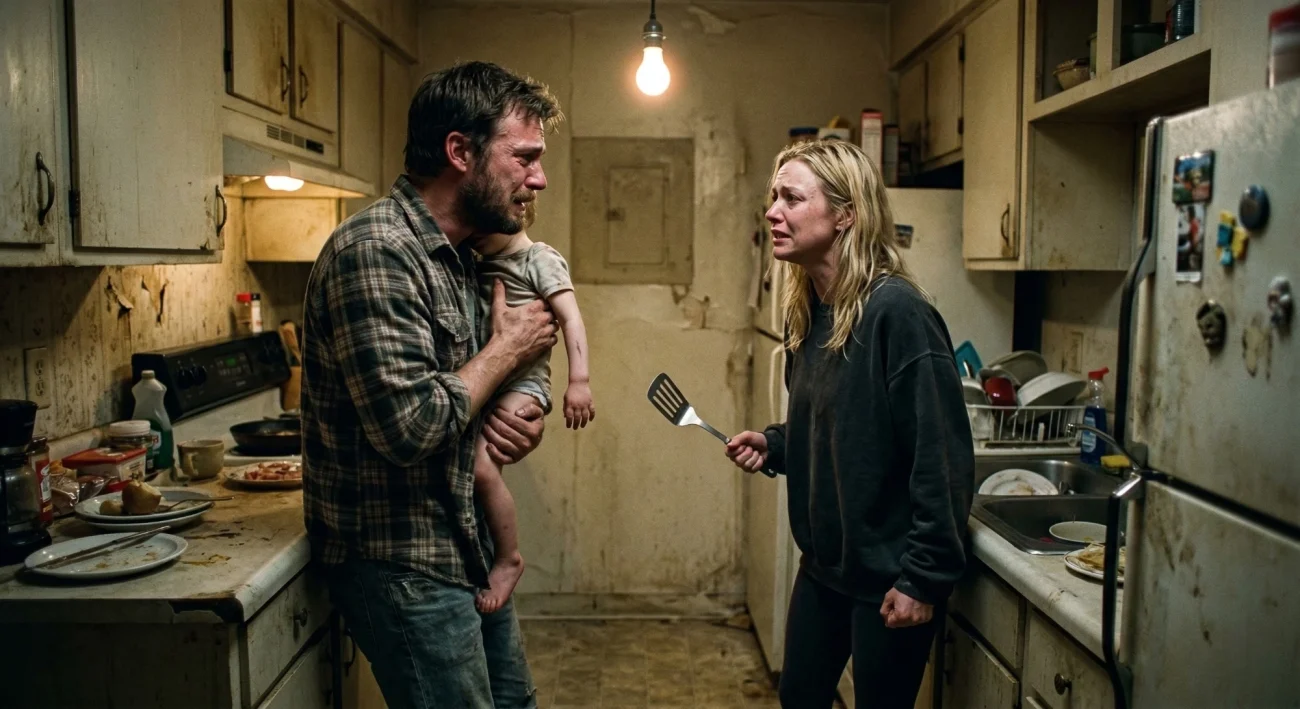
The kitchen was visible straight down the narrow hallway. Victoria stood at the sink in a sweatshirt and leggings, scraping a full plate of chicken, carrots, and potatoes into the disposal.
“He didn’t eat!” she hissed. Not to me. She didn’t know I was there.
“I told you, Emma. If he doesn’t eat when I say it’s time, he gets nothing. I am not running a restaurant for ungrateful brats.”
I took a step. The linoleum creaked but the disposal drowned it out.
Emma stood in the corner near the pantry. My eight-year-old daughter. She looked gray. Her oversized shirt hung off bony shoulders. Her hair was matted.
She was holding Thomas.
My son. Eighteen months old. I’d been picking up double shifts for months. Nights at the warehouse, weekends at the loading dock. I barely saw them anymore.
He looked skeletal.
His head was too big for his body. His arms were like twigs. His stomach wasn’t round with baby fat — it was distended, tight. He reached one tiny hand toward the food being destroyed, making a high-pitched sound. Not crying. He was past crying.
“Please,” Emma whispered. “Victoria, please. He’s so hungry. He didn’t mean to spit it out. He’s just little. Just let him have the bread. I’ll give him mine.”
Victoria spun around. Her face was twisted, ugly.
“I said no!” she screamed, raising the spatula like a weapon. “One more word and you go in the closet. You want to spend the night in the dark again?”
Emma flinched. She curled her body around Thomas, shielding him.
The disposal died. The silence was worse.
“Victoria.”
I said her name. Flat. Quiet.
She froze. Her arm, still raised, went stiff. Then she turned.
For one second, the snarl was still on her face. Then it vanished. Smoothed out. Replaced by a dazzling smile.
“Michael! Darling! You’re home!” She dropped the spatula and rushed toward me, arms wide. “You scared me! Why didn’t you call?”
She reached for my arm.
I stepped back.
“Don’t.”
“Michael? What’s wrong?” She blinked, smile faltering. “Was work bad? You look pale.”
She was acting like nothing had happened. Like the starving children behind her didn’t exist.
I walked past her. Straight to the corner.
Emma pressed herself into the wall. Her eyes darted between me and Victoria. She was calculating survival. An eight-year-old. In her own kitchen.
“Daddy?” she whispered, like she wasn’t sure I was real.
“I’m here, baby. I’m home.”
I reached for Thomas. When my hand touched his arm, I felt bone. No padding. No toddler softness. Just skin stretched over fragile skeleton.
He didn’t smile. He didn’t recognize me. He stared with sunken, hollow eyes that asked one question: Are you going to hurt me too?
I took him from Emma. He weighed nothing. His diaper sagged, soaked.
“Oh, Michael, don’t pick him up!” Victoria chirped behind me. “He’s been so sick. A terrible stomach bug. That’s why he looks peaked. He can’t keep anything down.”
Lies. Smooth. Easy. Practiced.
“A stomach bug?” I asked.
“Yes! I called the clinic. They said toast and water, ride it out. I’ve been up for days taking care of him.”
“If he has a stomach bug,” I said, “why did I just watch you throw away roast chicken? And why did Emma beg you for bread?”
Her eyes narrowed. One flicker of the predator.
“Emma is acting out,” Victoria sighed. “She’s jealous. She makes up stories. Drama queen, just like a typical little girl.”
I looked at Emma. “Tell me about the stomach bug.”
Victoria cut in. “Answer your father, Emma. Tell him how sick Thomas has been.”
Emma stared at the floor. “He threw up.”
“See?” Victoria beamed.
“Last week,” Emma finished. “He threw up because he ate toothpaste. Because he was hungry.”
Silence crashed into the room.
Victoria’s smile disappeared.
“He ate toothpaste?” I said.
“She’s lying!” Victoria snapped. “She hates me! She’s turning you against me!”
I walked to the disposal. Reached into the rubber flange. Pulled out a piece of chicken she hadn’t ground down. Perfectly good food.
“You were throwing this away,” I said, holding it up, “while my son is starving. Look at him, Victoria.”
I turned Thomas toward her.
“He looks like a skeleton. You think I’m blind?”
“He’s sick!” she shrieked. “Stop interrogating me! I am his mother!”
“You are not his mother,” I roared. “You are his stepmother. And right now, you look like his tormentor.”
“Go pack a bag,” I told Emma. “Just the essentials. We’re leaving.”
“Michael, you can’t!” Victoria blocked the hallway. “It’s late! You’re being hysterical!”
“Move,” I said.
“No! This is my house too!”
She grabbed my arm. Her nails dug in.
“If you don’t move,” I whispered, “I call the police right now. They inspect the pantry locks. They inspect the children’s bodies for bruises. Do you want that?”
Fear flickered behind her eyes. She stepped aside.
“Run,” I told Emma.
She ran. Her shirt slipped sideways as she passed.
On her upper arm. Dark purple against pale skin. Four bruises. Shaped like fingers.
An adult handprint.
“Did you touch her?” I growled.
“She fell! She’s clumsy! Michael, please—”
“I should terrify you,” I said.
I didn’t pack anything. I found Emma in her room shoving a stuffed rabbit into her backpack with shaking hands. I scooped her up with one arm, held Thomas against my chest with the other.
We headed for the front door.
“Michael! You are kidnapping my children! I will call the police! I will ruin you!”
Her screams chased us into the cold. I buckled them into my truck, hands shaking, tears blurring my vision.
In the rearview, Victoria stood in the lit doorway of the apartment. Not chasing. Watching. Calculating.
I drove to the ER.
“Daddy?” Emma whispered from the backseat.
“Yeah, honey?”
“Are we going to jail?”
I nearly drove off the road. “No. Why would you think that?”
“Victoria said if we told anyone, the police would take us away because we’re bad. She said we killed Mommy.”
I braked hard at the light. “Listen to me. Look at me in the mirror.”
She met my eyes.
“Victoria is a liar. A sick, evil liar. Mommy died of an aneurysm. Nobody’s fault. And nobody is going to jail except Victoria.”
We burst into the ER. I walked straight to the triage nurse with Thomas in my arms.
“My son hasn’t eaten. I don’t know how long. And my daughter has bruises.”
The nurse took one look at Thomas and hit a red button. “Code Peds, Bay 1!”
They whisked him onto a gurney. A doctor blocked me.
“He’s severely dehydrated. Blood sugar critically low. We need an IV now or he could seize. Stay with your daughter.”
Six hours. The hospital catalogued the wreckage of my family.
A nurse named Janet was the first to cry. She’d peeled Thomas’s diaper off and stepped back from the table, hand over her mouth. The rash had eaten through layers of skin. It was bleeding.
“How long has he been in this diaper?” she whispered.
“I don’t know,” I said. “I work nights.”
She looked at me like I’d confessed to a crime. Maybe I had.
Thomas: severe malnutrition. Failure to thrive. Dehydration so advanced his fontanelle was sunken. A diaper rash so severe it had become infected. Finger-shaped bruises on his thighs where someone had grabbed too hard.
Emma: multiple contusions in various stages of healing across her arms and back. A hairline fracture in her left wrist that had healed improperly — the doctor said it was consistent with a defensive wound, not a fall. Cavities in her teeth from months of malnutrition and no dental care.
“Mr. Grant,” the attending physician said, pulling his glasses off and looking at me with undisguised suspicion. “I’m legally obligated to contact Child Protective Services and the police. These injuries are consistent with long-term, systematic abuse.”
“Call them,” I said. My voice sounded dead, even to me. “Call everyone. I want it all on record.”
“You need to understand,” the doctor pressed, leaning forward, “they will investigate you too. You’re the father. You had access.”
“Good,” I said. “They should investigate me. I wasn’t there. I was loading trucks at the warehouse while my baby’s ribs were showing through his skin. Investigate the hell out of me.”
He studied my face for a long moment. Then he nodded and left.
Thomas slept fitfully in the hospital crib, an IV tube taped to his tiny skull because the veins in his arms had collapsed from dehydration. They couldn’t find a vein. The nurse had tried four times. Thomas hadn’t flinched. He was used to pain.
I sat in the plastic chair and stared at his chest rising and falling. I had worked sixty-hour weeks for two years. Double shifts. Holidays. I missed bedtimes and birthdays so I could keep the lights on and food on the table.
Except there was no food on the table. Not for them.
And while I was breaking my back, my wife was starving my baby.
I wasn’t providing for my family. I was funding their prison.
The police came at midnight. Detective Sarah Morrison, steel-gray hair and eyes that missed nothing, took my statement. Took photographs. Interviewed Emma gently in a separate room with a child psychologist present.
At 3 AM, the hospital finally went quiet.
Thomas’s color was slightly better. The fluids were flushing the gray from his skin. Emma lay curled on a pull-out cot beside his crib, staring at the ceiling. Not sleeping. Thinking.
“Emma,” I whispered.
She turned her head.
“I need to know everything.”
She sat up. Reached into her backpack and pulled out a small pink notebook. The diary her mother — her real mother, Emily — had given her for her sixth birthday. The little padlock on it was broken.
“I wrote it down,” she whispered. “Because I thought maybe if I died, someone would need to know why.”
The words hit me like a fist to the sternum.
“Read it,” she said, thrusting the book at me. “I can’t say it out loud. It hurts to say it.”
I took it. My hands shook so badly I could barely turn the pages.
The early entries were neat, bubbly. A happy first grader’s handwriting. Then they changed. Jagged. Rushed. Desperate.
She has a lock on the pantry. A big padlock. She keeps the key on a chain around her neck. She buys food for herself — takeout, candy, soda — and eats it in front of us at the table. She says she’s teaching us a lesson about being grateful.
I turned another page.
I stole a cracker for Thomas. She saw. She threw my dinner in the trash and said, “If you want to feed him, feed him your own food.” So I did. I gave him my sandwich. I’m dizzy today.
And another.
Daddy called on video. Victoria told me if I didn’t smile, she’d take away Thomas’s blanket. I smiled so big my face hurt. After the call, she pinched my arm until it turned blue.
I had to put the book down. I walked to the window because if I didn’t move, I was going to scream until the glass shattered.
I remembered that February video call. I remembered thinking: Emma looks so happy. She’s really adjusting well.
I was a blind, arrogant fool.
“She said we were burdens,” Emma said softly from the cot. “That you only kept us because you felt guilty about Mom dying. That you’d leave us too if you could.”
I crossed the room and pulled her into my arms. She melted into me, finally letting go of two years of tension.
“That is a lie from the pit of hell,” I sobbed into her hair. “You are my life. You are the only thing that matters.”
“She said you wouldn’t believe us. She said she’s the adult, and you love her more.”
“I hate her more than I have ever loved anyone. And I promise you, she will never hurt you again.”
Emma pulled back. Her eyes were far too old for her face. “She’s smart though, Daddy. She has a secret phone. And she has money. Your money.”
My blood went cold.
I’d given Victoria access to everything. The checking account. The small savings we had. The emergency fund I’d been building dollar by dollar.
I pulled out my phone and opened my banking app.
Checking account: ERROR. ACCOUNT NOT FOUND.
Savings: BALANCE $0.00.
She hadn’t just been starving my children. She’d been preparing. Siphoning every dollar for months. She knew this day might come, or she planned to vanish once she’d bled us dry.
“She took it all,” I whispered.
“It’s okay,” Emma said. She patted my hand. An eight-year-old comforting her father. “We don’t need money. We just need food. And you.”
I looked at this small warrior who had survived a war zone inside her own home, and I made a vow.
A lawyer from Legal Aid showed up at 8 AM. His name was Harold Weiss. He didn’t look like much — rumpled suit, scuffed shoes — but when he saw the photos of Thomas and Emma, he set his coffee down and wiped his eyes.
“Emergency restraining order,” he said, his voice thick. “Exclusive custody. Divorce on grounds of extreme cruelty and attempted murder.”
“Attempted murder?”
“Starvation of an infant is attempted murder. If you hadn’t come home, Thomas wouldn’t have lasted another week.”
Then Victoria struck first. She posted on Facebook. A photo of herself looking tearful with makeup bruises, captioned: “I tried to protect the children from him. He’s violent. He’s never home. I’m terrified.”
Her friends shared it. Then a local news page picked it up. Within hours, strangers were calling me a monster in the comments.
“She’s flipping the script,” Harold said. “Classic DARVO. She knows the evidence looks bad, so she’s painting you as the abuser.”
“I was at work!”
“We can prove it. Time cards. Security footage. But social media moves fast. We need witnesses.”
I remembered Patricia Gomez. Our neighbor from across the hall. Sweet older woman. She used to babysit when Victoria needed a break. Then one day Victoria told her to stop coming around, claiming Patricia was a bad influence on the kids.
“Find her,” I told Harold. “She saw things.”
Harold tracked her down that afternoon. Patricia didn’t just have testimony. She had recordings. She’d hidden a cheap nanny cam on top of our refrigerator the last time she babysat because she suspected the abuse. She never went to police because she was undocumented and Victoria had threatened to call ICE.
But she kept the SD card.
“There’s a problem,” Harold said, hanging up the phone. “Patricia says someone’s been watching her building since this morning. A car parked outside.”
Victoria. Tying up loose ends.
“We need to get her out,” I said. “If Victoria gets to Patricia first, we lose everything.”
Harold called Detective Morrison directly. Morrison sent two officers.
The next two hours were suffocating. I paced the hospital room. Every elevator ding made me flinch.
Harold stayed on the phone. “Just get to her building. Bring her to the precinct. Don’t let anyone stop you.”
Emma watched me from the cot. She was drawing in her diary — not writing, just drawing dark, jagged shapes.
“Is Patricia coming?” she asked softly.
“The police are getting her,” I promised.
At 6:15 PM, Morrison called.
“We have her,” Morrison said. “It was close. Someone tried to follow the officers’ car. We lost them. Patricia is at the precinct. We’re viewing the footage now.”
Thirty minutes later, Morrison walked into our room. The professional detachment was gone. Cold fury had replaced it.
“We viewed the files,” she said. “Judge Reynolds signed the warrant five minutes ago. Assault with a deadly weapon, child endangerment, grand larceny, attempted murder.”
“What was on it?” I needed to know. I needed to hate her enough to burn the world down if I had to.
Morrison looked at Emma. “Step outside with me.”
In the hallway, under buzzing fluorescent lights, she pressed play on a tablet.
Grainy footage. Kitchen angle from the top of the fridge. August 14th.
Victoria eating a steak at the table. Thomas in his high chair, crying, reaching for food with both hands.
Victoria poured ghost pepper hot sauce onto a cracker. Held it out.
“Here,” she said on screen. “Open wide.”
Thomas opened his mouth. Trusting. He was a baby. He trusted the person feeding him.
She pushed the cracker in.
The reaction was instant. He screamed. Choked. Turned red. Clawed at his own tongue with tiny fingers.
Victoria didn’t move. She sat back, took a sip of red wine, and watched my son suffer.
“That teaches you to beg,” she said to the sobbing infant. “Maybe next time you’ll learn to be quiet.”
I turned and retched into the hospital trash can.
“We have twelve videos like that,” Morrison said quietly, turning off the tablet. “Starving them. Locking Emma in the pantry overnight. Beating them with a wooden spoon. It’s over, Michael. She’s never seeing daylight again.”
“Find her,” I rasped. “Find her before I do.”
Then Victoria called.
“I have videos too,” she purred. “Edited ones. You yelling at the kids on FaceTime. Emma crying. I can make you look like a monster. Drop the charges. Sign the divorce giving me half. Or I know where Emma’s school is. I know which room Thomas is in.”
The fire alarm went off at 8 PM.
Not a drill. Smoke on the third floor. Evacuation.
I grabbed Thomas. Grabbed Emma’s hand. The hallway was chaos.
In the crush at the stairwell, Emma tripped. I let go of her hand for one second to catch her.
When I turned back, my left arm was empty.
Thomas was gone.
Through the fire door glass, I saw her. Blue scrubs. Surgical mask. Holding a bundle in a hospital blanket. Walking toward the staff elevator.
“VICTORIA!”
I slammed through the door. She looked back. Above the mask, her eyes were triumphant. She held Thomas up slightly. I have him.
She disappeared into the elevator. I got my fingers in the gap. The doors crushed them. I screamed.
B1. Basement. Garage.
I flew down the stairs with Emma in my arms. Burst into the garage as tires screeched.
A gray sedan tearing toward the exit.
I ran after it until my lungs burned, screaming my son’s name at the taillights.
I collapsed on the ramp.
She called. “That was close. There is no judge anymore. I have nothing to lose. People with nothing to lose do terrible things.”
“What do you want?”
“A trade. Me for him. I want a car. Cash. A head start. You call off the cops and let me drive. If I see a single cruiser, the baby dies.”
“Where?”
“I’ll text you.”
The police took over. Morrison wanted to stall, set up a perimeter.
“She’s a narcissist,” I argued. “If she thinks she’s lost, she’ll destroy the possession so no one else can have it.”
The text came. An abandoned farm. Route 9. The old silo.
I drove alone. Wire taped to my chest. Earpiece in. SWAT twenty minutes behind, coming through the cornfields.
I stopped the car. Got out, hands raised.
“Victoria! I’m here!”
A floodlight blinded me from the top of the silo.
“Walk forward! Stop at the door!”
I walked. My heart hammered so hard I thought the wire would pick it up.
The metal door screeched open.
Victoria stood there. Deranged. Scrubs torn. Hair wild. In one hand, a heavy flashlight. In the other, she held Thomas — by the back of his pajama shirt, dangling him over an open grain pit. Twenty-foot drop into darkness.
Thomas screamed. A weak, hoarse sound.
“Stop!” I froze. “I’m here. Where do you want to go?”
“You didn’t bring a car,” she sneered. “I know you, Michael. How far back are the cops? A mile? Two?”
“There’s no one. I brought cash. Everything I could get. It’s in the truck. Check for yourself.”
Greed battled paranoia in her eyes.
“Put him down. You have the money. Take my truck.”
“He’s the reason!” she shrieked, shaking Thomas. “He wouldn’t stop crying! He wouldn’t eat! If he had just been a good baby, we would have been fine!”
“It’s my fault!” I shouted. “Blame me! I wasn’t there! Give him to me!”
She pulled a gun. Pointed it at me.
“Kneel.”
I knelt in the dirt.
“Beg me.”
“Please,” I said, tears streaming. “You won. You’re smarter than me. Just let him go.”
She smiled. A terrible, twisted smile.
“No. I don’t think I will.”
Her grip on Thomas loosened. She was going to drop him.
CRACK.
Her shoulder exploded in red. The gun flew. Her grip failed.
Thomas fell.
I lunged. Five feet across the space. Hit the edge of the grate, sliding into darkness. My hand shot out blind.
Fabric.
I gripped it.
My chest slammed into the metal rim. I hung halfway in the pit, holding my son by the back of his shirt over the abyss.
“I’ve got you,” I gasped. “Daddy’s got you.”
I hauled him up. Rolled onto the concrete. Curled my body around him.
“Police! Go! Go! Go!”
The silo flooded with light. Tactical gear. The sniper who took the shot kept his laser on Victoria.
She was on the ground, clutching her shoulder, wailing. “My arm! You shot me! I’ll sue! I’m the victim!”
They zip-tied her. Dragged her up.
I didn’t watch. I buried my face in Thomas’s neck. He was breathing. Crying. Alive.
Five years later.
The kitchen smelled like burnt batter and maple syrup.
“Dad! You flipped it too early!”
I laughed, scraping the disaster off the griddle. “It’s rustic, Emma. Stylistic choice.”
Emma, thirteen now and taller than her mother ever was, rolled her eyes. But her smile was real. The shadows were gone.
“It looks like roadkill,” Thomas announced.
My son. Seven years old. Round cheeks. Flour on his nose. Soccer jersey. He ate everything in sight.
No locks on the pantry. The fridge was always full. Juice boxes and string cheese and everything a growing boy could want.
We moved out of that apartment the week after the trial. Victoria got forty years, maximum security. We never said her name.
We found a small house on a quiet street. Big backyard. Neighbors who waved.
“Are we ready?” I put the pancakes on the table.
“Yeah.” Emma pulled a small velvet pouch from her pocket.
Today was the anniversary. Not of the rescue. Of the day we became a family of three again.
We sat. We held hands.
“I’m thankful for soccer,” Thomas started. “And Emma helping me with math. And pancakes. Even the bad ones.”
“I’m thankful for art class,” Emma said. “And that Dad is home every night for dinner.”
She looked at me.
“I’m thankful,” I said, voice thick, looking at the two miracles at my table, “that I woke up. I’m thankful for second chances. And I’m thankful that love is stronger than hunger.”
Thomas drowned his pancake in syrup. “Can we go to the park? I want to show you how fast I can run.”
“You can show me,” I said. “I’ll be watching. I’ll always be watching.”The garbage disposal screamed.
I stood in my own doorway, work boots still on, the November wind cutting through my jacket. I’d gotten off the warehouse shift four hours early. Truck broke down, so they sent us home. I didn’t call. I didn’t text.
I wanted to surprise them.
The kitchen was visible straight down the narrow hallway. Victoria stood at the sink in a sweatshirt and leggings, scraping a full plate of chicken, carrots, and potatoes into the disposal.
“He didn’t eat!” she hissed. Not to me. She didn’t know I was there.
“I told you, Emma. If he doesn’t eat when I say it’s time, he gets nothing. I am not running a restaurant for ungrateful brats.”
I took a step. The linoleum creaked but the disposal drowned it out.
Emma stood in the corner near the pantry. My eight-year-old daughter. She looked gray. Her oversized shirt hung off bony shoulders. Her hair was matted.
She was holding Thomas.
My son. Eighteen months old. I’d been picking up double shifts for months. Nights at the warehouse, weekends at the loading dock. I barely saw them anymore.
He looked skeletal.
His head was too big for his body. His arms were like twigs. His stomach wasn’t round with baby fat — it was distended, tight. He reached one tiny hand toward the food being destroyed, making a high-pitched sound. Not crying. He was past crying.
“Please,” Emma whispered. “Victoria, please. He’s so hungry. He didn’t mean to spit it out. He’s just little. Just let him have the bread. I’ll give him mine.”
Victoria spun around. Her face was twisted, ugly.
“I said no!” she screamed, raising the spatula like a weapon. “One more word and you go in the closet. You want to spend the night in the dark again?”
Emma flinched. She curled her body around Thomas, shielding him.
The disposal died. The silence was worse.
“Victoria.”
I said her name. Flat. Quiet.
She froze. Her arm, still raised, went stiff. Then she turned.
For one second, the snarl was still on her face. Then it vanished. Smoothed out. Replaced by a dazzling smile.
“Michael! Darling! You’re home!” She dropped the spatula and rushed toward me, arms wide. “You scared me! Why didn’t you call?”
She reached for my arm.
I stepped back.
“Don’t.”
“Michael? What’s wrong?” She blinked, smile faltering. “Was work bad? You look pale.”
She was acting like nothing had happened. Like the starving children behind her didn’t exist.
I walked past her. Straight to the corner.
Emma pressed herself into the wall. Her eyes darted between me and Victoria. She was calculating survival. An eight-year-old. In her own kitchen.
“Daddy?” she whispered, like she wasn’t sure I was real.
“I’m here, baby. I’m home.”
I reached for Thomas. When my hand touched his arm, I felt bone. No padding. No toddler softness. Just skin stretched over fragile skeleton.
He didn’t smile. He didn’t recognize me. He stared with sunken, hollow eyes that asked one question: Are you going to hurt me too?
I took him from Emma. He weighed nothing. His diaper sagged, soaked.
“Oh, Michael, don’t pick him up!” Victoria chirped behind me. “He’s been so sick. A terrible stomach bug. That’s why he looks peaked. He can’t keep anything down.”
Lies. Smooth. Easy. Practiced.
“A stomach bug?” I asked.
“Yes! I called the clinic. They said toast and water, ride it out. I’ve been up for days taking care of him.”
“If he has a stomach bug,” I said, “why did I just watch you throw away roast chicken? And why did Emma beg you for bread?”
Her eyes narrowed. One flicker of the predator.
“Emma is acting out,” Victoria sighed. “She’s jealous. She makes up stories. Drama queen, just like a typical little girl.”
I looked at Emma. “Tell me about the stomach bug.”
Victoria cut in. “Answer your father, Emma. Tell him how sick Thomas has been.”
Emma stared at the floor. “He threw up.”
“See?” Victoria beamed.
“Last week,” Emma finished. “He threw up because he ate toothpaste. Because he was hungry.”
Silence crashed into the room.
Victoria’s smile disappeared.
“He ate toothpaste?” I said.
“She’s lying!” Victoria snapped. “She hates me! She’s turning you against me!”
I walked to the disposal. Reached into the rubber flange. Pulled out a piece of chicken she hadn’t ground down. Perfectly good food.
“You were throwing this away,” I said, holding it up, “while my son is starving. Look at him, Victoria.”
I turned Thomas toward her.
“He looks like a skeleton. You think I’m blind?”
“He’s sick!” she shrieked. “Stop interrogating me! I am his mother!”
“You are not his mother,” I roared. “You are his stepmother. And right now, you look like his tormentor.”
“Go pack a bag,” I told Emma. “Just the essentials. We’re leaving.”
“Michael, you can’t!” Victoria blocked the hallway. “It’s late! You’re being hysterical!”
“Move,” I said.
“No! This is my house too!”
She grabbed my arm. Her nails dug in.
“If you don’t move,” I whispered, “I call the police right now. They inspect the pantry locks. They inspect the children’s bodies for bruises. Do you want that?”
Fear flickered behind her eyes. She stepped aside.
“Run,” I told Emma.
She ran. Her shirt slipped sideways as she passed.
On her upper arm. Dark purple against pale skin. Four bruises. Shaped like fingers.
An adult handprint.
“Did you touch her?” I growled.
“She fell! She’s clumsy! Michael, please—”
“I should terrify you,” I said.
I didn’t pack anything. I found Emma in her room shoving a stuffed rabbit into her backpack with shaking hands. I scooped her up with one arm, held Thomas against my chest with the other.
We headed for the front door.
“Michael! You are kidnapping my children! I will call the police! I will ruin you!”
Her screams chased us into the cold. I buckled them into my truck, hands shaking, tears blurring my vision.
In the rearview, Victoria stood in the lit doorway of the apartment. Not chasing. Watching. Calculating.
I drove to the ER.
“Daddy?” Emma whispered from the backseat.
“Yeah, honey?”
“Are we going to jail?”
I nearly drove off the road. “No. Why would you think that?”
“Victoria said if we told anyone, the police would take us away because we’re bad. She said we killed Mommy.”
I braked hard at the light. “Listen to me. Look at me in the mirror.”
She met my eyes.
“Victoria is a liar. A sick, evil liar. Mommy died of an aneurysm. Nobody’s fault. And nobody is going to jail except Victoria.”
We burst into the ER. I walked straight to the triage nurse with Thomas in my arms.
“My son hasn’t eaten. I don’t know how long. And my daughter has bruises.”
The nurse took one look at Thomas and hit a red button. “Code Peds, Bay 1!”
They whisked him onto a gurney. A doctor blocked me.
“He’s severely dehydrated. Blood sugar critically low. We need an IV now or he could seize. Stay with your daughter.”
Six hours. The hospital catalogued the wreckage of my family.
A nurse named Janet was the first to cry. She’d peeled Thomas’s diaper off and stepped back from the table, hand over her mouth. The rash had eaten through layers of skin. It was bleeding.
“How long has he been in this diaper?” she whispered.
“I don’t know,” I said. “I work nights.”
She looked at me like I’d confessed to a crime. Maybe I had.
Thomas: severe malnutrition. Failure to thrive. Dehydration so advanced his fontanelle was sunken. A diaper rash so severe it had become infected. Finger-shaped bruises on his thighs where someone had grabbed too hard.
Emma: multiple contusions in various stages of healing across her arms and back. A hairline fracture in her left wrist that had healed improperly — the doctor said it was consistent with a defensive wound, not a fall. Cavities in her teeth from months of malnutrition and no dental care.
“Mr. Grant,” the attending physician said, pulling his glasses off and looking at me with undisguised suspicion. “I’m legally obligated to contact Child Protective Services and the police. These injuries are consistent with long-term, systematic abuse.”
“Call them,” I said. My voice sounded dead, even to me. “Call everyone. I want it all on record.”
“You need to understand,” the doctor pressed, leaning forward, “they will investigate you too. You’re the father. You had access.”
“Good,” I said. “They should investigate me. I wasn’t there. I was loading trucks at the warehouse while my baby’s ribs were showing through his skin. Investigate the hell out of me.”
He studied my face for a long moment. Then he nodded and left.
Thomas slept fitfully in the hospital crib, an IV tube taped to his tiny skull because the veins in his arms had collapsed from dehydration. They couldn’t find a vein. The nurse had tried four times. Thomas hadn’t flinched. He was used to pain.
I sat in the plastic chair and stared at his chest rising and falling. I had worked sixty-hour weeks for two years. Double shifts. Holidays. I missed bedtimes and birthdays so I could keep the lights on and food on the table.
Except there was no food on the table. Not for them.
And while I was breaking my back, my wife was starving my baby.
I wasn’t providing for my family. I was funding their prison.
The police came at midnight. Detective Sarah Morrison, steel-gray hair and eyes that missed nothing, took my statement. Took photographs. Interviewed Emma gently in a separate room with a child psychologist present.
At 3 AM, the hospital finally went quiet.
Thomas’s color was slightly better. The fluids were flushing the gray from his skin. Emma lay curled on a pull-out cot beside his crib, staring at the ceiling. Not sleeping. Thinking.
“Emma,” I whispered.
She turned her head.
“I need to know everything.”
She sat up. Reached into her backpack and pulled out a small pink notebook. The diary her mother — her real mother, Emily — had given her for her sixth birthday. The little padlock on it was broken.
“I wrote it down,” she whispered. “Because I thought maybe if I died, someone would need to know why.”
The words hit me like a fist to the sternum.
“Read it,” she said, thrusting the book at me. “I can’t say it out loud. It hurts to say it.”
I took it. My hands shook so badly I could barely turn the pages.
The early entries were neat, bubbly. A happy first grader’s handwriting. Then they changed. Jagged. Rushed. Desperate.
She has a lock on the pantry. A big padlock. She keeps the key on a chain around her neck. She buys food for herself — takeout, candy, soda — and eats it in front of us at the table. She says she’s teaching us a lesson about being grateful.
I turned another page.
I stole a cracker for Thomas. She saw. She threw my dinner in the trash and said, “If you want to feed him, feed him your own food.” So I did. I gave him my sandwich. I’m dizzy today.
And another.
Daddy called on video. Victoria told me if I didn’t smile, she’d take away Thomas’s blanket. I smiled so big my face hurt. After the call, she pinched my arm until it turned blue.
I had to put the book down. I walked to the window because if I didn’t move, I was going to scream until the glass shattered.
I remembered that February video call. I remembered thinking: Emma looks so happy. She’s really adjusting well.
I was a blind, arrogant fool.
“She said we were burdens,” Emma said softly from the cot. “That you only kept us because you felt guilty about Mom dying. That you’d leave us too if you could.”
I crossed the room and pulled her into my arms. She melted into me, finally letting go of two years of tension.
“That is a lie from the pit of hell,” I sobbed into her hair. “You are my life. You are the only thing that matters.”
“She said you wouldn’t believe us. She said she’s the adult, and you love her more.”
“I hate her more than I have ever loved anyone. And I promise you, she will never hurt you again.”
Emma pulled back. Her eyes were far too old for her face. “She’s smart though, Daddy. She has a secret phone. And she has money. Your money.”
My blood went cold.
I’d given Victoria access to everything. The checking account. The small savings we had. The emergency fund I’d been building dollar by dollar.
I pulled out my phone and opened my banking app.
Checking account: ERROR. ACCOUNT NOT FOUND.
Savings: BALANCE $0.00.
She hadn’t just been starving my children. She’d been preparing. Siphoning every dollar for months. She knew this day might come, or she planned to vanish once she’d bled us dry.
“She took it all,” I whispered.
“It’s okay,” Emma said. She patted my hand. An eight-year-old comforting her father. “We don’t need money. We just need food. And you.”
I looked at this small warrior who had survived a war zone inside her own home, and I made a vow.
A lawyer from Legal Aid showed up at 8 AM. His name was Harold Weiss. He didn’t look like much — rumpled suit, scuffed shoes — but when he saw the photos of Thomas and Emma, he set his coffee down and wiped his eyes.
“Emergency restraining order,” he said, his voice thick. “Exclusive custody. Divorce on grounds of extreme cruelty and attempted murder.”
“Attempted murder?”
“Starvation of an infant is attempted murder. If you hadn’t come home, Thomas wouldn’t have lasted another week.”
Then Victoria struck first. She posted on Facebook. A photo of herself looking tearful with makeup bruises, captioned: “I tried to protect the children from him. He’s violent. He’s never home. I’m terrified.”
Her friends shared it. Then a local news page picked it up. Within hours, strangers were calling me a monster in the comments.
“She’s flipping the script,” Harold said. “Classic DARVO. She knows the evidence looks bad, so she’s painting you as the abuser.”
“I was at work!”
“We can prove it. Time cards. Security footage. But social media moves fast. We need witnesses.”
I remembered Patricia Gomez. Our neighbor from across the hall. Sweet older woman. She used to babysit when Victoria needed a break. Then one day Victoria told her to stop coming around, claiming Patricia was a bad influence on the kids.
“Find her,” I told Harold. “She saw things.”
Harold tracked her down that afternoon. Patricia didn’t just have testimony. She had recordings. She’d hidden a cheap nanny cam on top of our refrigerator the last time she babysat because she suspected the abuse. She never went to police because she was undocumented and Victoria had threatened to call ICE.
But she kept the SD card.
“There’s a problem,” Harold said, hanging up the phone. “Patricia says someone’s been watching her building since this morning. A car parked outside.”
Victoria. Tying up loose ends.
“We need to get her out,” I said. “If Victoria gets to Patricia first, we lose everything.”
Harold called Detective Morrison directly. Morrison sent two officers.
The next two hours were suffocating. I paced the hospital room. Every elevator ding made me flinch.
Harold stayed on the phone. “Just get to her building. Bring her to the precinct. Don’t let anyone stop you.”
Emma watched me from the cot. She was drawing in her diary — not writing, just drawing dark, jagged shapes.
“Is Patricia coming?” she asked softly.
“The police are getting her,” I promised.
At 6:15 PM, Morrison called.
“We have her,” Morrison said. “It was close. Someone tried to follow the officers’ car. We lost them. Patricia is at the precinct. We’re viewing the footage now.”
Thirty minutes later, Morrison walked into our room. The professional detachment was gone. Cold fury had replaced it.
“We viewed the files,” she said. “Judge Reynolds signed the warrant five minutes ago. Assault with a deadly weapon, child endangerment, grand larceny, attempted murder.”
“What was on it?” I needed to know. I needed to hate her enough to burn the world down if I had to.
Morrison looked at Emma. “Step outside with me.”
In the hallway, under buzzing fluorescent lights, she pressed play on a tablet.
Grainy footage. Kitchen angle from the top of the fridge. August 14th.
Victoria eating a steak at the table. Thomas in his high chair, crying, reaching for food with both hands.
Victoria poured ghost pepper hot sauce onto a cracker. Held it out.
“Here,” she said on screen. “Open wide.”
Thomas opened his mouth. Trusting. He was a baby. He trusted the person feeding him.
She pushed the cracker in.
The reaction was instant. He screamed. Choked. Turned red. Clawed at his own tongue with tiny fingers.
Victoria didn’t move. She sat back, took a sip of red wine, and watched my son suffer.
“That teaches you to beg,” she said to the sobbing infant. “Maybe next time you’ll learn to be quiet.”
I turned and retched into the hospital trash can.
“We have twelve videos like that,” Morrison said quietly, turning off the tablet. “Starving them. Locking Emma in the pantry overnight. Beating them with a wooden spoon. It’s over, Michael. She’s never seeing daylight again.”
“Find her,” I rasped. “Find her before I do.”
Then Victoria called.
“I have videos too,” she purred. “Edited ones. You yelling at the kids on FaceTime. Emma crying. I can make you look like a monster. Drop the charges. Sign the divorce giving me half. Or I know where Emma’s school is. I know which room Thomas is in.”
The fire alarm went off at 8 PM.
Not a drill. Smoke on the third floor. Evacuation.
I grabbed Thomas. Grabbed Emma’s hand. The hallway was chaos.
In the crush at the stairwell, Emma tripped. I let go of her hand for one second to catch her.
When I turned back, my left arm was empty.
Thomas was gone.
Through the fire door glass, I saw her. Blue scrubs. Surgical mask. Holding a bundle in a hospital blanket. Walking toward the staff elevator.
“VICTORIA!”
I slammed through the door. She looked back. Above the mask, her eyes were triumphant. She held Thomas up slightly. I have him.
She disappeared into the elevator. I got my fingers in the gap. The doors crushed them. I screamed.
B1. Basement. Garage.
I flew down the stairs with Emma in my arms. Burst into the garage as tires screeched.
A gray sedan tearing toward the exit.
I ran after it until my lungs burned, screaming my son’s name at the taillights.
I collapsed on the ramp.
She called. “That was close. There is no judge anymore. I have nothing to lose. People with nothing to lose do terrible things.”
“What do you want?”
“A trade. Me for him. I want a car. Cash. A head start. You call off the cops and let me drive. If I see a single cruiser, the baby dies.”
“Where?”
“I’ll text you.”
The police took over. Morrison wanted to stall, set up a perimeter.
“She’s a narcissist,” I argued. “If she thinks she’s lost, she’ll destroy the possession so no one else can have it.”
The text came. An abandoned farm. Route 9. The old silo.
I drove alone. Wire taped to my chest. Earpiece in. SWAT twenty minutes behind, coming through the cornfields.
I stopped the car. Got out, hands raised.
“Victoria! I’m here!”
A floodlight blinded me from the top of the silo.
“Walk forward! Stop at the door!”
I walked. My heart hammered so hard I thought the wire would pick it up.
The metal door screeched open.
Victoria stood there. Deranged. Scrubs torn. Hair wild. In one hand, a heavy flashlight. In the other, she held Thomas — by the back of his pajama shirt, dangling him over an open grain pit. Twenty-foot drop into darkness.
Thomas screamed. A weak, hoarse sound.
“Stop!” I froze. “I’m here. Where do you want to go?”
“You didn’t bring a car,” she sneered. “I know you, Michael. How far back are the cops? A mile? Two?”
“There’s no one. I brought cash. Everything I could get. It’s in the truck. Check for yourself.”
Greed battled paranoia in her eyes.
“Put him down. You have the money. Take my truck.”
“He’s the reason!” she shrieked, shaking Thomas. “He wouldn’t stop crying! He wouldn’t eat! If he had just been a good baby, we would have been fine!”
“It’s my fault!” I shouted. “Blame me! I wasn’t there! Give him to me!”
She pulled a gun. Pointed it at me.
“Kneel.”
I knelt in the dirt.
“Beg me.”
“Please,” I said, tears streaming. “You won. You’re smarter than me. Just let him go.”
She smiled. A terrible, twisted smile.
“No. I don’t think I will.”
Her grip on Thomas loosened. She was going to drop him.
CRACK.
Her shoulder exploded in red. The gun flew. Her grip failed.
Thomas fell.
I lunged. Five feet across the space. Hit the edge of the grate, sliding into darkness. My hand shot out blind.
Fabric.
I gripped it.
My chest slammed into the metal rim. I hung halfway in the pit, holding my son by the back of his shirt over the abyss.
“I’ve got you,” I gasped. “Daddy’s got you.”
I hauled him up. Rolled onto the concrete. Curled my body around him.
“Police! Go! Go! Go!”
The silo flooded with light. Tactical gear. The sniper who took the shot kept his laser on Victoria.
She was on the ground, clutching her shoulder, wailing. “My arm! You shot me! I’ll sue! I’m the victim!”
They zip-tied her. Dragged her up.
I didn’t watch. I buried my face in Thomas’s neck. He was breathing. Crying. Alive.
Five years later.
The kitchen smelled like burnt batter and maple syrup.
“Dad! You flipped it too early!”
I laughed, scraping the disaster off the griddle. “It’s rustic, Emma. Stylistic choice.”
Emma, thirteen now and taller than her mother ever was, rolled her eyes. But her smile was real. The shadows were gone.
“It looks like roadkill,” Thomas announced.
My son. Seven years old. Round cheeks. Flour on his nose. Soccer jersey. He ate everything in sight.
No locks on the pantry. The fridge was always full. Juice boxes and string cheese and everything a growing boy could want.
We moved out of that apartment the week after the trial. Victoria got forty years, maximum security. We never said her name.
We found a small house on a quiet street. Big backyard. Neighbors who waved.
“Are we ready?” I put the pancakes on the table.
“Yeah.” Emma pulled a small velvet pouch from her pocket.
Today was the anniversary. Not of the rescue. Of the day we became a family of three again.
We sat. We held hands.
“I’m thankful for soccer,” Thomas started. “And Emma helping me with math. And pancakes. Even the bad ones.”
“I’m thankful for art class,” Emma said. “And that Dad is home every night for dinner.”
She looked at me.
“I’m thankful,” I said, voice thick, looking at the two miracles at my table, “that I woke up. I’m thankful for second chances. And I’m thankful that love is stronger than hunger.”
Thomas drowned his pancake in syrup. “Can we go to the park? I want to show you how fast I can run.”
“You can show me,” I said. “I’ll be watching. I’ll always be watching.”
I took a bite of the burnt pancake. It tasted like ash and sugar.
It was the best thing I had ever eaten.
I took a bite of the burnt pancake. It tasted like ash and sugar.
It was the best thing I had ever eaten.
Original fictional stories. AI-assisted creative content.
