
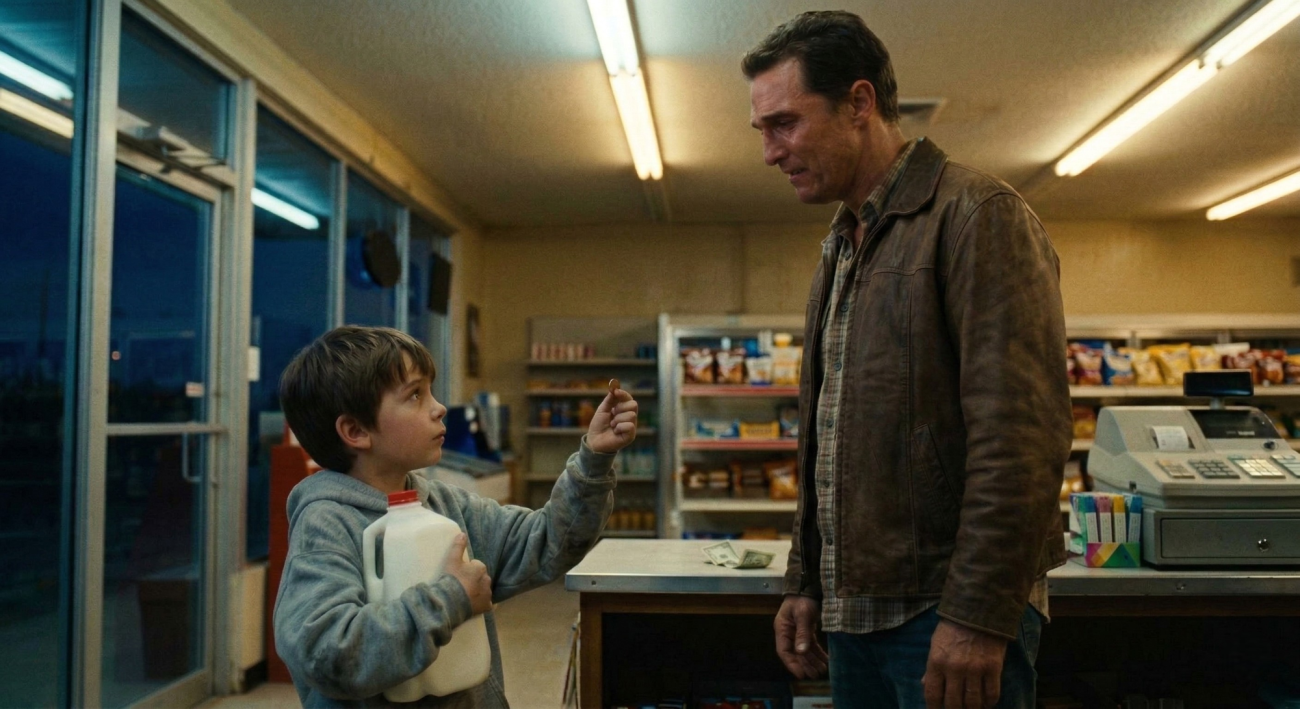
The fluorescent light above Pump 3 buzzed and flickered like it was counting down to something.
11:56 PM. West Texas. The kind of night where the highway disappears into nothing and even the coyotes go quiet.
Martha leaned against the register and rubbed her eyes. Twelve years on the night shift at the Crossroads Quick Stop. Twelve years of truckers, drunks, and silence. She’d stopped expecting surprises around year four.
The bell above the door chimed.
She looked up, already reaching for the scanner.
A boy walked in.
Small. Thin. Couldn’t have been more than seven.
His hoodie swallowed him whole—sleeves past his fingers, hem nearly to his knees. The cuffs were stained dark, like he’d been wiping his hands on dirt or worse. His sneakers were caked with dust. His hair stood in every direction, matted and unwashed.
But that wasn’t what made Martha’s hand stop mid-reach.
It was his eyes.
They moved across the store the way a stray dog checks a yard before crossing—careful, watchful, ready to bolt.
He walked to the refrigerator case without a word. Pressed one small palm flat against the glass. Stared at a gallon of milk like it was the only thing in the world that mattered.
He stood there for almost thirty seconds.
Then he picked it up with both hands and carried it to the counter like it was made of glass.
Martha smiled. The same tired, automatic smile she gave everyone.
“That all for tonight, sweetheart?”
He nodded. No smile. No words.
She scanned the milk.
“Three forty-nine.”
He didn’t reach for a wallet.
He opened his fist.
Coins spilled across the counter—quarters, dimes, nickels, pennies. Some of them were so worn the faces had nearly rubbed off. He started pushing them together with his fingertips, counting under his breath. His lips moved carefully around each number, like he’d rehearsed this on the walk over.
Martha watched him. Her throat tightened.
When he finished, she counted too.
Two dollars and eighty-seven cents.
He was short.
Not by much. But enough.
“I’m sorry, honey,” she said, keeping her voice as gentle as she could. “You’re a little short.”
The boy didn’t argue. Didn’t ask for a break. Didn’t cry.
He just nodded.
And started pulling the coins back.
One by one. Slowly. Like each penny was a tiny piece of hope he was putting back in his pocket.
Martha opened her mouth to say something—she didn’t know what—but the bell above the door chimed again.
Cold air rushed in.
A man stepped through. Tall. Broad-shouldered. Leather jacket worn soft at the elbows. Boots that had seen a thousand miles of highway. Gray streaked through a beard that hadn’t been trimmed in weeks. A scar ran along the edge of his jaw, faded but visible.
His name was Ray Dalton, though nobody in the store knew that.
He walked straight to the coffee machine, filled a large cup without looking at the menu, and set a crumpled five on the counter.
“Keep it,” he said.
Martha made change anyway. House rules.
As she slid the coins back, Ray’s eyes drifted left.
To the boy.
To the small pile of coins being swept off the counter.
To the milk sitting alone by the register, unclaimed.
Ray didn’t say anything. He sipped his coffee. Watched.
The boy slid the last penny into his palm and turned toward the door. His shoulders were hunched. His steps were slow. He wasn’t crying, but something worse was happening—he was being quiet about it.
“Hey.”
The boy stopped.
Ray set his coffee down. Reached into his jacket pocket. Pulled out a ten-dollar bill and placed it flat on the counter beside the milk.
“Ring it up,” he told Martha.
Martha blinked. Then moved fast, scanning the milk before the moment could evaporate.
The boy turned around slowly. His eyes went from the bill to Ray’s face, confused.
“Why?” the boy asked.
Ray shrugged. “Because you need milk and I’ve got ten bucks.”
“But you don’t know me.”
“Don’t need to.”
The boy stared at him for a long beat. Then his chin trembled, just barely, and the words came out before he could stop them.
“My mom hasn’t eaten today.”
The store went silent.
Even the refrigerator hum seemed to drop.
Ray’s hand froze around his coffee cup. Something shifted behind his eyes—fast, involuntary, like a door being kicked open from the inside.
“How long?” he asked. His voice was lower now.
“Since yesterday morning. She said she wasn’t hungry, but I saw her drink water three times for dinner.”
Martha pressed her hand to her mouth.
Ray set the coffee down. Pulled out his wallet. Laid two twenties beside the ten.
“Get bread,” he said. “Eggs. Peanut butter. Whatever she likes.”
The boy shook his head. “That’s too much.”
“No,” Ray said quietly. “It’s not enough.” He looked at Martha. “Help him pick out what he needs.”
Martha came around the counter and walked the boy through the aisles. Bread. A carton of eggs. Peanut butter. A box of crackers. Two cans of soup. She added a small container of chicken noodle from behind the warmer and a pack of applesauce cups. She didn’t ring those up.
When the boy came back to the counter with a full bag, Ray was leaning against the door frame, staring out at the empty parking lot.
“You live close?” Ray asked without turning around.
“About a mile,” the boy said. “Down Route 9. The yellow house with the broken mailbox.”
Ray nodded slowly. “Your mom—she sick?”
The boy hesitated. Then: “She hurt her back at work. Three weeks ago. They told her not to come back until she’s better, but they stopped paying her after the first week.”
“She see a doctor?”
“She says doctors cost too much.”
Ray turned around. His jaw was tight.
“What’s your name, kid?”
“Eli.”
“Eli what?”
“Eli Marsh.”
“And your mom?”
“Dana. Dana Marsh.”
Ray pulled a small notebook from his jacket and wrote something down. Martha watched him, curious.
“You walking home?” Ray asked.
“Yes sir.”
“It’s midnight.”
“I know. I waited until the cars stopped so it’d be safer.”
Ray closed his eyes for a second. When he opened them, they were wet.
“Martha,” he said, “you got a phone book back there? Or a computer?”
“I’ve got Wi-Fi and a browser that barely works.”
“Good enough.” He looked at Eli. “Sit tight for a minute.”
Martha pulled up the ancient desktop behind the register. Ray leaned over her shoulder and typed in a search. County assistance programs. Emergency food banks. Worker’s comp claims in the state of Texas.
“She filed a claim?” Ray asked Eli.
“I don’t know what that means.”
“When she got hurt at work—did anyone give her papers to fill out?”
Eli shook his head. “They just told her to go home.”
Ray’s expression hardened. “What’s the company?”
“I don’t know the name. She cleans offices. Big building off the highway. She takes the bus.”
Ray wrote that down too.
Martha watched him scribble notes like a man on a mission. “You a lawyer?” she asked.
“No,” Ray said. “I’m a welder. But I know what it looks like when someone gets screwed.” He tore the page from the notebook and folded it carefully. Then he crouched down in front of Eli.
“Listen to me,” he said. “I’m going to write a number on this paper. It’s a help line—people who can make sure your mom gets what she’s owed. You give this to her tomorrow. Can you do that?”
Eli nodded seriously.
“And this,” Ray pulled out another twenty, “is for anything else you need this week. Not a gift. Consider it borrowed from the universe.”
“I don’t understand.”
“You will someday.”
Ray stood up and looked at Martha. She was wiping her eyes with her sleeve.
“You see this kid come in again,” Ray said, “you call this number.” He handed her a scrap of paper with his cell on it. “I mean it.”
“I will,” Martha said.
Ray picked up his coffee, now lukewarm. Took a sip. Made a face. Tossed it in the trash.
“Terrible coffee,” he said.
“It’s been sitting there since six,” Martha said.
“Figures.”
He pushed the door open. The bell chimed. The desert wind rolled in, warm and restless.
He was three steps into the parking lot when he heard small footsteps behind him.
“Sir?”
Ray turned.
Eli stood in the doorway, the grocery bag held tight against his chest with both arms. His face was serious in a way that only children who’ve grown up too fast can manage.
He reached into his pocket and pulled something out.
A single penny.
He held it up.
“For you,” Eli said. “So you don’t have zero.”
Ray stared at the penny.
His hand reached out slowly and took it, turning it over in his rough fingers like it was something ancient and sacred.
“Where’d you learn that?” Ray’s voice cracked.
“My mom says everybody should have at least one penny. Because then you’re never all the way broke.”
Ray pressed his lips together hard. A tear slid down into his beard.
He’d heard those words before.
Twenty-three years ago. In a gas station in El Paso. From a woman behind the counter who handed a hungry sixteen-year-old boy a sandwich and a penny and said the exact same thing.
Her name was June Dalton.
His mother.
She’d worked nights at a gas station too—two jobs, no insurance, a bad hip she never got fixed. She died the year Ray turned nineteen, alone in a hospital waiting room because the ER was full and nobody triaged her fast enough.
He’d carried guilt like luggage ever since.
He never went back to El Paso. Never talked about her. Never visited the grave because he couldn’t stand the math—all the money he’d made welding pipeline, all the overtime, all the union checks, and none of it had come fast enough to save her.
And now a seven-year-old boy was handing him a penny in a gas station parking lot in West Texas and repeating his dead mother’s words like a message from somewhere he didn’t believe in anymore.
Ray swallowed hard.
“Thank you, Eli,” he whispered.
Eli nodded once, satisfied. Then he turned and started walking down the dark shoulder of Route 9, grocery bag clutched against his chest, small sneakers crunching gravel.
Ray watched him go.
Then he got on his motorcycle, didn’t start it, and sat there for five minutes with the penny in his fist.
Martha came outside. “You okay?”
“No,” Ray said. “But I’m going to be.”
He started the bike. But he didn’t head for the highway.
He turned down Route 9.
He found the yellow house with the broken mailbox. The porch light was off, but a faint glow leaked from behind a curtain. He parked across the street and waited until he saw Eli’s shadow pass through the front door. Waited until a light turned on in the kitchen. Waited until he could imagine the boy setting the grocery bag on a table and saying, “Mom, I got eggs.”
Then Ray pulled out his phone and made three calls.
The first was to his union rep, a guy named Carl who owed him a favor from a job in Odessa. He told Carl about Dana Marsh’s employer—an office cleaning company that was ducking worker’s comp and shorting a single mother. Carl said he’d make calls first thing in the morning.
The second was to the county assistance office’s after-hours voicemail. He left Dana’s name, address, and a detailed message about a mother and child in need of emergency support. He gave his own number as backup contact.
The third call was to his ex-wife, Linda, who ran a community food pantry out of a church in Midland.
“I need a delivery,” Ray said.
“It’s midnight, Ray.”
“I know. Tomorrow morning. Yellow house off Route 9. Broken mailbox. Woman named Dana Marsh and her son.”
“How bad?”
“She hasn’t eaten in two days and her seven-year-old walked a mile to a gas station at midnight to buy her milk with pocket change.”
Linda was quiet for three seconds.
“I’ll be there by eight,” she said.
“Thank you.”
“Ray?”
“Yeah?”
“You sound different.”
“I feel different.”
He hung up and looked at the yellow house one more time. The kitchen light was still on. He could picture them in there—Eli probably heating soup on the stove, Dana probably crying into a slice of bread, not because she was sad, but because her kid just walked through the desert at midnight and came back with everything she needed.
Ray put the penny in his wallet, behind his license, where he’d see it every time he opened it.
He rode back to the highway.
Three weeks later, Martha was restocking the cooler when the bell chimed.
She looked up.
Dana Marsh walked in. She was thin but standing straight. Her arm was in a brace, not a sling—progress. She had a folder under her good arm.
“You Martha?” Dana asked.
“That’s me.”
“A man named Ray told me to come thank you. He said you helped my son.”
Martha shook her head. “I barely did anything.”
Dana set the folder on the counter. “My employer settled. Back pay, medical coverage, and a formal apology. Carl from the welders’ union connected me with a lawyer who took the case pro bono.” She paused. “I start a new position Monday. Desk job. Benefits. Health insurance for both of us.”
Martha’s eyes welled up. “That’s wonderful.”
“There’s something else.” Dana pulled out her phone and showed Martha a photo. It was Eli, grinning ear to ear, sitting at a table covered in groceries. Behind him, a woman in a church t-shirt was stacking canned goods on a shelf.
“Linda’s pantry has been coming every week,” Dana said. “Ray set that up too.”
“Have you met him?” Martha asked.
“Once. He came by the house last Saturday. Fixed the mailbox. Didn’t say much. Eli gave him a glass of lemonade and showed him his school project—a poster about welding.”
Martha laughed. “Of course he did.”
Dana smiled. It was the kind of smile that had been gone for a while and was still finding its way back.
“He left something on the porch before he drove off,” Dana said. She reached into her purse and pulled out a small envelope. Inside was a single penny taped to an index card.
Written underneath in block letters:
“So you’re never all the way broke. — Ray”
Martha put her hand over her heart.
“Your son started something that night,” she said.
Dana nodded. “I know.” She tucked the envelope back in her purse. “I used to think asking for help was the worst thing you could do. That it meant you’d failed. But Eli walked into this store with thirty-seven cents less than he needed, and a stranger turned it into a whole new life for us.”
She looked around the small gas station—the flickering lights, the burnt coffee, the dusty shelves.
“Doesn’t look like much,” Dana said. “But this is where everything changed.”
Martha reached under the counter and pulled out a small jar. She dropped a penny inside and set it beside the register.
“What’s that for?” Dana asked.
“In case the next kid comes up short.”
By the end of that year, the jar had a name. Someone taped a label to it in black marker: Eli’s Penny Fund.
It was never empty.
Truckers dropped in quarters. Travelers tossed in dimes. One woman on a cross-country drive put in a hundred-dollar bill and said, “My son is seven too.”
Martha kept a notebook under the register. Every time the fund helped someone—a gallon of milk, a tank of gas, a bag of groceries for a family passing through—she wrote it down.
Page after page after page.
Ray came back to the gas station exactly once more, six months later. He walked in, saw the jar, read the label, and stood there for a long time without speaking.
“You need anything?” Martha asked.
Ray shook his head. He reached into his wallet, pulled out the original penny—the one Eli had given him in the parking lot—and held it up to the light.
“I’m keeping this one,” he said.
“I’d be offended if you didn’t.”
He bought a cup of coffee. Took one sip. Made the same face.
“Still terrible,” he said.
“Still from six this morning,” Martha said.
Ray laughed. It was the kind of laugh that sounded rusty, like it hadn’t been used in a long time and was just now remembering how.
He walked to the door, stopped, and turned back.
“Martha.”
“Yeah?”
“Thank you for not telling him the milk was only three forty-nine.”
Martha frowned. “What do you mean?”
“The milk. When I came in that night, you’d already decided to cover the difference yourself. I saw you reach for your apron pocket before I put the ten down.”
Martha’s face went red. “You weren’t supposed to see that.”
“I see everything,” Ray said. “Occupational hazard of being alone too long.”
He pushed through the door. The bell chimed. The desert wind caught his jacket.
Martha watched his motorcycle disappear down the highway, taillight shrinking to a red dot and then gone.
She looked at the penny jar. Looked at the clock. 11:58 PM.
Two more minutes until tomorrow.
Two more minutes of the same silence.
But it didn’t feel the same anymore.
The bell chimed.
Martha looked up.
A young woman walked in, holding a toddler on her hip. The child was fussing. The woman looked exhausted—dark circles, wrinkled shirt, the kind of tired that sleep doesn’t fix.
She walked to the refrigerator case and picked up a gallon of milk.
At the counter, she patted her pockets. Her face fell.
“I think I left my card in the car,” she said. “I’m so sorry, I—”
Martha reached for the penny jar.
“Don’t worry about it,” she said. “This one’s on Eli.”
The woman looked confused. “Who’s Eli?”
Martha smiled—not the tired, automatic one she’d worn for twelve years. A real one.
“Just a kid who taught this whole highway that nobody should ever have zero.”
She bagged the milk, slid it across the counter, and nodded toward the door.
“Have a good night, sweetheart.”
The woman thanked her and walked out into the warm Texas dark, toddler on her hip, milk in her hand.
Martha leaned back against the register.
For the first time in twelve years, the silence felt full.
Original fictional stories. AI-assisted creative content.
