
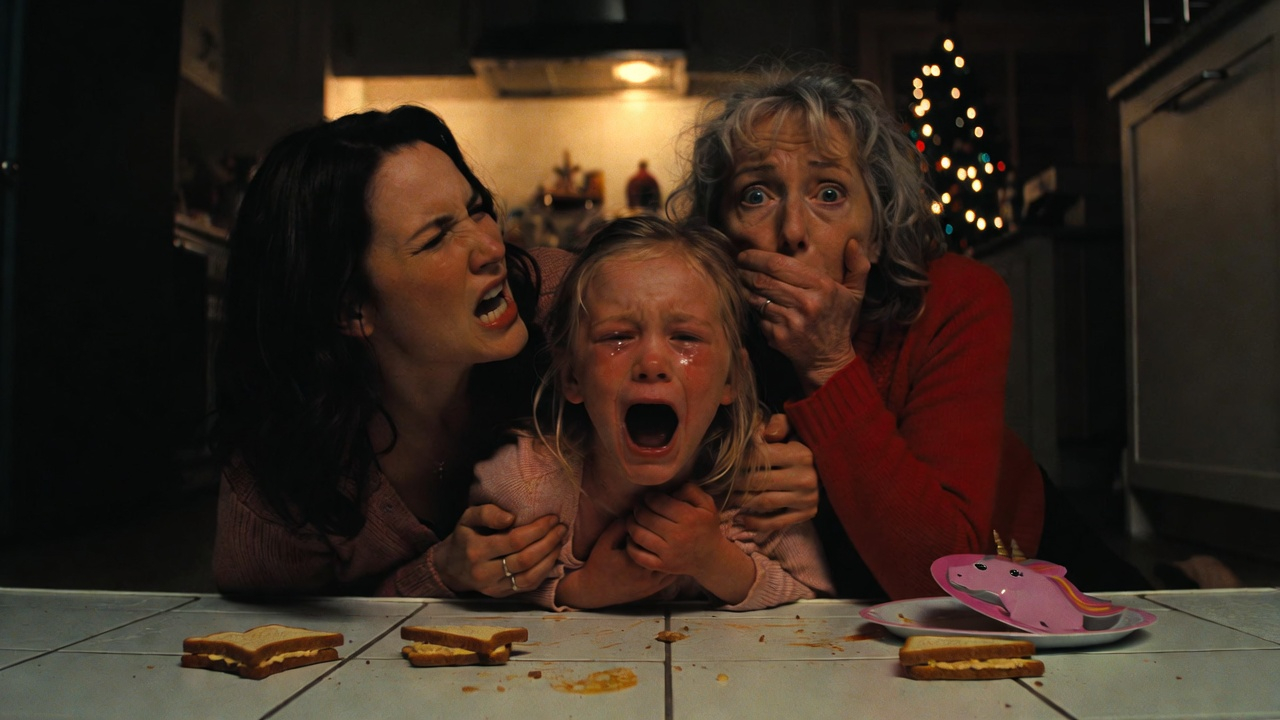
The house smelled like cinnamon and roasted vegetables. Christmas lights threw soft gold across the windows, and laughter drifted from the living room into the kitchen where I stood arranging appetizers. Everything looked exactly the way a holiday gathering should look on the surface.
Underneath, nothing was right.
My mother had arrived two hours early, letting herself in with the spare key I’d forgotten to take back. By the time I came downstairs she’d rearranged half the kitchen and started prepping a glaze I hadn’t asked for. “You always forget the glaze, Karen,” she said without looking up. “I don’t know how you manage this house alone.”
“I manage fine,” I said.
She smiled the way she always did when she wanted me to know she disagreed.
Derek showed up at five with a bottle of wine and a grin that didn’t reach his eyes. My ex-husband had no business being at my Christmas dinner, but he’d called the week before claiming he wanted to “keep things normal for Lucy,” and I’d agreed because I was tired of fighting.
“Place looks great,” he said, scanning the room like he was appraising it.
“Thanks.”
“You do anything with the backyard? Looks different.”
“New fence.”
He nodded slowly. “Nice. Must’ve cost a bit.”
I didn’t answer. Everything Derek said lately had a second meaning, and I’d learned to stop engaging with the subtext.
My friend Jenna arrived last, already checking her watch before she’d taken off her coat. “How long is this going to be?” she whispered when she hugged me.
“Two hours, tops.”
“I’m holding you to that.”
Lucy was the only honest person in the room. My eight-year-old daughter sat on the couch with her legs pulled up, watching the adults move around her like she was studying animals at a zoo. When I sat beside her she grabbed a fistful of my sweater and pulled herself close.
“What’s wrong, baby?”
She leaned into my ear. “I’m scared of Grandma.”
The words landed like ice water on my spine. Lucy was cautious by nature, quiet around strangers, slow to warm up. But she had never said she was scared of someone in our family before. Not once.
“Why are you scared?” I asked carefully.
She shook her head and pressed closer. “She keeps looking at me weird. And she was in your purse.”
I kissed the top of her head and stood up slowly, keeping my face neutral. In the kitchen, my mother was hunched over the counter with her back to me, spreading something onto a cookie. The jar beside her caught my eye immediately.
It was the wrong color.
I kept a strict peanut-free kitchen. Every label checked, every product verified, every guest warned before they walked through the door. Lucy’s peanut allergy was severe — not the kind that gave her hives, but the kind that closed her throat in minutes. Everyone in this house knew that.
The jar on my counter was Skippy. Regular, full-fat, unmistakable Skippy peanut butter.
My mother placed the finished cookie on a small pink plate decorated with unicorns. Lucy’s plate. The one she’d picked out herself at Target last spring, the one nobody else ever used.
“Mom,” I said quietly. “What is that?”
She turned with a pleasant expression. “Just a little treat for Lucy. She’s been so good today.”
“That’s peanut butter.”
“Oh, Karen, it’s a tiny amount. You’re always so dramatic about this.”
“She could die.”
My mother waved her hand dismissively. “Children outgrow these things. You baby her too much. That’s half the problem.”
I picked up the plate and scraped the cookie into the trash. My mother watched me do it with an expression I couldn’t read — not anger, not surprise, but something patient and calculated, like a chess player watching an expected move.
That expression terrified me more than the peanut butter.
I walked to the hallway and grabbed my purse from the hook by the door. I unzipped the inner pocket where I always kept Lucy’s EpiPen.
Empty.
I checked every pocket. Every compartment. Dumped the contents onto the hallway table and sorted through them with shaking hands.
It was gone.
I picked Lucy up without a word and carried her to my bedroom, locking the door behind us. She watched me with wide brown eyes as I pulled open my nightstand drawer and found the backup EpiPen I kept hidden there.
“Mommy, what’s happening?”
“Nothing, baby. I’m just checking something.”
She was quiet for a moment. Then she said, very softly, “Grandma took it.”
I stopped moving. “Took what?”
“The pen thing. The medicine. I saw her take it out of your bag and put it in her purse. She did it when you were in the bathroom.”
The room narrowed. Sound faded. I could hear my own heartbeat, loud and steady, filling the silence like a drum.
“When?” I asked.
“Right when she got here. Before anyone else came.”
Two hours. My mother had been in this house for two hours with a jar of peanut butter and my daughter’s stolen EpiPen, waiting for the right moment.
This was not carelessness. This was a plan.
I pulled out my phone and dialed 911. My hands were shaking so badly I had to try twice.
“911, what’s your emergency?”
“My daughter has a life-threatening peanut allergy. Someone in my home brought peanut products inside and removed her emergency EpiPen from my bag. I need officers here immediately.”
The dispatcher’s voice was calm and professional. “Ma’am, is your daughter currently experiencing a reaction?”
“No. I caught it before she ate anything. But the person who did this is still in my house.”
“Officers are en route. Stay with your daughter and keep her safe.”
I hung up and sat on the bed beside Lucy, pulling her into my lap. Outside the bedroom door I could hear the muffled sounds of conversation, my mother’s laugh, Derek’s voice telling some anecdote about work. Normal sounds. Holiday sounds. The soundtrack of a family that looked fine from the outside.
The doorbell rang seven minutes later.
I carried Lucy out of the bedroom and walked into the living room. Two officers stood in the doorway — a tall woman with her hair pulled back and a stocky man with a calm, unreadable expression.
My mother turned from the kitchen with a dish towel over her shoulder. “Oh my goodness, officers! Is everything all right?”
The female officer stepped forward. “Ma’am, we received a call regarding a potential endangerment situation involving a child with a severe allergy. We need to ask a few questions.”
My mother laughed lightly. “Endangerment? That’s quite a word for a family Christmas dinner. Karen, did you call them?” She looked at me with theatrical disbelief.
“I did,” I said.
“Over what? A cookie?”
The male officer spoke. “Ma’am, we’ve been informed that an EpiPen belonging to a minor was removed from the home. Do you have any knowledge of that?”
“Of course not. This is absurd.”
“Would you mind if we looked in your purse?”
Her smile vanished. “Excuse me? You can’t just go through someone’s personal belongings because my daughter is having one of her episodes.”
“Ma’am, we can obtain a warrant, but given the circumstances involving a child’s safety, we’d appreciate your cooperation.”
“This is harassment.”
The female officer moved to the counter where my mother’s large leather bag sat open. She looked at my mother, waited three seconds, then reached inside.
She pulled out Lucy’s EpiPen first. Pink case, Lucy’s name written on it in my handwriting. Then a small jar of peanut butter, half empty, with the safety seal already broken.
The living room went completely silent.
Derek stopped mid-sentence. Jenna’s hand froze around her wine glass. My mother’s face cycled through three expressions in two seconds: shock, fury, and then something cold and controlled.
“That isn’t mine,” she said flatly.
“It was in your bag, ma’am.”
“Someone must have put it there.”
The officer looked at me, then back at my mother. “Ma’am, we need you to come with us to the station.”
“You cannot be serious. This is my daughter’s house. It’s Christmas.”
“Ma’am, please.”
She turned to me with a look that was supposed to make me feel guilty. It was the same look she’d used my entire life — the narrowed eyes, the slight tilt of the head, the unspoken message that I was being ungrateful, unreasonable, difficult.
“Karen, tell them this is a misunderstanding.”
“It isn’t,” I said.
Her mask cracked. Her voice rose to a near-shout. “You’re going to have your own mother arrested on Christmas? Over a cookie? What kind of daughter does that?”
“The kind whose child almost died tonight.”
She kept shouting as they walked her out the front door. The neighbors’ porch lights flickered on one by one down the street. The door closed behind her, and the house fell into a silence so deep I could hear the Christmas tree lights buzzing.
Derek stood frozen by the fireplace. His face was blank, but his hands were shaking.
“You should go,” I told him.
He opened his mouth, closed it, then grabbed his coat and left without a word.
Jenna stayed. She didn’t say anything for a long time. She just sat with me on the couch while Lucy fell asleep between us, and when she finally spoke, all she said was, “You did the right thing.”
I didn’t sleep that night. I sat in the dark with Lucy curled against me, listening to the house settle and creak, running through every moment of the evening. How early my mother had arrived. How she’d positioned herself in the kitchen. How she’d moved to my purse the instant I left the room. Every step calculated. Every detail planned.
The phone rang at seven the next morning. My mother’s name on the screen.
I answered, hoping for an apology. Hoping for something human.
“How could you do this to me?” she screamed. “You had me arrested. On Christmas. In front of the neighbors. Do you have any idea what people are going to say?”
“You put peanut butter on Lucy’s plate and stole her EpiPen.”
“Oh, stop being dramatic.”
“Were you trying to kill her?”
“Don’t be ridiculous. She wasn’t going to eat it.”
My blood went cold. “What do you mean she wasn’t going to eat it?”
A pause. Then her voice dropped to something almost conspiratorial. “Derek had another EpiPen ready. He was going to step in the moment anything happened. Lucy would have been perfectly fine.”
I couldn’t breathe.
“You planned this together,” I said.
She sighed like I was being slow. “You don’t understand the pressure you’re under, Karen. You can’t handle everything alone. We were trying to help you. If Lucy had a reaction and Derek saved her, people would see that you need support. The court would see it. Everyone would see it.”
“You were going to poison my daughter to win a custody argument.”
“That’s such an ugly way to put it.”
“It’s the truth.”
“Derek said it was the only way to get full custody. He said the judge needed to see you fail. I was trying to help both of you.”
“By hurting Lucy.”
Her voice hardened. “It was Derek’s idea. I just went along with it. Blame him.”
She hung up.
I sat in the kitchen for twenty minutes, staring at the phone. Then I called my lawyer.
The investigation moved faster than I expected. My attorney, a sharp-eyed woman named Patricia who’d handled custody cases for twenty years, listened to everything I told her without interrupting. When I finished, she took off her glasses and rubbed the bridge of her nose.
“This isn’t negligence,” she said. “This is premeditated endangerment. We’re going to the court today.”
She filed an emergency motion that afternoon, and the judge — who had a daughter with a shellfish allergy and took the matter personally — ordered Derek to surrender his phone and email records within forty-eight hours. Derek’s lawyer tried to argue it was an overreach. The judge overruled him in less than a minute.
What they found made the peanut butter look like a warm-up.
Six weeks of messages between Derek and my mother. Detailed, methodical, chilling.
Derek had researched Lucy’s allergy severity. He’d looked up exactly how much peanut exposure would trigger a visible reaction without causing permanent damage, as if endangering a child could be done on a sliding scale. My mother had agreed to smuggle the peanut butter into the house and remove the EpiPen from my bag. Derek would arrive with a hidden backup EpiPen, play the hero when Lucy reacted, and then use the incident to file an emergency custody petition claiming I was negligent.
They’d discussed it like a business plan. Bullet points. Timelines. Contingencies. My mother had even researched which hospitals had the fastest emergency response times, not to help Lucy, but to make sure the reaction looked serious enough without becoming fatal.
One message from Derek read: “She needs to react visibly. Swelling at minimum. Throat tightening would be better for the optics.”
My mother had replied: “What if she actually stops breathing?”
Derek’s response: “That’s what the second pen is for. Relax.”
Another exchange, three days before Christmas, discussed the exact placement of the cookie. My mother wrote: “I’ll put it on her unicorn plate. She always eats off that one first. She won’t question it.”
Derek replied: “Perfect. I’ll keep the backup pen in my jacket. Left pocket. I’ll be standing close enough to reach her in ten seconds.”
Ten seconds. They’d timed it. They’d calculated how long my daughter could suffocate before someone intervened, and they’d decided ten seconds was acceptable.
I threw up after reading that exchange. Then I read the rest.
In exchange for my mother’s cooperation, Derek had promised to get my younger brother hired at his company and to help my mother financially. She’d sold out her granddaughter’s safety for a job referral and a monthly check.
The legal fallout was thorough and merciless.
My mother was charged with child endangerment and conspiracy. She tried to fight it initially, hiring a lawyer who argued she’d been manipulated by Derek. But the messages showed her as an active, willing participant — she’d suggested the unicorn plate, she’d confirmed the timing, she’d volunteered to handle the EpiPen removal. Her lawyer negotiated a plea deal: two years of probation, mandatory counseling, and a permanent restraining order barring her from any contact with Lucy.
Derek was charged with conspiracy to commit child endangerment. His company’s HR department called him in the same day the charges were filed. He walked out of the building carrying a cardboard box, and the security guard watched him all the way to his car. Colleagues who’d played golf with him for years stopped returning his calls. His new girlfriend, who’d posted Instagram photos of their “perfect blended family,” quietly scrubbed her account, packed her things, and moved back to her parents’ house in Connecticut.
The custody hearing lasted two days. The judge read the messages aloud in the courtroom, every single one, and Derek’s attorney visibly winced at each line. Derek sat in his chair with his hands folded, staring at the table, while his own words were read back to him in a judge’s measured voice.
“Throat tightening would be better for the optics,” the judge repeated, then paused and looked directly at Derek. “You wrote that about your own daughter.”
Derek didn’t respond. His lawyer put a hand on his arm.
I was awarded full, sole custody with no visitation rights for Derek until he completed a comprehensive psychological evaluation, a certified parenting course, and six months of supervised therapy. He was ordered to pay significantly increased child support, and any future visitation would be supervised by a court-appointed monitor at his expense.
When the judge delivered the ruling, Derek’s face was blank. He didn’t look at me. He didn’t look at anyone. He just stood up and walked out of the courtroom like a man who’d finally run out of strategies.
My brother called me after the sentencing, furious. “You destroyed this family,” he said. “Mom can’t show her face at church. Derek lost everything. And for what? A cookie nobody even ate?”
“For what?” I repeated. “They planned to poison your niece.”
“It wasn’t poison. It was peanut butter. You’re blowing this out of proportion, just like Mom said you would.”
“Lucy could have died.”
“But she didn’t.”
“Because I stopped it.”
He was quiet for a long time. Then he said, “You always have to be the victim, don’t you?” and hung up.
I stared at the phone for a while after that. Then I blocked his number, and my mother’s, and Derek’s. Three contacts, deleted in thirty seconds. Twenty years of family obligations, gone with three taps of my thumb.
It should have felt harder than it did.
The first few months after were hard in ways I hadn’t anticipated. The adrenaline faded, and what replaced it was a bone-deep exhaustion that made ordinary tasks feel enormous. I checked Lucy’s EpiPen location compulsively — before breakfast, before school, before bed. I read ingredient labels so many times the cashiers at the grocery store started giving me looks. I flinched every time someone brought food near my daughter.
Lucy noticed. Kids always notice.
“Mommy, you’re doing the checking thing again,” she said one morning as I inspected her lunchbox for the third time.
“Just making sure.”
“You already made sure. Twice.”
I laughed despite myself. She was right.
Therapy helped. Not immediately, not dramatically, but slowly, the way sunrise works — so gradual you don’t realize it’s happening until suddenly the room is light. My therapist, a calm woman named Dr. Rivera who never rushed me, helped me untangle the guilt from the grief. “You’re mourning people who are still alive,” she said during one session. “That’s one of the hardest kinds of loss, because there’s no funeral, no closure. Just absence.”
She was right. I mourned the mother I thought I had. I mourned the co-parent Derek could have been. I mourned the family Lucy deserved but would never get from them.
I learned to separate reasonable caution from hypervigilance. I learned to trust my own judgment without needing constant verification. I learned that protecting my daughter and punishing myself were two different things, and that I’d been doing both simultaneously for months without realizing it.
Lucy started sleeping through the night again. She stopped asking about Grandma. She made new friends at school, joined an art club, and started leaving her drawings taped to the refrigerator again. Small signs of a child returning to normal.
One evening, about eight months after Christmas, Lucy found me sitting on the porch watching the sunset. She climbed into my lap and rested her head against my shoulder.
“Mom?”
“Yeah, baby?”
“Thank you for keeping me safe.”
I held her tighter and didn’t say anything for a while, because sometimes the right response isn’t words.
Our house is quiet now. Not empty quiet — the kind of quiet that comes when danger has been removed and what’s left is just life, ordinary and imperfect and safe. I changed the locks. I took back the spare key. I built a home where the only people allowed inside are the ones who would never, under any circumstances, trade my daughter’s life for leverage.
Some nights I still think about that pink unicorn plate sitting on the counter with peanut butter glistening on a cookie. I think about how close it came. I think about what would have happened if Lucy hadn’t whispered those words, if I hadn’t checked the jar, if I hadn’t found the backup EpiPen.
Then I walk down the hall and look in on her sleeping — blankets kicked off, one arm hanging over the side of the bed, mouth slightly open — and the fear dissolves into something fiercer and cleaner.
She’s safe. She’s mine. And nobody will ever use her as a pawn again.
Original fictional stories. AI-assisted creative content.
