
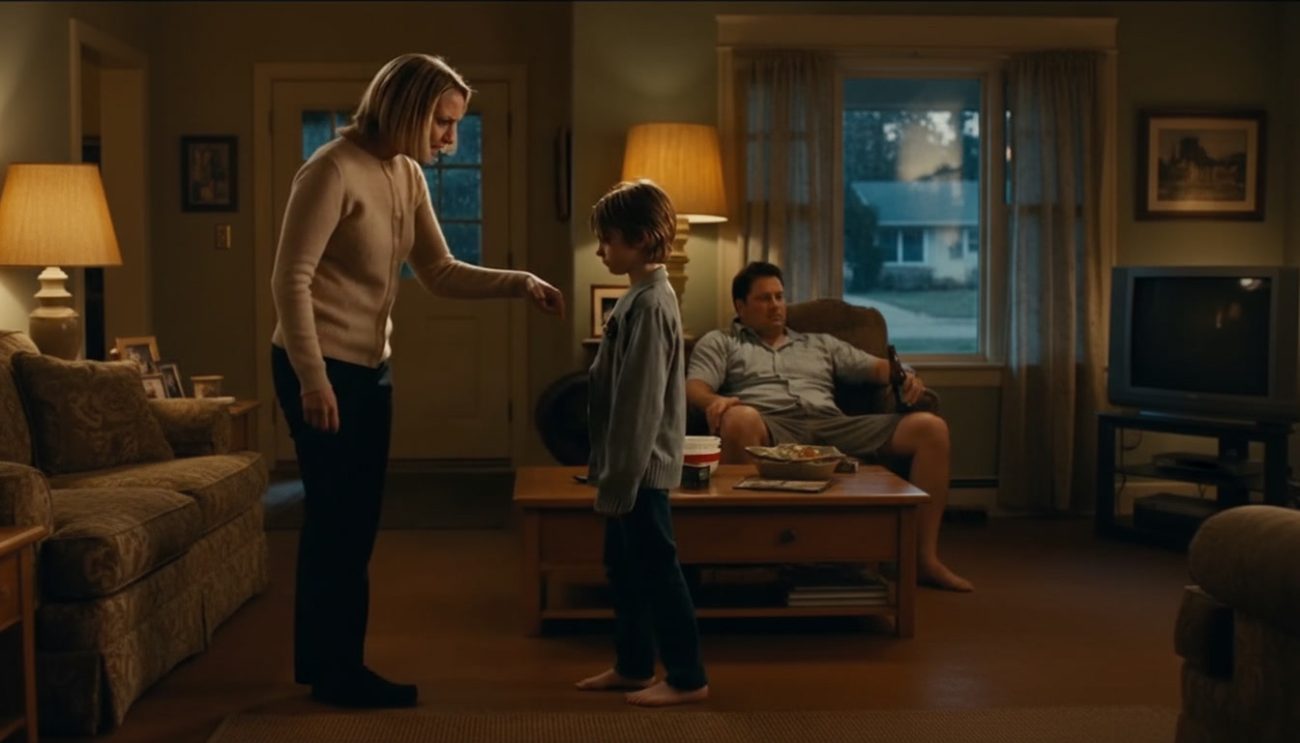
The rain hit Maple Ridge Drive like it had a grudge.
Not a drizzle. Not a mist. A full assault—wind ripping through oak branches, gutters overflowing onto sidewalks, thunder cracking so close the car alarms woke up two blocks over.
At 9:47 PM, every house on the street had its lights on and its doors locked.
Every house except one.
Evan Parker was eight years old, barefoot, and standing on a concrete porch in forty-degree rain.
His jacket was a hand-me-down from a kid twice his size. It hung past his wrists and did nothing against the wind. His socks were gone—taken away that morning as punishment for spilling orange juice on the kitchen counter.
He knocked on the front door. Soft. Careful.
“Please,” he whispered. “I’ll be really quiet. I promise.”
Nothing.
Inside, he could hear plates clinking. The television playing some game show. Someone laughed—a woman’s laugh, high and sharp, like breaking glass.
Evan knocked again. A little harder.
The deadbolt didn’t turn. But a voice came through the door like a fist.
“Stop knocking.” His father’s voice. Flat. Tired. Final. “You’re not coming back in tonight. You know the rules.”
The porch light clicked off.
Evan stood in darkness.
The rain found every gap in his jacket. It ran down his neck, pooled in the hollow of his collarbone, soaked through his jeans until they felt like they weighed twenty pounds.
He sat down against the wall, pulled his knees to his chest, and started counting.
One. Two. Three.
Counting helped. His mom had taught him that—back when she was still around. “When your chest gets tight,” she’d say, “you count. You breathe. You wait. It always passes.”
He counted to sixty. Then he started over.
Across the street, Margaret Hollis pulled her kitchen curtain back two inches and looked out.
She saw the boy. She’d seen him before—dragging trash cans in the dark, weeding the garden in August heat while the other kids on the block rode bikes.
Her husband appeared behind her. “What is it?”
“The Parker boy. He’s on the porch again.”
Gerald glanced over her shoulder and grunted. “Family matter.”
Margaret let the curtain fall. She went back to her crossword puzzle. She filled in seven across: SILENCE.
The irony didn’t register.
By minute four, Evan’s fingers had gone white.
By minute six, his teeth chattered so hard he bit his tongue. He tasted copper.
By minute eight, he stopped knocking. Stopped counting. Just sat there, arms wrapped around himself, eyes closed, rain hammering his skull like it was trying to wake something up inside him.
At minute ten, headlights swept across the street.
A dark sedan—newer model, polished even in the downpour—slowed as it passed the house. Brake lights flared red. The car stopped. Reversed.
The driver’s door opened.
A man stepped out. Tall, mid-forties, wearing a dark overcoat. He popped an umbrella against the wind and walked toward the porch with the kind of stride that said he’d been somewhere important and was about to make this place important too.
He stopped at the bottom of the steps.
“Hey,” he said. Not loud. Not soft. Just precise. “What are you doing out here?”
Evan looked at the man’s shoes first. Polished leather. The kind of shoes that cost more than everything in Evan’s closet combined. Then he looked up.
“I’m waiting,” Evan said. “I’m not allowed inside.”
The man’s jaw shifted. His eyes moved to the house—the warm glow leaking through curtained windows, the muffled laughter, the locked door.
“Who lives here?”
“My dad. And my stepmom.”
“And they put you out here?”
Evan didn’t answer. He’d learned what happened when he answered that question.
The man crouched down. Eye level. Rain dripped off the umbrella’s edge between them.
“Evan,” he said. “Is that your name?”
Evan’s whole body went rigid. “How do you know my name?”
The man didn’t blink. “Because I’ve been looking for you for two years.”
The man’s name was David Brennan. He was a corporate attorney from Raleigh. He drove a leased Audi, owned a three-bedroom house with a paid-off mortgage, and hadn’t slept through the night since his sister disappeared.
Her name was Claire.
Claire Brennan—before she became Claire Parker, before she married a man who promised stability and delivered silence, before she vanished from David’s life like smoke through a screen door.
Two years ago, David had gotten a voicemail. Claire’s voice, thin and rushed: “I need help. He won’t let me—” The line cut. When he called back, the number was disconnected.
He filed a missing persons report. Hired a private investigator. Called every hospital, shelter, and women’s crisis center within three hundred miles.
Nothing.
Then, six weeks ago, his investigator found a custody transfer document buried in a county courthouse in Virginia. Claire Parker had relinquished custody of her son, Evan, to his biological father, Thomas Parker.
Except Claire hadn’t signed it.
The signature was forged.
David traced the address. Drove four hours in the rain. And found his nephew sitting barefoot on a porch in a thunderstorm.
David walked Evan to the front door and knocked.
Not politely.
The door swung open. A woman stood there—mid-forties, blonde highlights, manicured nails, wearing a cashmere sweater that cost more than Evan’s entire wardrobe.
Her name was Diane. Thomas Parker’s second wife.
Her smile died the second she saw the boy.
“I told you—”
“Why is this child outside?” David said.
Diane’s eyes narrowed. “He’s being disciplined. He lies, he breaks things, he—”
“He’s eight. And it’s forty degrees.”
Thomas appeared behind Diane. Shorter than David. Softer. The kind of man who folded when someone pushed.
“Sir,” Thomas said quickly. “We’ve got this handled. He gets wound up and—”
“He’s soaking wet,” David said. “He’s not wearing shoes. It’s ten o’clock at night.”
Thomas blinked. “Who are you?”
David pulled out his phone. “I’m someone who’s about to call 911 unless you open this door and let this boy inside right now.”
Diane’s chin lifted. “You have no authority here. This is our home. Our child.”
“He’s my nephew.”
The hallway went silent.
Thomas’s face drained white. Diane’s mouth opened, then closed, then opened again.
“That’s—no.” Diane shook her head. “Claire had no family. She told us—”
“Claire didn’t tell you anything,” David said. “Because Claire didn’t sign those papers.”
He held up his phone. On the screen: a scanned document. The forged custody transfer.
“I had a handwriting analyst review this six days ago,” David said. “This isn’t Claire’s signature. It’s not even close.”
Thomas took a step back. “I don’t—I didn’t—”
“Where is she?” David asked. His voice had dropped to something dangerous. Quiet and edged. “Where is my sister?”
Thomas sat down at the kitchen table like a man who’d just been told the building was on fire and the exits were locked.
Diane stayed standing. Arms crossed. Jaw tight.
“Claire left,” Thomas said. “Two years ago. She packed a bag and walked out.”
“Without her son?”
“She wasn’t—she wasn’t stable.”
David leaned forward. “My sister graduated summa cum laude. She ran a nonprofit for three years. She raised Evan alone for four years before she met you.”
Thomas looked at the table. “Things changed.”
“What changed?”
Silence.
Evan stood in the kitchen doorway, wrapped in a towel David had found in the hall closet. His eyes moved between the adults like he was watching a tennis match where every serve could hit him.
“She didn’t leave,” Evan said.
Every head turned.
“She didn’t leave,” Evan repeated. His voice was small but steady. The voice of a kid who’d been rehearsing this sentence in his head for two years. “She tried to take me. Diane called the police and said Mom was trying to kidnap me. They took her away.”
The room cracked open.
Thomas put his head in his hands.
Diane pointed at Evan. “He’s lying. That’s what he does. That’s why he—”
“There’s a report,” Evan said. “Mom told the police what really happened. She told them about the closet.”
Diane’s face went white.
David looked at her. “What closet?”
The closet was in the basement.
Six feet by four feet. No light. No ventilation. A deadbolt on the outside.
David found it while Diane screamed that he had no right to be in her house. He opened the door and saw scratch marks on the inside of the wood. Small fingernails. A child’s height.
He also saw a sleeping bag, a plastic water bottle, and a bucket.
David photographed everything. His hands were shaking, but his voice was steel.
“How long?” he asked Evan.
“Depends,” Evan said. “Sometimes a few hours. Sometimes overnight. Once it was two days.”
David turned to Thomas. “Did you know?”
Thomas didn’t answer. But his silence was the loudest thing in the room.
David called 911.
The police arrived in seven minutes. Two patrol cars and a detective.
Detective Sandra Reeves was the kind of woman who’d seen everything and still believed things could get worse. She walked through the house with a body camera and a face made of granite.
She saw the closet.
She saw the scratch marks.
She saw Evan’s bare feet, his too-thin jacket, the red marks on his wrists where he’d been grabbed earlier that evening.
“Who did this?” she asked Evan.
Evan looked at Diane.
Diane laughed. Actually laughed. “This is ridiculous. He fell. He always falls.”
Detective Reeves didn’t blink. “Ma’am, I’m going to need you to step outside.”
“This is my house—”
“Step outside. Now.”
Two officers flanked Diane. She went, but not quietly. Her voice carried through the walls—threats about lawyers, lawsuits, ruined careers.
Thomas sat at the kitchen table, staring at nothing.
“Mr. Parker,” Detective Reeves said. “I need you to tell me about your ex-wife. Claire Brennan Parker.”
Thomas opened his mouth. Closed it. Opened it again.
“She’s at Millbridge,” he whispered.
David’s blood went cold. “Millbridge? The psychiatric facility?”
Thomas nodded. “Diane had her committed. Said she was a danger to herself and to Evan.”
“On what grounds?”
Thomas swallowed. “Diane filled out the paperwork. I signed it. She told me it was the right thing.”
David grabbed the edge of the table. “You had my sister locked in a psychiatric facility for two years. While your wife locked your son in a closet.”
Thomas started to cry.
David didn’t care.
Detective Reeves made three calls in the next twenty minutes.
The first was to Millbridge Psychiatric Center. She requested Claire Brennan Parker’s intake records, commitment documents, and attending physician notes.
The second was to Child Protective Services. An emergency removal order for Evan Parker.
The third was to the District Attorney’s office.
While they waited, David sat with Evan on the living room couch. The boy hadn’t cried. Not once. That bothered David more than anything.
“You’re safe now,” David said.
Evan looked at him. “People say that a lot.”
“I know. But I’m your uncle. And I’m not leaving.”
Evan studied his face. Searching for the lie. The catch. The part where the promise collapsed.
“Mom talked about you,” Evan said finally. “She said you were a bulldog.”
David almost smiled. “She wasn’t wrong.”
“She said if anything ever happened, you’d come.”
“I’m here.”
Evan’s chin trembled. Just once. Then he straightened up and nodded.
“Okay,” he said.
By midnight, the neighborhood had woken up.
Porch lights clicked on one by one. Curtains opened and stayed open. Neighbors stood in doorways, watching the police cars, the detective, the parade of consequences marching up and down the Parker driveway.
Margaret Hollis stood on her porch with her arms wrapped around herself. Gerald stood behind her.
“We should have called,” she said.
Gerald said nothing.
Detective Reeves approached them as she was leaving. “Ma’am, did you ever observe anything concerning about the child across the street?”
Margaret’s eyes welled. “I saw him. On the porch. In the cold.”
“And you didn’t report it?”
Margaret’s voice broke. “I thought it was… I thought they were just strict.”
Detective Reeves nodded. Not with forgiveness. Not with judgment. Just acknowledgment of a truth that would sit in Margaret’s chest for the rest of her life.
The Millbridge call came back at 1:15 AM.
Claire Brennan Parker was alive. She was in a long-term ward, heavily medicated, listed as a voluntary patient—except the “voluntary” admission form had the same forged signature as the custody transfer.
David was on the road by 1:30.
He arrived at Millbridge at 5:42 AM, still in his rain-soaked overcoat, still running on adrenaline and fury.
The facility director met him in a sterile hallway that smelled like bleach and regret.
“I’m here for my sister,” David said. “Claire Brennan.”
“Sir, visiting hours—”
David handed over a folder. Inside: the forged custody documents, the forged commitment papers, the handwriting analysis, the police report from that night, and a court order his partner at the firm had drafted and filed at 3 AM.
The facility director read the court order twice.
Then she picked up her phone.
Claire was thinner than David remembered. Her hair had gone gray at the temples. Her hands shook when she held a cup of water.
But her eyes were the same. Sharp. Clear. Fighting.
“David?” she whispered.
He sat down across from her. “I found him.”
Claire’s face crumpled. Two years of sedation and isolation and silence collapsed in a single breath.
“Is he—”
“He’s safe. He’s at my house. Jenny’s with him.”
Claire pressed both hands over her mouth. Her shoulders shook.
“They told me he didn’t want to see me,” she said through her fingers. “They told me he was happy.”
“He wasn’t.”
“They told me no one was looking.”
“They lied.”
Claire lowered her hands. Her eyes were red but focused. “I need to see him.”
“You will. Today. But first we need to get you out of here legally.”
“How?”
David opened his briefcase. “I’m a lawyer, Claire. And for the first time in my career, I’m glad I am.”
The legal machinery moved fast when fraud was involved.
By noon the next day, Claire’s commitment was overturned. A judge reviewed the forged documents, the handwriting analysis, and the police report, and issued an immediate release order.
By 2 PM, Diane Parker was arrested. The charges: custodial interference, forgery, false imprisonment, child abuse, and fraudulent commitment of a person to a psychiatric facility.
Thomas Parker was arrested an hour later. His charges: accessory to false imprisonment, custodial interference, and criminal negligence.
The forged documents led investigators to a notary in Virginia who’d been paid $500 cash to stamp papers he never read. He was charged separately.
Diane’s lawyer tried to arrange bail. The judge denied it after seeing photographs of the basement closet.
“The scratch marks are from a child,” the judge said. “Bail is denied.”
Diane screamed in the courtroom. Nobody flinched.
Three days after the storm, Evan sat at David’s kitchen table eating scrambled eggs.
Real scrambled eggs. With cheese. And toast with butter—not the dry bread he’d gotten used to.
Jenny, David’s wife, sat across from him. She’d already bought him new shoes, three books, and a nightlight shaped like a rocket ship.
“You don’t have to eat fast,” Jenny said gently. “Nobody’s going to take it.”
Evan slowed down. Looked at his plate. Then looked at Jenny with an expression that broke her heart—gratitude mixed with suspicion, like he was waiting for the trick.
The front door opened.
David walked in first. Behind him, a woman in a hospital discharge gown, clutching a plastic bag of belongings.
Evan dropped his fork.
“Mom?”
Claire stood in the doorway. She looked like she’d aged ten years. She looked like she hadn’t slept. She looked like she was terrified the moment wasn’t real.
“Baby,” she said.
Evan launched out of his chair. He hit her so hard she stumbled back a step. His arms locked around her waist and he buried his face in her stomach and the sound that came out of him wasn’t crying—it was two years of silence breaking open like a dam.
Claire dropped to her knees and held him. She rocked him. She said his name over and over like a prayer she’d been whispering in the dark.
David stood in the hallway with Jenny. He put his arm around his wife. Neither of them spoke.
Some moments don’t need words.
The trial happened four months later.
Diane Parker received twelve years. The jury deliberated for less than three hours. The basement closet photographs sealed it. The forged psychiatric commitment added another count of fraud. Her lawyer’s closing argument—”She was trying to provide structure”—was met with visible disgust from three jurors.
Thomas Parker received six years. His defense—”I didn’t know the extent”—collapsed when the prosecution played a recording from Evan’s school counselor. The counselor had called the house fourteen months earlier to report concerns about bruises on Evan’s arms. Thomas had answered. He’d said: “He falls a lot. Boys are rough.”
The counselor had documented the call. Thomas never followed up.
The notary received eighteen months and lost his license permanently.
The judge’s statement at sentencing made the evening news:
“A child was locked outside in a storm. A child was locked in a closet in a basement. A mother was locked in a psychiatric facility on forged documents. Three locks. Three crimes. Three people who decided a child’s suffering was an acceptable price for their convenience. This court disagrees.”
Six months after the trial, Claire and Evan moved into a small apartment twelve minutes from David’s house. It had two bedrooms, a kitchen with yellow curtains, and a front porch where they sat on warm evenings and didn’t talk about anything important.
Evan started fourth grade at a new school. His teacher, Mrs. Okafor, noticed he flinched when adults raised their voices. She never raised hers.
By November, he’d made two friends. By January, he’d joined the school’s art club. He drew landscapes mostly—open fields, wide skies, doors that were always open.
Claire got a part-time job at a legal aid office. The irony wasn’t lost on her.
One evening, David came over for dinner. Evan had made spaghetti—his first attempt. The noodles were overcooked and the sauce was from a jar and it was perfect.
“Uncle David,” Evan said, twirling pasta on his fork. “How did you find me? Like, really?”
David set down his fork. “I never stopped looking.”
“But how did you know to drive down that street?”
“I didn’t. I had the address from the custody records. I was coming to check on you during the day. But my flight was delayed, and I got there late. In the storm.”
Evan nodded slowly. “So the storm helped.”
David looked at Claire. Claire looked at Evan.
“Yeah,” David said. “I guess it did.”
Evan went back to his spaghetti. Then, without looking up, he said: “I’m glad you didn’t wait until morning.”
Claire reached across the table and took her son’s hand.
The rain tapped gently on the window. Not angry this time. Just there. Just passing through.
On Maple Ridge Drive, the Parker house sat empty. A FOR SALE sign rusted in the front yard. The porch light had burned out months ago and nobody replaced it.
Margaret Hollis walked past it every morning on her way to get the mail. She never looked at it directly. But she always slowed down.
One morning, a moving truck pulled up. A young couple with a toddler climbed out, laughing, pointing at the yard, already planning where to put a swing set.
Margaret watched from her porch.
The woman waved. “Hi! We’re the new neighbors!”
Margaret waved back. Then she walked across the street—something she hadn’t done in two years—and said: “Welcome. If you ever need anything, my door’s open.”
She meant it this time.
Evan kept the rocket ship nightlight until he was twelve. By then, he didn’t need it anymore. But he kept it on his shelf anyway, next to a framed photo of his mom and his uncle and Jenny, taken on the day Claire came home.
In the photo, everyone is smiling. Not the kind of smile you put on for cameras. The kind that happens when the thing you were most afraid of losing comes back.
Evan never slept on a porch again. He never counted his breaths to survive. He never wondered if someone was coming.
Someone had come.
And the door stayed open.
Original fictional stories. AI-assisted creative content.

I cried so hard reading this. I wish I could throw hands on evil. I would in a heartbeat
every day, somewhere a child is abused…
Everyone needs to keep watch and make the call. It is the obligation of adults to protect children.
A book to read: “Somewhere a child is crying”… Published around 1960’s