
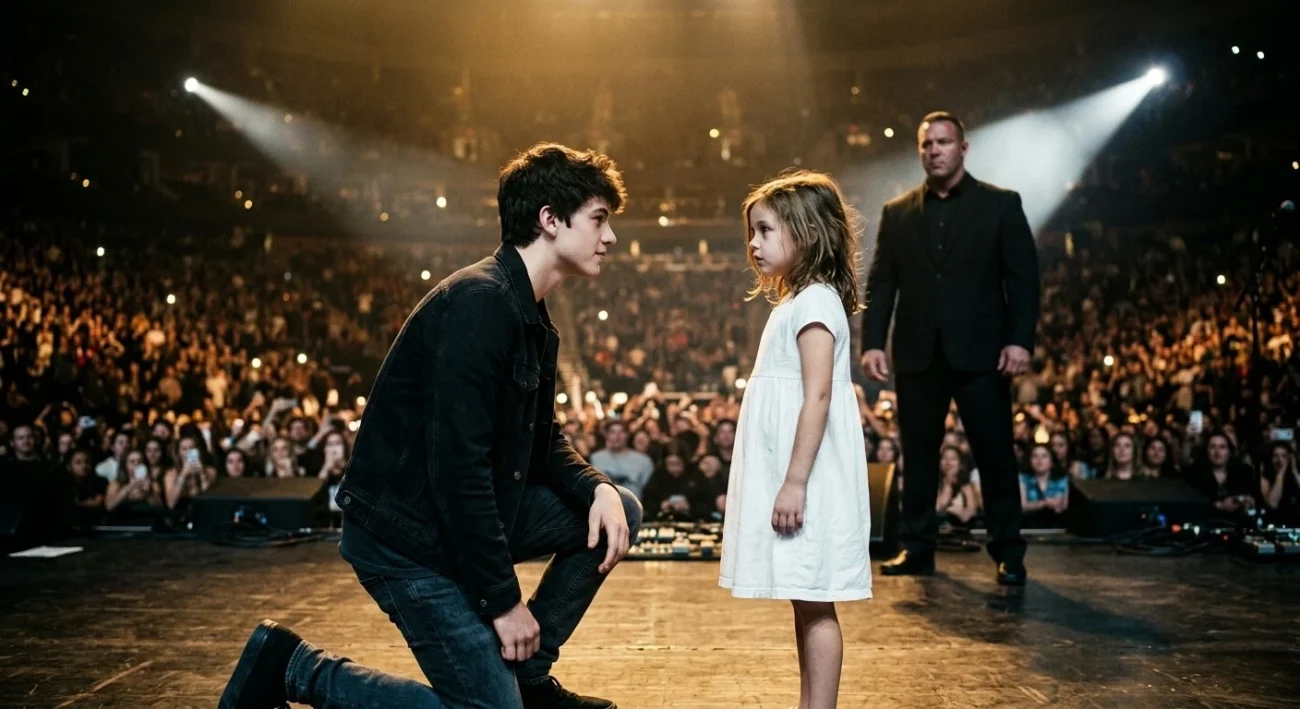
The ballroom had never been this quiet.
Three thousand people. Black ties. Diamond earrings. Crystal glasses mid-air.
And a man standing on a stage, holding his daughter’s hand like it was the only thing keeping him upright.
Marcus Hale — worth eleven billion dollars, founder of three companies, owner of every room he’d ever walked into — was shaking.
“My daughter cannot speak.”
The microphone carried his voice to every corner of the room, but it cracked before it reached the back wall.
Emma stood beside him in a blue dress and a tiara, eyes down, fingers curled tight around his. She was seven years old and she hadn’t said a word in fourteen months. Not since her mother’s funeral. Not since the car accident. Not since the world rearranged itself into something she couldn’t explain out loud.
Three doctors. Six specialists. Twelve therapists.
Nothing.
“If anyone in this room can make her speak—” Marcus paused. Swallowed. “I will give one billion dollars.”
A gasp moved through the crowd like a wave.
Phones went up. Cameras tilted. Security tensed along the walls.
And then nobody moved.
Because what do you say to that? What do you do? You straighten your tie. You lean toward your spouse and whisper. You feel sorry and helpless and a little grateful it’s not your child.
That was what three thousand people did.
Except one.
At the very back of the room, near the service entrance, a teenage boy in a green hoodie and worn-out jeans had stopped walking.
He wasn’t a guest. He’d been carrying a tray of empty glasses toward the kitchen when the announcement hit him somewhere in the chest and wouldn’t let go.
His name was Daniel. He was seventeen. He worked weekends at catering gigs to help his mom pay rent.
He set the tray down on a side table.
And he started walking forward.
The crowd parted — not because he demanded it, but because something in the way he moved made people step aside without knowing why.
Security clocked him from twenty feet out.
Two guards moved.
“Sir—”
“I need to get to the stage.”
“This is a private event—”
“I know.” He didn’t stop. “I need thirty seconds.”
The head of security, a big man named Crane, stepped directly in front of him.
“Son. Turn around.”
Daniel looked at him. No anger. No fear. Just steady.
“She’s not broken,” he said quietly. “She’s waiting. And she’s been waiting for someone to notice the difference.”
Crane blinked.
Daniel walked around him.
Nobody stopped him after that.
He stepped onto the stage.
Marcus turned instantly — protective, furious, confused all at once.
“Who are you? Get off this stage.”
“My name’s Daniel.”
“I don’t care what your name is. Security—”
“She can speak,” Daniel said simply. “She just doesn’t have a reason to yet.”
Marcus’s jaw tightened. His hand pulled Emma slightly behind him.
“Get out of here. This is not a children’s game.”
His voice boomed. It was the voice he used in boardrooms. The one that ended arguments.
Daniel didn’t even blink.
He crouched down.
Right there on the stage, in front of three thousand people and every phone camera in the room, he knelt on one knee until he was at Emma’s eye level.
“Hey,” he said.
Emma’s eyes moved slowly toward him.
“I’m not going to ask you to talk,” he said. “I just want to show you something.”
He reached into the pocket of his hoodie and pulled out a small, folded piece of paper.
It was a drawing. Pencil. Rough edges. A girl in a blue dress sitting under a tree, a small dog beside her, and a single word written in the corner in a child’s handwriting: safe.
He held it out to her.
“My sister drew this,” he said, “after she stopped talking. She was eight. She didn’t talk for almost two years.”
Emma looked at the drawing. Then at him. Then at the drawing again.
“She started again,” Daniel said. “Slowly. But she did.”
Marcus’s voice dropped from fury to something rawer. “What happened to her?”
Daniel looked up at him. “She lost someone. And the world felt too loud to talk in.”
The ballroom had gone completely still.
No clattering glasses. No whispered conversations. No shuffling feet.
Just three people on a stage, lit from above, and the weight of fourteen months pressing on all of them.
Emma’s fingers uncurled from her father’s hand.
Slowly.
One by one.
She reached out and touched the edge of the drawing.
Daniel didn’t move. Didn’t rush. Didn’t say anything.
She pulled the paper gently toward her and looked at it for a long time.
Then she looked up at him again.
Her lips moved.
Just once.
No sound.
But her mouth shaped a word clearly.
Dog.
Daniel nodded. “Yeah. His name was Biscuit.”
Emma’s eyes went wide.
And then — quiet as a breath, rough as something waking up after a very long sleep — she said:
“Did he—” She stopped. Her face crumpled slightly, like the effort of it was enormous. “Did he know her? Like — really know her?”
Three words became eight.
Nobody in the ballroom breathed.
Marcus Hale made a sound that no microphone could have prepared for — halfway between a sob and a laugh, both of them desperate.
He dropped to his knees on the stage.
“Emma—”
She turned to him and, for the first time in fourteen months, said his name.
“Daddy.”
Not a lot. Not a speech. Not a miracle performed on cue.
Just one word.
But it broke every wall in the room.
People cried who hadn’t cried in years. Strangers grabbed each other’s hands. Security guards looked at the ceiling and tried to hold it together.
Marcus pulled his daughter into his arms and held her like he was afraid she’d disappear.
Daniel stood up quietly. He took a step back.
He was already heading toward the edge of the stage when Marcus’s voice stopped him.
“Wait.”
Daniel turned.
Marcus was still holding Emma, but his eyes were locked on the boy.
“You said a billion dollars.”
Daniel shook his head. “I don’t want your money.”
“A job then. An education. Whatever you need—”
“I’m good.” He said it without arrogance. Without performance. Like he meant it simply.
Marcus stared at him for a moment.
“Why?” he asked. “Why’d you even come up here?”
Daniel looked at Emma, who was watching him now with something new in her face — not the blank distance of before, but genuine, awake attention.
“Because someone did it for my sister,” he said. “And she’s the reason I’m still standing.”
He folded his hands into his hoodie pocket.
“She’s the one who drew the picture.”
He nodded once at Emma, then walked off the stage.
The crowd moved to let him through.
Some people tried to stop him — to thank him, to ask his name again, to hand him business cards. He kept walking.
He picked up his tray from the side table.
He carried it to the kitchen.
He clocked out at 11:47 PM.
Six days later, Marcus Hale’s legal team tracked down a catering company in South Queens and found the name on the weekend payroll list.
The call came on a Tuesday afternoon while Daniel was at school.
His mother took it.
She sat down slowly at the kitchen table and didn’t get up for a while.
When Daniel got home, she slid a piece of paper across the table.
He looked at it.
Then looked at her.
“Mom—”
“It’s a full scholarship,” she said. Her voice was steady, but her eyes weren’t. “Four years. Any university in the country. Plus a trust for grad school.” She paused. “He said you’d say no.”
Daniel looked back at the paper.
“He said to tell you it’s not a reward. It’s a gift. From Emma.” She pressed her lips together. “She picked out the school herself.”
He was quiet for a long time.
Then he folded the letter carefully along the crease.
“Which school?” he asked.
His mother almost smiled. “The one with the best veterinary program in the country.”
Daniel looked at the paper again.
In the corner, in a child’s pencil handwriting, were two words:
For Biscuit.
He didn’t say anything else.
He went to his room and sat on the edge of his bed and thought about his sister, who was twenty-two now and studying biology, and who had spent weeks learning to talk again with the help of a woman who never once told her she was broken.
He thought about the drawing she’d made at eight years old.
He thought about a girl in a blue dress who had held fourteen months of silence in her chest like something heavy and sharp.
He thought about how sometimes one small thing — a piece of paper, a word, a person who kneels down instead of towers over — is the difference between closed and open.
Then he unfolded the letter.
And he called the number at the bottom.
Original fictional stories. AI-assisted creative content.
