
The fourth placement had ended before winter.
By then, Tessa Quinn already knew how to make herself smaller than any room she walked into. She was eleven years old, and she carried her whole life in one duffel bag and one faded stuffed rabbit with a crooked ear. The rabbit had belonged to her mother. That was the only reason it still existed.
Her caseworker, Marlene Voss, hated bringing children to new doors.
She hated the polite smiles that vanished too fast. She hated the paperwork that made pain look tidy. Most of all, she hated how often older foster children were summed up in careful professional phrases that all meant the same cruel thing: hard to place, hard to keep, easy to give back.
The Whitaker file looked clean on paper.
Ron and Sheila Whitaker. Small town outside Dayton. Foster experience. Stable residence. No criminal history. Approved.
On paper, too many things did.
The house at the end of Mill Street had peeling porch paint and a yard that looked like it had given up. Ron Whitaker opened the door before Marlene reached the second step. He was thick through the shoulders, with eyes that already looked annoyed.
“This her?” he asked.
“This is Tessa,” Marlene said, forcing brightness into her voice.
Ron looked the child over slowly, as if measuring a burden and not a person.
“She looks small.”
“She’s eleven,” Marlene said.
Sheila appeared behind him. Narrow face, pale hair pulled too tight, a smile that showed teeth but no warmth.
“Come in, sweetheart. We’ll get you settled.”
The room they gave her was a bare space in the back of the house. Thin mattress. Bare bulb. No curtains. No blanket folded at the foot of the bed. No sign anyone had prepared for a child at all.
Tessa set her rabbit carefully on the mattress and sat beside it.
From the hallway she heard Ron’s voice, flat and private.
“How much are we getting for her?”
Sheila’s answer came just as easily.
“Enough. If she learns to be useful.”
Tessa stared at the floor and wrapped her arms around her knees. She did not cry. She had stopped trusting tears to change anything a long time ago.
The rules of the house were never spoken, but they arrived fast.
Wake before sunrise. Sweep, mop, scrub, haul. Sheila inspected every task with cold precision. A missed corner meant starting over. A folded towel done wrong meant the whole stack came down. Breakfast was for the family. Tessa stood nearby unless told otherwise.
One morning she reached for a leftover half slice of toast sitting on a plate.
Sheila slapped the air just above her hand.
“You eat when I say you can.”
“I’m hungry,” Tessa said.
“Then work faster.”
Their son laughed from the table. Their daughter didn’t even look up.
That evening Tessa found the end of a sandwich near the trash. She brought it to her room and ate in the dark with her back against the wall.
“It won’t be forever,” she whispered to the rabbit.
But as the weeks passed, she understood something that settled in her chest like cold weight.
This was not a rough adjustment.
This was the plan.
Sheila ruled through control. Food was the currency. Warmth was a reward. Every basic need was attached to some standard Tessa had always somehow failed to meet.
Ron preferred a different approach.
He handed her chores no child should have been doing alone — dragging scrap wood, scrubbing the garage floor while wind pushed through the cracks, hauling boxes too heavy for her frame. He watched with arms crossed, as if waiting for her to collapse so he could say he’d always known she would.
His favorite phrase never changed.
“Nobody owes you anything.”
One afternoon a bundle of wood slipped from her arms and clattered across the cement. Ron stepped closer and lowered his voice.
“You know what your problem is?”
She bent to pick it up, hands shaking.
“You still think somebody out there is coming for you.”
She said nothing.
“That’s the kind of thinking that gets people disappointed.”
He walked back inside and left her kneeling on the cold garage floor.
She did not tell anyone. There was no one to tell. She just kept going.
School was not easy, but it was different.
At Fair Hollow Middle School, Tessa was still noticed for the wrong reasons. Her clothes were old. Her silence made people curious. But school gave her something the house never did.
Breathing room.
The safest place in the building was Room 214. The art room.
Mrs. Laurel Bennett had been teaching for more than twenty years and had the quiet instincts of a person who noticed suffering long before it introduced itself. She had seen quiet children before. The ones who disappeared by being too easy. Too still. Too grateful.
Tessa’s drawings told her everything she needed to know.
Open roads under storm clouds. Birds breaking out of cages. A small girl standing in front of a line of motorcycles lit by headlights. And tucked into nearly every corner, always — a rabbit.
One afternoon Mrs. Bennett paused at her desk.
“May I look?”
Tessa hesitated, then handed over the sketchbook.
Mrs. Bennett turned each page carefully.
“These are beautiful,” she said.
Tessa waited for the rest — the correction, the doubt, the polite redirect.
It never came.
“This one especially.” Mrs. Bennett touched a drawing of a girl riding toward a sunset she had clearly never seen but still believed in. “You have real talent.”
Tessa looked up, unsure what to do with plain sincerity.
Then Mrs. Bennett asked, quietly, “Are things all right at home?”
Tessa’s expression closed in one second flat.
“Yes.”
Mrs. Bennett didn’t push. She nodded once.
“All right. But this room is open to you anytime. Before class, after class, lunch. You don’t have to explain.”
Tessa thought about that offer for days after.
Soon she began lingering in Room 214 whenever she could. Mrs. Bennett left extra pencils where she would find them. A granola bar appeared in the third drawer of the supply cabinet. Crackers. Half a peanut butter sandwich wrapped in foil.
Nothing was said about it.
It did not need to be.
Two houses down from the Whitakers, June Mercer watched the street the way only a seventy-one-year-old widow who had seen enough nonsense truly could.
At first she noticed the foster girl because the child was always cold.
Then she noticed how often Tessa was working outside while the rest of the family stayed in.
Then she noticed how the child flinched at Ron’s voice from all the way across the yard.
June called the hotline once after seeing Tessa hauling garbage in a thin sweater before sunrise.
A worker came. The family smiled. Tessa wore a cleaner shirt. Everyone performed normal life for twenty careful minutes.
Nothing changed.
So June began writing things down. A small spiral notebook. Dates. Times. Weather. What the child was carrying. How long she was left outside. What excuses the adults used when she watched from across the street.
She wrote it all with a hand made steadier by anger.
In December, after Sheila caught Tessa with a dinner roll she’d brought home from the school cafeteria, the girl was pushed into the back utility shed and the door was locked.
The temperature dropped hard that night.
June stood at her kitchen window and watched the moon cross the yard. She wanted to march over there and pull the door open herself. But she knew that reckless courage can leave a child worse off if it fails at the wrong moment.
At dawn, after Tessa stumbled out pale and barely steady, June picked up the phone.
She called her nephew.
Gabriel Soto answered at six in the morning. He was forty-six, a mechanic, former Marine, and a senior member of a motorcycle club with members across several states. He had lived enough of life to know the difference between neighborhood gossip and the sound of someone finally saying this has gone too far.
June told him everything. The chores. The hunger. The cold. The locked shed. The way every official door had opened just long enough to close again.
When she finished, Gabriel asked only two questions.
“What’s the address?”
“What’s the girl’s name?”
“Tessa Quinn,” June said.
He repeated it once.
“Don’t confront them,” he told her. “Keep watching. Keep writing.”
“I’ve been doing that for months.”
“Good. Now someone else is watching too.”
Gabriel brought the notebook to a man everyone called Bishop — president of a regional riding chapter, the kind of person whose calm could quiet a room faster than any raised voice. They met in a roadside diner off the interstate. Bishop read every page without speaking.
When he finished, his jaw was set so hard it looked like it hurt.
“How old is she?”
“Eleven.”
“And the system saw this?”
“More than once.”
Bishop closed the notebook.
“Then we do this the right way. Fast, legal, and final.”
The word spread through rider networks across Ohio, Indiana, Kentucky, and West Virginia. Men and women who had known hard childhoods and harder homes heard one simple message: a little girl in Fair Hollow had been overlooked for too long.
No one needed it said twice.
At the same time, Gabriel and Bishop went to Sheriff Nolan Price, who had received complaints before but never had enough documented evidence to move. June’s notebook changed that. What she had written — every date, every detail, every morning in the cold — was the thing the system had been missing.
They waited for the moment that couldn’t be ignored.
It came sooner than anyone wanted.
January arrived with bitter air and bright, heartless sky.
That morning, Ron accused Tessa of taking money from his wallet.
She denied it once, clearly, and looked him straight in the face.
He didn’t want the truth. He wanted a reason.
By noon he had pushed her out to the front porch in socks and a thin shirt with no coat. The wind came straight off the open fields and cut through the porch rails like it had something to prove.
“You stay out here until you learn,” he said.
“Please,” Tessa whispered. “I didn’t do anything.”
The door shut.
The lock turned.
Across the street, June was already at her window. She saw the child curl against the step, pulling her knees to her chest. She picked up the phone before she had even finished thinking.
“It’s now,” she told Gabriel. “She’s out there now.”
She heard engines in the background before he had finished answering.
“We’re on the way.”
June called 911. Then she stood at the window with her notebook pressed to her chest and waited.
Tessa’s world narrowed to cold. Her fingers had gone numb. Her mother’s face drifted through her thoughts. Mrs. Bennett’s unlocked drawer. The rabbit on her mattress. The drawings of headlights she’d made so many times without ever fully understanding why.
Then she heard it.
Distant at first. A low vibration that she felt in the step beneath her before she heard it in the air. Then a growl. Then a rolling wall of engines that made the porch boards hum.
At the end of Mill Street, headlights appeared.
One.
Then five.
Then dozens.
Then what felt like an entire horizon, moving.
Motorcycles filled the street from curb to curb. Neighbors came out onto porches. Curtains shifted. Dogs barked. The sound rolled through the entire town, and every quiet lie the Whitakers had hidden behind was suddenly exposed to open daylight.
The lead rider stopped in front of the house. One by one, engines cut until a deep, impossible silence settled over the block.
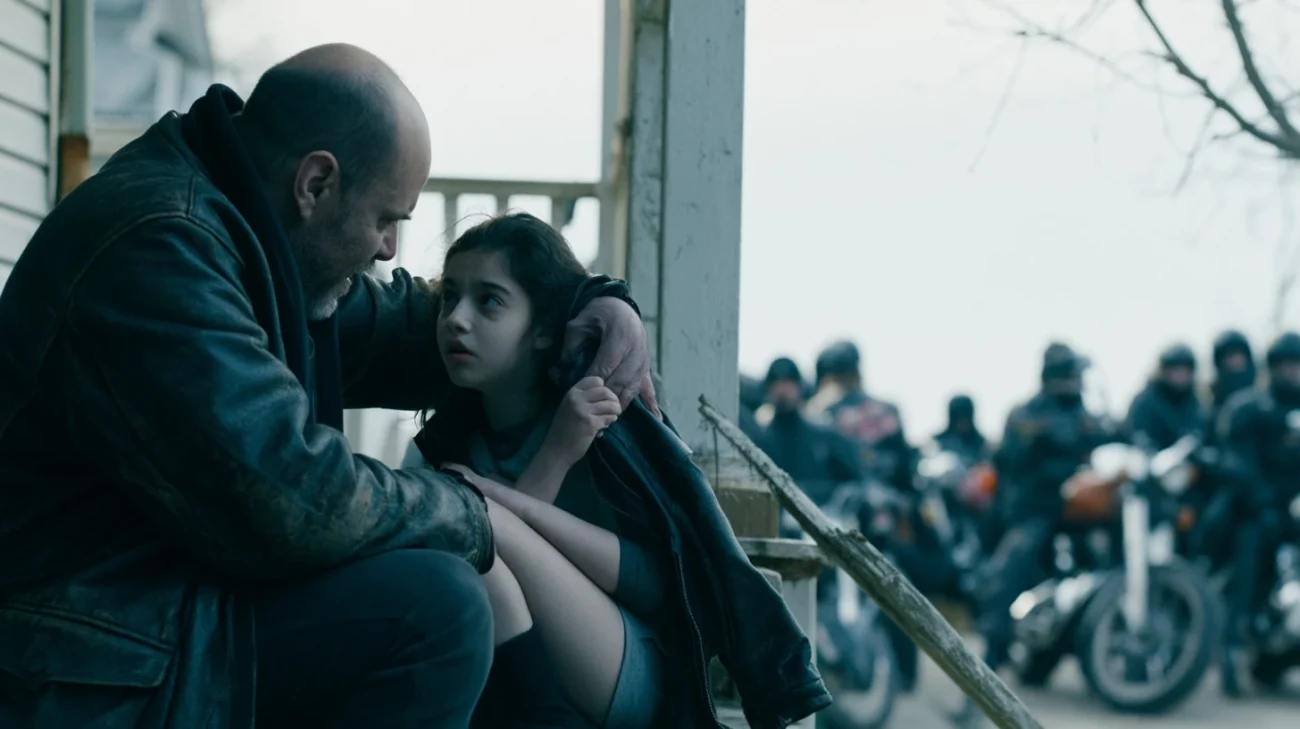
Bishop climbed off his bike and walked toward the porch with slow, unmistakable purpose. He crouched at the bottom step so he was level with Tessa.
“You Tessa?”
She nodded, barely.
He took off his leather jacket — still warm from his body — and laid it around her shoulders.
“I’m Bishop,” he said. “You’re not alone anymore.”
The front door flew open.
Ron came out fast with anger arriving well ahead of any judgment.
“What the hell is this?”
Bishop stood and turned. He did not raise his voice. He didn’t need to.
“This is where it stops.”
Sheila appeared behind Ron with her phone already in hand and fear beginning to show through the cracks in her performance.
“We’re calling the police,” she said.
“Good,” Bishop said. “So are we.”
A female rider named Raina stepped forward with a thermal blanket and wrapped Tessa with such careful gentleness that the child nearly broke from it alone.
“Stay with me, sweetheart,” Raina murmured. “You’re safe now.”
Ron drew himself up and pointed at Tessa.
“She lies. She steals. She causes trouble wherever she goes.”
From across the street, June Mercer made her way over slowly with her cane in one hand and her notebook in the other. She stopped at the edge of the porch steps and held the notebook up like evidence in a courtroom.
“No,” she said. “I’ve been writing it all down for months.”
Her voice didn’t shake.
“Every morning she was outside before daylight. Every time she was sent out without a coat. Every day she worked while you sat inside. Every time I saw that child looking like she had been forgotten by the very people being paid to care for her.”
Ron turned toward her.
Something in the gathered stillness of the riders behind him made him stop.
Sheriff Nolan Price arrived two minutes later, followed closely by an ambulance. He took in the scene in one sweep — the child on the porch, the riders standing firm, June with her notebook, the adults at the door rearranging their faces into innocence — and walked straight to Tessa.
“You’re safe now,” he said quietly. “I need you to hear me. You are safe.”
That was when the words finally came out of her.
Not all at once. But enough.
“I didn’t take anything,” she whispered. “And my mom loved me. She didn’t leave me on purpose.”
The whole street seemed to hold its breath.
Raina pressed her hand gently against Tessa’s back.
“I know,” she said.
Ron and Sheila Whitaker were placed under investigation before the ambulance left the block. Child protective services opened a formal case that afternoon. The Whitakers lost their foster certification within the week. Criminal charges followed shortly after, covering child endangerment and the incident with the locked shed. The state district supervisor, Dana Reeves, took over Tessa’s case personally and told her something no official had ever said to her face before.
“We failed you,” Dana said. “And we are not going to fail you again.”
That sentence did not fix everything.
But it mattered more than Tessa could explain.
At the hospital, doctors documented what Tessa’s body had been saying for months.
Underfed. Dehydrated. Exhausted. Older injuries that had been left untreated. Her hands and feet were painfully cold. Her nervous system reacted to every opening door as if danger might walk through it.
This time, no one looked away.
Mrs. Bennett came with a fresh sketchbook and sat beside her bed without demanding anything. June came with tears she didn’t bother hiding. Sheriff Price checked in personally.
A few weeks later, Tessa met Aaron and Celia Brooks — a quiet couple outside Springfield with a small white farmhouse and a back porch that caught the evening light.
Celia brought watercolor paints on the first visit. Aaron stayed back and gave Tessa room.
“What if it doesn’t work?” Tessa asked.
Celia met her eyes without flinching.
“Then we keep working. We don’t give up on people here.”
Tessa didn’t believe her right away.
But she watched.
The pantry stayed open. No one counted slices of bread. Aaron never raised his voice. Celia noticed lavender appearing in Tessa’s paintings and one day a lavender sweater appeared folded neatly on the bed without explanation or announcement.
Trust came slowly.
But it came.
And so did healing. Not in a straight line. Not in a single dramatic moment. In small things that accumulated until they added up to something that felt, carefully and then less carefully, like safety.
A child sleeping through one whole night.
A hand reaching for food without checking first whether anyone was watching.
A laugh escaping at school, unguarded, real.
A drawing with more light than storm.
The riders kept visiting. June stayed in her life. Mrs. Bennett kept making room. Aaron and Celia kept showing up, day after day, proving that love means very little unless it remains.
Years later, Tessa would understand exactly what had saved her.
Not one hero.
A chain.
A teacher who noticed.
A neighbor who wrote it down.
A sheriff who listened.
A woman in the system who admitted the system had been wrong.
A family who meant what they said.
And yes, a street full of riders who arrived like thunder when silence had lasted too long.
Tessa Quinn was once made to feel invisible.
She did not stay that way.
She grew up. She painted. She helped other children find language for what they had survived. She became the kind of person who answered the phone when another frightened child whispered from somewhere dark and uncertain — because someone had once answered for her.
The people who tried to define her by fear did not get the final word.
The people who showed up did.
Those are the ones who always should.
Original fictional stories. AI-assisted creative content.
