
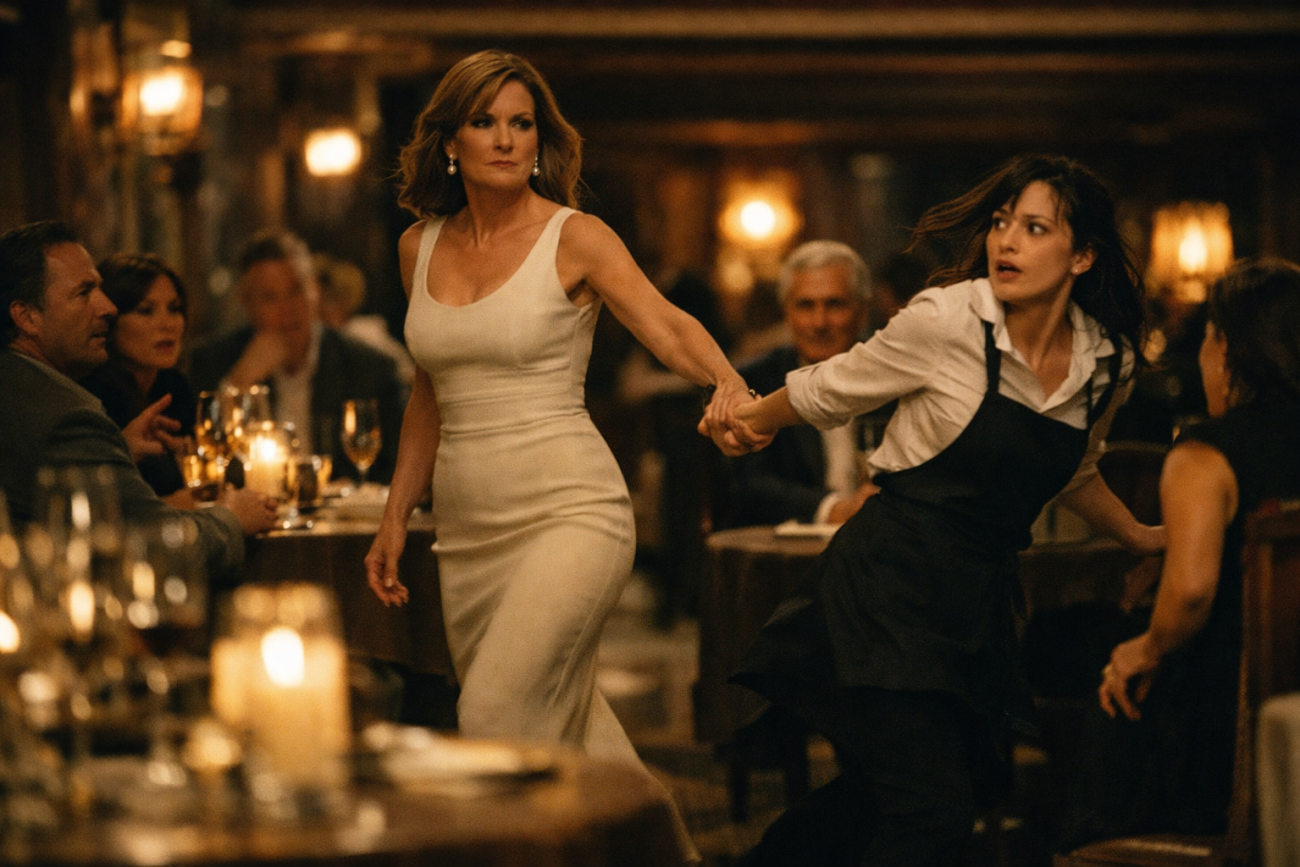
No one was prepared for what happened that Tuesday night at Meridian.
It was the kind of restaurant where the lighting was calibrated to make people look rich and the silence cost extra. Crystal caught the chandelier glow. Waiters moved like they’d been trained not to breathe too loud. And somewhere near the grand piano, a violinist was halfway through something soft and forgettable.
Then the slap came.
Sharp. Ugly. Loud enough to kill the music dead.
The tray hit the marble floor before anyone finished flinching. Champagne flutes shattered. A woman near the window screamed. And the entire room froze, mid-bite, mid-sentence, mid-sip.
“Stay away from my husband!”
The voice belonged to Vanessa Hale.
She was standing beside a candlelit table in a fitted ivory dress, one hand still raised, chest heaving, fury radiating off her like heat off pavement. Beautiful in that expensive, controlled way that made other people feel underdressed and nervous at the same time.
The girl she’d struck swayed.
She couldn’t have been more than twenty-two. Slim, pale, dark hair pulled back too fast. Her cheek had already gone red. Her lip was trembling, but she was trying not to fall apart in front of two hundred strangers who were all watching and doing nothing.
Vanessa grabbed her by the arm.
“Tell them,” she snapped. “Tell them why you keep following him.”
Every eye in the room shifted to the husband.
Richard Hale looked stunned.
Not guilty. Not defensive. Stunned. He was a broad man in his late forties, silver just beginning at his temples, the kind of face that had probably been warmer before years of money and pressure sanded the softness out of it. He sat completely still, one hand near his untouched wine, staring at the girl like he’d walked into a story everyone else already knew.
“What is she talking about?” he asked.
What came out of the girl first was a sob.
The room tightened around it. Phones lifted. No one intervened. They never do when wealth is involved. They just watch and wait for someone else to decide what decency costs.
“I’m sorry,” the waitress whispered. “I’m so sorry. I just needed—”
Vanessa yanked harder.
“You needed what? His attention? His money?”
A few guests shifted in their seats.
Still no one moved.
Then the girl did something no one expected.
With shaking fingers, she reached into her apron pocket and pulled out a photograph.
Small. Faded. Bent at one corner from being held too many times. The kind of photo that lives in drawers and wallets and the bottom of boxes no one opens until someone dies.
She held it out.
Richard took it almost on reflex. At first he looked irritated. Then confused. Then something happened to his face that changed the entire temperature of the room.
The color drained out of him.
Fast. Completely. Like someone had pulled a plug.
He stared at the photo without blinking. In it was a baby wrapped in a pale knitted blanket. Tiny. Eyes closed. Mouth half-open in the middle of a cry. The woman holding the infant had part of her face torn away by time, but what remained showed someone young. Beautiful. And terrified.
Richard’s hand began to shake.
Not subtly. Violently.
Across the room, the pianist had stopped playing.
The last note hung for a moment and then died under the weight of silence. He was an elderly man, white-haired, his face carved by decades of watching people from behind music. He’d gone completely still, staring at the photo in Richard’s hand with an expression that did not belong in a luxury restaurant.
It belonged in a graveyard.
Then he spoke.
Softly. But everyone heard it.
“That blanket,” he said, his voice barely steady. “I wrapped his missing daughter in that blanket the night she disappeared.”
For one full second, nobody in the room breathed.
Vanessa’s grip dropped from the girl’s arm.
Richard stood so fast his chair scraped backward across the floor. He turned toward the pianist like a man trying to outrun his own heartbeat.
“What did you say?”
The old man looked sick.
Not confused. Sick.
He rose slowly from the bench, one hand on the polished edge for support. His fingers were unsteady, but his eyes were clear. Whatever he had just recognized had come from somewhere deep and undamaged in his memory.
“Pale wool,” he said. “Hand-knit. Tiny flaw in the lower corner where one stitch pulled loose. I remember because a nurse argued with me for wrapping the child too tightly. I told her babies sleep better when they feel held.”
Richard looked down at the photo.
Then at the waitress.
Then back at the pianist.
His voice dropped lower. Rougher.
“My daughter died nineteen years ago.”
The waitress shook her head.
Tears spilling freely now.
“No,” she whispered. “That’s what they told you.”
Vanessa found her voice before anyone else found theirs.
“This is insane.” She stepped forward, sharp and controlled. “Richard, sit down. This girl is a liar. Someone put her up to this.”
But no one was looking at Vanessa anymore.
The center of the room had shifted.
The waitress lifted her eyes to Richard with a grief that didn’t look rehearsed. Couldn’t have been.
“My mother died three weeks ago,” she said. “And right before she died, she told me I had to find my real father.”
The sentence landed like broken glass.
Richard said nothing.
You could see the fight happening inside him. Denial. Rage. Terror. Hope. All of it moving at once, each one too dangerous to touch.
Vanessa stepped closer.
“Enough.”
Her voice had changed. Less theatrical. More frightened.
“Richard, listen to me. Some girl shows up with an old photo and a story, and you’re going to—”
“Be quiet,” he said.
It was the first time he’d raised his voice.
Vanessa stopped cold.
The waitress swallowed, then pulled something else from her pocket. Not a photograph this time. A folded piece of paper. Worn soft at the edges, the kind that had been handled in the dark too many times to count.
“My mother kept this with the photo,” she said quietly. “She told me never to open it unless she was gone. I opened it the night she died.”
Richard took it slowly this time.
When he unfolded it, I could see from where I sat that it was old. Not just aged — carried. The color of something that had survived years in complete darkness. He scanned the first lines and whatever control he had left simply dissolved.
His mouth opened.
Then closed again.
The pianist crossed himself under his breath.
Vanessa moved toward the paper. Richard pulled it away from her.
“What is it?” someone whispered from a nearby table.
He didn’t answer them.
He answered no one.
He just stared at the note like it had reached across twenty years to put its hands around his throat.
Then he read the last line aloud.
“If anything happens to me, tell Richard Hale his daughter was never buried.”
The room didn’t erupt.
That would have been easier.
Instead it sank into a silence so complete it felt almost holy.
Because in that moment, every person in that restaurant understood the same thing.
This was no scene.
This was a resurrection.
And Vanessa Hale looked like she’d just watched something return that she had spent twenty years making sure stayed dead.
Richard didn’t leave with Vanessa.
That was the first crack.
She pleaded. Insisted they deal with it privately. Said the girl was playing him, that grief made men stupid, that a handwritten note proved nothing.
He ignored every word.
Instead he turned to the waitress and asked one question.
“What is your name?”
She looked like she was afraid the truth itself might break if she said it too quickly.
“Elena,” she whispered. “Elena Ward. At least, that’s the name I grew up with.”
Richard nodded once.
Not because he believed her. Because he needed to hear her called something.
The pianist then did something no one anticipated. He asked Richard if he remembered St. Catherine’s Maternity Home.
Richard turned toward him slowly.
No one around us understood the name. But Richard did. I could see it in the way his shoulders drew together, the way his jaw tightened.
St. Catherine’s had closed nearly twenty years ago after a financial scandal. Before that, it had been a private maternity and recovery home used by wealthy families who preferred certain births and tragedies to remain discreet. Richard and his first wife, Lillian, had gone there when their daughter arrived premature.
The official story had always been simple. The baby fell critically ill. Complications. Panic. Signatures. And finally a tiny sealed coffin no grieving parent was ever asked to open.
Lillian never recovered. Not physically. Not mentally. She died less than two years later after a spiral of medications, depression, and what the family called a broken heart.
Richard had buried the child.
Then buried his marriage.
Then buried the version of himself who still believed life followed rules.
The pianist had worked at St. Catherine’s back then.
Not as a musician. As an orderly.
“The memory has haunted me for years,” he said. “Though I never understood the full story until tonight.”
He described what he’d witnessed. A woman crying in one room. A baby moved in secret through a service corridor. An argument between a nurse and a doctor that stopped the moment a supervisor appeared.
“And a woman,” he said. “Beautiful. Wearing pearls. Standing in the shadows at the end of the hall, telling them to sign the paperwork immediately.”
Richard turned to Vanessa when he heard that.
Not because he fully believed it yet.
Because something in him had already started connecting pieces faster than his mind was willing to follow.
Vanessa had known him then. Long before she became his wife. She had been Lillian’s closest friend. The loyal one. The grieving one. The woman who stayed near him after the funeral, who became indispensable while everything else collapsed.
“You were at St. Catherine’s that night,” he said.
Vanessa’s expression shifted for a fraction of a second.
Then smoothed.
“That was twenty years ago. You cannot be serious.”
But Elena was staring now.
Not with recognition. With dread.
“My mother wrote another name in that note,” she said quietly. “Not yours. A woman’s name. She said if anyone tried to stop me, I should remember the name Vanessa.”
The restaurant felt suddenly too small for what was happening inside it.
Vanessa laughed.
And the laugh was wrong. Too fast. Too brittle. The sound of something that used to work and no longer did.
“This is absurd.”
But Richard was no longer looking at her like a husband.
He was looking at her like a witness.
They went to St. Catherine’s that same night.
Not all of them. Only Richard, Elena, the pianist, and me — because by then I had become part of the strange gravity of the moment. Not family. Not law enforcement. Just someone who had seen the beginning and could not walk away from the ending.
Vanessa followed in a separate car.
Of course she did.
People like her never let the truth travel without an escort.
The building stood at the edge of the old quarter, hidden behind overgrown hedges and rusted gates that had once promised discretion to wealthy families and now only promised rot. One security lamp over a side entrance. Rain had started by then, thin and cold.
The pianist had a contact. An elderly groundskeeper who still checked the property twice a week for the bank that owned the ruins. Money keeps old buildings alive longer than memory does.
The man recognized the pianist and let us in without questions.
The corridors smelled of mildew and something faintly medicinal, buried so deep in the walls it had become part of the plaster. Elena wrapped her arms around herself as we passed shuttered rooms and rusted brackets where machines had once hung.
Richard said almost nothing.
He looked like a man walking through his own autopsy.
The basement archive sat behind a metal door swollen by years of damp. It took the groundskeeper and Richard together to force it open. Inside were shelves, filing cabinets, stacked boxes, and decades of paper left to yellow in the dark.
Vanessa arrived just as they pulled the first ledger.
She came down the stairs too quickly for someone who claimed this was all nonsense. Hair damp from the rain. Face pale under expensive makeup. For the first time that night, she looked her age.
“Richard,” she said. “Please stop this. You are humiliating yourself.”
He didn’t answer.
He was already flipping pages.
Birth records. Transfer logs. Medication authorizations. Temporary guardianship forms.
The pianist searched a second cabinet. Elena opened a box marked neonatal intake. I found a tray of old envelopes tied with brittle string.
And then Richard stopped turning pages.
His name.
Lillian’s name.
A female infant listed under Baby Hale.
Admission. Complications. Stabilized.
Then one line added in different ink.
Transfer authorized.
Richard’s voice had gone flat.
“Transfer where?”
The line below had been scratched out. Not neatly. Deliberately. Like someone had pressed a pen through it twice.
Vanessa stepped forward.
“That proves nothing.”
Richard looked up.
“There’s a signature.”
There was.
Not his. Not Lillian’s.
Vanessa’s.
The room changed. Completely.
Elena’s hand flew to her mouth. The pianist swore under his breath. Vanessa did not attempt shock. Only anger. Cold and immediate, the kind that makes everything clearer than denial ever could.
“She asked me to sign,” Vanessa snapped. “Lillian was sedated. Out of her mind. The doctors said the child needed emergency placement. I did what I was told.”
“Placement,” Richard repeated, voice dead quiet. “You told me she died.”
Vanessa’s eyes flashed.
“Because that was easier.”
No one moved. No one blinked.
She seemed to realize, too late, that she had said it out loud.
She drew a breath to recover, but the damage was already done.
Richard walked toward her slowly.
“Easier for who?”
Her face hardened into something terrible.
“For everyone,” she said. “Your wife was unstable. The baby was sickly. You were drowning back then, whether you admit it or not. That child would have destroyed what was left of your life.”
Elena made a sound.
Broken. Disbelieving.
Vanessa turned toward her with contempt so complete it looked almost like pride.
“You should be grateful. You were raised by someone who actually wanted you.”
Elena was shaking now, years of confusion given a face at last.
“My mother loved me,” she whispered.
Vanessa smiled. Without warmth.
“Your mother was paid.”
The sentence hit harder than the slap that had started everything.
Paid.
Not rescued.
Not chosen through kindness.
Bought into silence.
Richard lunged toward Vanessa, but the pianist caught his arm before he reached her.
Not out of pity for her.
Because prison would have been too small a reward for what she had done. And he knew it.
That was when the final envelope was opened.
Inside were sealed transfer documents, a payment voucher, and one last piece of proof Vanessa could not talk her way around.
A receipt.
Issued to Marianne Ward.
For private infant care.
Signed the same week Richard Hale’s daughter was declared dead.
Police came quietly.
There was no dramatic chase. Vanessa didn’t run. She stood in the archive while the officers read her rights, and even then there was something chillingly composed about her. As though being finally exposed was less humiliating than losing control in public.
Richard didn’t speak while they handcuffed her.
Elena didn’t either.
They stood on opposite sides of the room, connected by a history neither of them had asked for and both of them had been robbed of.
The rest came in layers over the following weeks.
Lillian had never signed away her child. Vanessa had used her sedated state and Richard’s panic to route the baby through a private arrangement with Marianne Ward — a nurse’s widowed cousin who had recently lost her own infant and was desperate enough to accept money without asking too many questions.
Why?
The answer was uglier than grief.
Vanessa had been obsessed with Richard long before Lillian died. Friends later admitted she had hovered too closely around the marriage, too closely around the pregnancy, too closely around the tragedy. She had believed the baby trapped him in a life she wanted for herself. When the child was born early and chaos created an opening, she took it.
Not by murder.
By erasure.
Then she stayed close to the grieving widower until she became necessary.
Necessary became trusted.
Trusted became loved.
Loved eventually became married.
It was monstrous. But it was also patient. That was what made it feel almost inhuman.
Marianne had raised Elena with a tenderness no money could fake. But fear had shadowed that love for years. She had known the arrangement was wrong, then criminal, then unforgivable. By the time she wanted to confess, too much time had passed. So she left fragments instead. The photo. The note. The truth delayed until death made silence impossible.
Richard ordered a DNA test anyway.
Not because he doubted.
Because some losses are too large to allow hope without proof.
The result came back twelve days later.
99.99%.
His daughter had not died.
She had worked double shifts and carried plates in a restaurant while he sat in magazine spreads beside the woman who had stolen twenty years from both of them.
The first time Richard and Elena met after the test, there were no cameras.
No public scene. No violin. Just a quiet room in a lawyer’s office, rain against the glass, and two people sitting across from everything that had been taken.
“I don’t expect anything from you,” Elena said before he could speak. “I didn’t come for money. I came because my mother begged me not to let the truth die with her.”
Richard looked at her for a long moment.
Then he knelt.
Not dramatically. Not for effect.
Just a father brought low by the weight of everything he had missed.
When he started to cry, it was with the stunned, broken grief of a man mourning a death that had never happened and a life that had.
Elena knelt too.
Then they held each other.
Not yet as family.
Not quite as strangers.
Something fragile between the two. Something that would break if named too quickly.
Vanessa was charged with fraud, falsification of medical and legal records, unlawful infant transfer, and obstruction. More charges followed as old staff records surfaced and surviving employees began coming forward. Truth has a smell to it. Once one person catches it, others start noticing too.
The restaurant reopened the next evening.
Rich places are built to survive scandal better than people are.
But no one who was there that night ever forgot it. The night an elegant woman slapped a waitress and accidentally brought a dead child back to life.
Elena didn’t return to waiting tables.
Richard offered everything at once — money, a home, apologies large enough to drown in. She refused most of it. Not out of pride. Out of caution. Love that has been stolen and returned doesn’t become simple overnight.
So they started small.
Breakfast once a week. Then stories. Then photographs. Then the slow, painful work of laying two decades side by side and admitting what had been taken.
Richard said later that the first moment he truly believed — not suspected, not hoped, but believed — was not the DNA result.
It was the blanket in the photograph.
Because grief forgets many things.
But it never forgets what it wrapped around the child it loved.
And somewhere, that is what still haunts Vanessa most.
Not the prison. Not the exposure. Not the collapse of the life she built on a stolen cradle.
It is the fact that after all her planning, all her patience, all her years keeping a daughter buried in paperwork and lies, she was undone by the one thing she had dismissed as worthless.
A crying girl in an apron, holding a faded photograph.
Original fictional stories. AI-assisted creative content.
