
The restaurant was the kind of place where bad things weren’t supposed to happen.
Soft piano. Golden light. Couples leaning close over candlelit tables, their voices low and controlled. The kind of place where everyone performed being happy.
Mara had worked the dinner shift for three years. She knew every table. Every regular. Every exit.
She did not know tonight would end her old life.
Table twelve ordered the lamb and the sea bass. A birthday celebration — the hostess had whispered it when they walked in. The man wore a charcoal suit that cost more than Mara’s rent. His wife wore a white dress and a smile sharp enough to cut glass.
Mara crossed the floor with the champagne tray balanced on her palm.
She set the first flute down.
Then she looked up.
And the world stopped.
She had studied that face for twenty-three years — in old photographs, in her mother’s shaking hands, in the one story her mother could never finish without crying. She knew the line of his jaw. The slight hook of his nose. The gray at his temples that used to be dark.
Her tray tilted.
“Watch yourself,” the wife snapped, not looking up.
Mara steadied it. Her hands were trembling. She set the second glass down, stepped back, and stood very still for a moment, processing.
This is him.
This is really him.
She turned toward the service corridor.
But her legs weren’t listening.
She came back to the table without meaning to. Just stood there. Just stared.
The wife noticed first.
Her eyes moved up slowly from the menu. Assessed Mara with the efficient cruelty of someone who ranked people automatically.
“Is there a problem?” she said.
“No,” Mara said. “I’m sorry.”
She looked at him.
He hadn’t looked up yet. He was reading the wine list, head tilted slightly, completely unaware that the thing he had buried twenty-three years ago had just walked out of the kitchen and was standing four feet away.
“Daniel,” the wife said.
He looked up.
Their eyes met.
He didn’t recognize her.
Why would he? He had never seen her face. She had only seen his.
Mara turned and walked away before she did something she wasn’t ready to do.
She sat in the walk-in cooler for six minutes. Counted her breaths. Pressed her palms flat against the cold metal shelving until she stopped shaking.
You came here to work, she told herself. You didn’t plan this. This isn’t the moment.
But her mother’s voice answered back, the way it always did: If you ever find him, Mara — don’t run. Don’t run the way I did.
Her mother had run for twenty-three years.
And she had died still running, four months ago, in a one-room apartment that smelled like instant coffee and old photographs.
Mara pressed her eyes shut.
I’m not running.
She went back to the floor.
She served other tables. Smiled at a couple celebrating an anniversary. Refilled water glasses. Said “of course” and “right away” and “enjoy” until the words felt like sounds with no meaning.
At some point she walked past table twelve again, and this time the wife was watching her.
Not suspicious. Not jealous.
Just watchful. The way rich women sometimes watched the help when they thought they recognized something — a posture, a gesture — that felt out of place.
She sees it, Mara thought.
Good.
It happened at 8:47.
Mara was crossing toward the service bar when the wife stood up from table twelve, said something sharp and low to her husband, and then turned.
Walked directly toward Mara.
Mara stopped.
The wife stopped two feet away. Up close her eyes were a pale, steely gray. The kind of eyes that had won a lot of arguments.
“How long?” she said.
“Excuse me?”
“How long have you been sleeping with my husband.”
The sentence landed flat. Not a question. A verdict.
The piano played on. The conversations around them continued. But the nearest tables had gone quiet, the way restaurant tables always do when they sense blood.
“I don’t know your husband,” Mara said.
“Don’t.” The wife’s voice dropped to something colder. “Don’t do that. I saw you looking at him. I saw his face when you walked by. I’m not stupid.”
“I’m not—”
The slap came without warning.
Open palm. Full force.
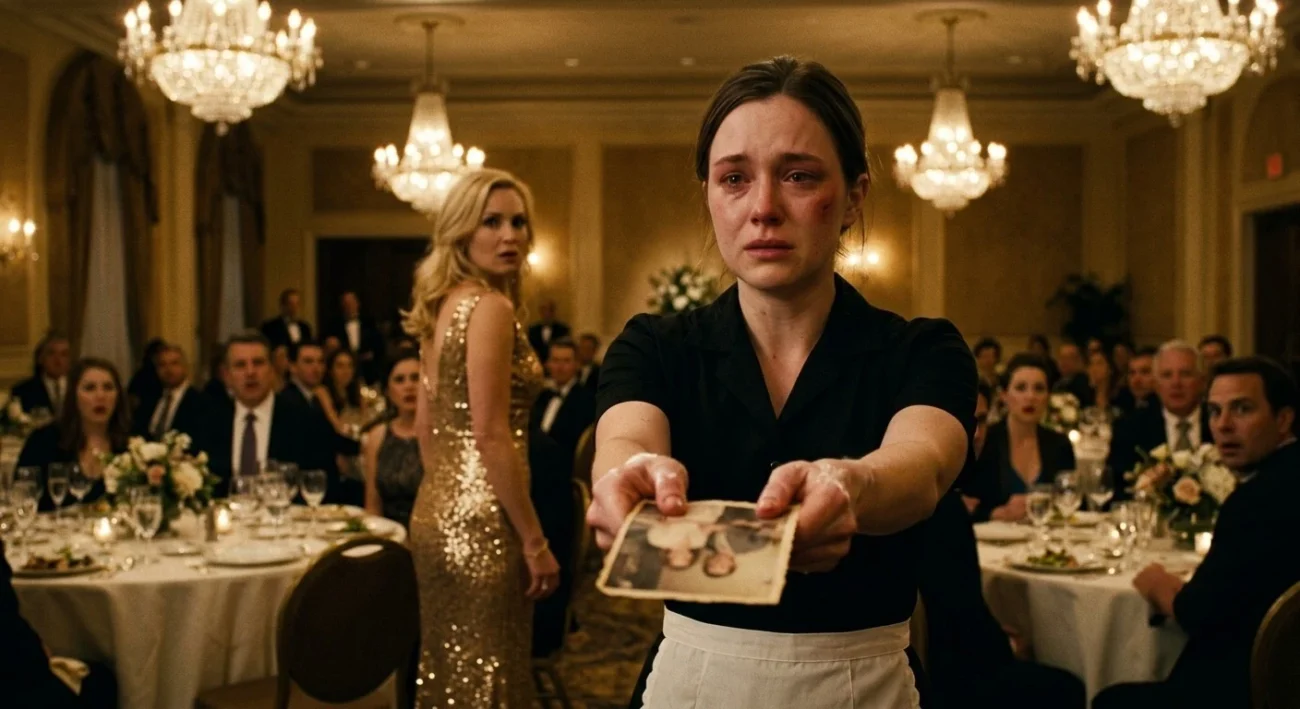
The tray left Mara’s hand. Champagne flutes hit the marble floor and shattered with a sound like a gunshot. The whole room went silent.
Mara’s cheek burned. Her eyes watered. She pressed her tongue against the inside of her teeth and breathed through her nose.
Don’t fight back. Don’t run.
Around her, a hundred people sat frozen, watching.
At table twelve, the man had stood up. His face was unreadable.
“Diane—” he started.
“Don’t,” his wife said.
Mara bent down slowly and began picking up the broken glass.
“Leave it,” a nearby busboy said quietly. “I’ve got it.”
She straightened. Her hands had stopped trembling.
She reached into her apron.
“I didn’t come here for him,” she said.
The wife laughed — a hard, ugly sound. “Then why are you crying?”
“I’m not.” Mara’s voice was steady. “Not yet.”
She pulled out the photograph.
Small. Worn. The edges soft from years of being held.
She walked to table twelve and set it on the white tablecloth.
The man looked down.
His face changed.
It didn’t just go pale. It collapsed — like something structural had given way beneath the skin. His jaw moved without producing sound.
“Where did you get that,” he whispered.
“My mother kept it,” Mara said.
He looked up at her. Really looked, for the first time.
And she watched the moment it happened — the recognition moving through him like cold water, slow and then all at once.
“Oh God,” he said.
“Daniel,” his wife said sharply. “What is this. Daniel—”
He wasn’t listening.
He was looking at Mara’s eyes. Her jaw. The slight way she tilted her chin when she was trying not to cry — a gesture that had apparently belonged to someone else first.
“She has Elena’s face,” said a voice.
Everyone turned.
The pianist had stopped playing. He was standing beside the bench, one hand pressed over his mouth. An older man — seventies, maybe — with white hair and red-rimmed eyes.
“Victor?” the man at the table said, his voice cracking.
“I remember her,” the pianist said. “God help me, I remember that night.” He looked at Mara. “You look exactly like her. Exactly.”
The wife had gone completely still.
“Someone tell me what is happening,” she said, very quietly.
No one answered her.
Mara had rehearsed this moment. Not this specific restaurant, not this specific night, but this moment — what she would say, how she would say it, whether she would be able to say it at all.
In every version, she was calmer than this.
“Your husband’s name was Daniel Reeve before he moved here and became Daniel Cross,” she said. Her voice was steady but her hands were not. “Twenty-four years ago he was living in Harleston. He was going to marry a woman named Elena Marsh.”
“That’s not—” the wife started.
“There was a fire,” Mara said. “In the apartment building. He told everyone Elena died. He told the pianist, he told the neighbors, he told whoever would listen.” She paused. “She didn’t die.”
The room was utterly silent now.
“She woke up in the hospital three days later. He was gone.”
The man in the charcoal suit said nothing.
“She was seven months pregnant,” Mara said.
Somewhere behind her, a woman gasped.
“She searched for him for two years. And then she stopped, because she realized—” Mara’s voice cracked for the first time, just slightly. She pulled it back. “She realized he knew she’d survived. He knew. He just chose not to come back.”
“That isn’t true,” the man said. His voice was barely audible. “I didn’t know. I thought—”
“Then why did you hide the blanket?”
Silence.
“The one in the photograph. The one you had in the apartment, wrapped around the baby you never met. My mother found it in your things before the fire. She kept it because she thought—” Mara stopped. Breathed. “She thought you’d want it. She thought you’d come back and you’d want it.”
“She kept it in a box under her bed for twenty-three years,” Mara said. “And then she died.”
The man’s hands were flat on the tablecloth. His head was down.
“I thought you were both gone,” he said.
“Don’t,” Mara said.
“I’m telling you the truth—”
“You reported her dead.” Her voice went cold and clean. “I have the paperwork. I’ve had it for two years. You filed a death report while she was still in that hospital. You buried an empty box. You buried us without ever looking back.”
“Daniel.” His wife’s voice had changed entirely — no longer sharp, just hollow. “Is this true.”
He didn’t answer.
Which was its own answer.
The pianist, Victor, had sat back down. He was shaking.
“I was there that night,” he said to no one in particular. “I helped him carry things out. He said — he told me she didn’t make it. I believed him.” He looked up at Mara. “I’m so sorry. I am so deeply sorry.”
“You didn’t know,” Mara said. “He did.”
The wife stood up very slowly. She pulled her napkin from her lap and set it on the table. She reached for her clutch.
“Diane,” the man said.
“Don’t speak to me,” she said. Not angry. Not loud. Just final.
She walked to the coat check and did not look back.
The man watched her go.
Then he looked at the photograph still lying on the white tablecloth.
The baby in the blanket.
His daughter, who he had never met, who had grown up in a one-room apartment while he built himself a new life with a new name and a new wife in a restaurant with golden chandeliers and soft piano.
“I thought you were dead,” he said again, to Mara. Quieter this time. Almost to himself.
“I know,” she said.
“I’m your father.”
“I know that too.”
He looked up. His eyes were wet.
“Can we—”
“No,” she said.
He flinched.
“Not tonight,” she said. “Not like this. Not with me standing here in a uniform with a red handprint on my face.”
He looked at her cheek. Something moved across his expression that might have been shame.
“I came here to give you the photograph,” she said. “Because my mother asked me to. Because she spent twenty-three years carrying it and she wanted you to carry it for a change.”
She looked at him for a long moment.
“She didn’t hate you,” Mara said. “Right up until the end, she didn’t hate you. I don’t know what that says about her.” She paused. “I know what it says about you.”
She turned.
The restaurant was still silent. Every face watched her cross the floor.
She reached the door. Pushed it open.
The night air was cold and clean and smelled like nothing at all.
She stood on the sidewalk and breathed.
Behind her, through the glass, she could see the man still sitting at table twelve. Alone now. The photograph in his hands. His shoulders bent in a way they probably hadn’t bent since he was young and the world was still capable of surprising him.
Victor the pianist had started playing again.
Something slow. Something that sounded like grief.
Three weeks later, a certified letter arrived at Mara’s apartment.
From a law firm she didn’t recognize.
She almost didn’t open it.
Inside was a single page. A paternity acknowledgment, notarized. And a handwritten note in the margin, in careful, unfamiliar handwriting:
Your mother deserved better. So did you. This doesn’t fix it. But it’s a start — no. It’s not a start. It’s just the truth, finally on paper. Do with it whatever you want.
— D
Mara read it twice.
Then she set it on the kitchen table next to her mother’s photograph — the one she kept out now, face up, not hidden in a box — and she made herself a cup of coffee.
She did not forgive him.
She wasn’t sure she ever would.
But she had walked into that restaurant as a ghost — her mother’s daughter, erased before she was born — and she had walked out as a person with a name and a history and a father who could no longer pretend she didn’t exist.
That wasn’t everything.
But it was real.
And real, after twenty-three years of nothing, felt like enough to build on.
She picked up her coffee. Looked out the window at the gray morning sky.
Said, out loud, to no one:
“I found him, Mom.”
Paused.
“He knew.”
She drank her coffee.
Outside, the city went on being itself — loud and indifferent and full of people carrying things they’d never put down.
She had put something down last night.
Not forgiveness.
Just the weight of being invisible.
It turned out that was the heaviest thing she’d ever carried.
Original fictional stories. AI-assisted creative content.
