
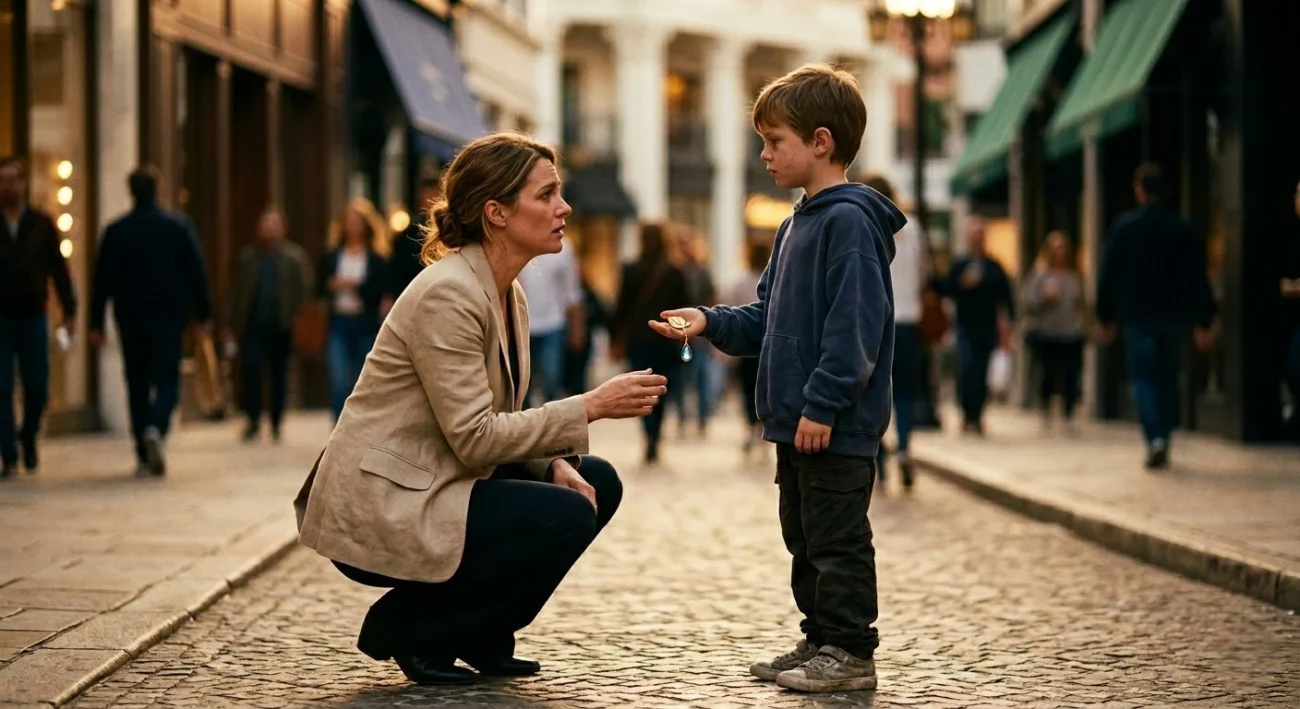
The summer evening smelled like money. Gold light poured between glass towers, and the shopping district hummed with the easy noise of people who had nowhere they urgently needed to be. Emma Blake moved through all of it without seeing any of it. Her heels clicked. Her phone buzzed. Her designer bag pressed against her hip like a second heartbeat.
She was halfway past a coffee kiosk when the fingers found her chain.
Tiny. Grubby. Trembling.
Emma spun so fast the bag swung wide. “Hey! Don’t—”
The boy flinched back like she’d thrown something at him. He was maybe eight years old. The hoodie he wore was three sizes too large, its sleeves swallowing his hands. His sneakers were gray with old dust. His eyes were the worst part — red-rimmed, exhausted in a way no child’s eyes should be.
“Sorry,” he whispered. “I didn’t mean to—”
Emma tightened her grip on the bag strap. Around her, a handful of pedestrians had slowed to watch. She hated that. She hated the whole situation.
“I don’t carry cash,” she said. Her tone was controlled. Final.
She turned to walk.
He didn’t move.
She turned back. “I said I don’t have—”
“I’m not asking for money.”
His voice was so small she almost missed it over the street noise. He had both hands extended now, palms up, the way a person holds something fragile and precious and possibly borrowed.
In his right palm sat a pin.
Gold. Leaf-shaped. A single blue teardrop jewel set at the center.
Emma’s lungs stopped working.
She looked down at her own coat. At the identical pin fastened to the lapel. The same curve of the leaf. The same jewel cut. The same tiny imperfection at the base of the stem where her mother’s jeweler had accidentally nicked the mold.
There were only two of those pins in existence. Her mother had commissioned them from a private jeweler twenty years ago, a week before she was diagnosed. She’d given one to Emma and one to—
“Where did you get that?” Emma’s voice came out strange. Low. Not quite hers.
“My mom.” He swallowed. “She said if I ever got lost, I should look for the woman with the matching one.”
The city got very loud and very far away at the same time.
“What is your mother’s name?”
The boy hesitated. He searched her face like he was checking for something — some reason not to trust her.
Then: “Sophia.”
The name landed like a key turning in a lock Emma had forgotten existed.
Sophia.
Her little sister. Gone eleven years ago without a goodbye, without a note, without a single verifiable trace. The police had filed it as a voluntary disappearance after eighteen months of nothing. Her parents had both died not knowing. Emma had eventually stopped letting herself search.
“That’s not possible,” Emma said, mostly to herself.
“She said you’d say that.”
The boy reached into his kangaroo pocket and produced a photograph. It was creased down the center and worn at the corners, the way a photo gets when someone carries it everywhere for a long time.
Emma took it with fingers she couldn’t quite feel.
The woman in the photo was thinner than she should have been, her hair shorter, cheekbones harder. But the eyes were the same dark brown Emma had grown up staring at across a kitchen table. There was a small scar above the left eyebrow from a bicycle accident in 1998. Emma knew that scar. She had been the one who held her sister’s face while their father cleaned the cut.
Standing beside the woman in the photo — the same boy.
Emma realized she was crying only when she tasted salt.
“Where is she right now?”
The boy’s face shifted. Something shuttered behind his eyes.
“She told me to run.”
“Run from what? From whom?”
Before he could answer, the sound of tires interrupted everything — a hard, sudden shriek of rubber on warm pavement. A black SUV had stopped at the curb less than thirty feet away. Not parked. Stopped. The difference mattered. The hazards didn’t come on. The engine stayed running.
The boy went absolutely still.
“No,” he breathed.
Both passenger doors opened at once. Two men. Big, dressed in the kind of forgettable business casual that is designed not to be remembered. One of them scanned the sidewalk and found the boy immediately.
“There he is.”
The boy grabbed Emma’s wrist.
She didn’t think. She stepped in front of him.
“Who are you?” she said, loud enough that the people around them slowed down and looked.
One of the men — older, with a jaw like a parking barrier — raised a hand in a gesture that was meant to look reasonable. “Ma’am, the child isn’t safe with you. We’re here to help him.”
“He looks terrified of you,” Emma said. “That’s not what help looks like.”
The other man moved around to the right. Emma felt the boy’s grip tighten on her wrist.
She swung her bag.
The corner of it caught the first man across the cheekbone with a crack that turned heads on both sides of the street. He stumbled. She didn’t wait to see what happened next.
“Run,” she said. “Now.”
They ran.
The boy was faster than she expected — he’d clearly done this before, navigating the evening crowd with sharp pivots, ducking between a group of tourists, vaulting a low planter box. Emma followed, lungs burning, heels threatening to snap.
The SUV crawled parallel to them in the street, unhurried in the way only something with resources can afford to be unhurried.
“Left,” the boy said, and grabbed her hand, pulling her into a narrow service alley behind a restaurant. The smell of cooking oil and dumpsters hit her like a wall. They crouched behind two industrial waste bins.
Footsteps on the street. Slowing. Then moving past.
Emma pressed her back against the brick and tried to breathe quietly.
“Tell me what’s happening,” she said. “All of it.”
The boy looked at his sneakers for a moment. Then he looked at her.
“My mom worked for them. A finance company. She found something in the accounts.”
“Found what?”
“I don’t know all the words. She tried to explain it once.” He chewed his lip. “She said they were moving money through accounts that didn’t really exist. She made copies of everything.”
“And then she tried to leave.”
“And then she tried to leave.” He nodded. “They’ve been watching us ever since. We move a lot. She taught me what to do if we got separated. She said find you.”
Emma processed this. The timeline fit. Eleven years ago, Sophia had taken a finance position overseas — a company Emma had only vaguely registered, too preoccupied with her own wedding preparations to ask many questions. Three months later, Sophia had vanished.
Emma had always assumed heartbreak. Sophia had been quietly, painfully in love with someone she couldn’t have.
She looked at the boy now — really looked at him. The shape of his nose. The way his eyebrows pulled together when he was thinking. The specific angle of his jaw.
Something cold settled into her chest.
“What’s your name?”
“Daniel.”
“And your father, Daniel?”
He was quiet for a long time.
“My mom said he didn’t know I existed. She said it was better that way.”
Emma’s throat tightened. Before she disappeared, Sophia had been in love with Michael — Emma’s then-fiancé, now husband of nine years. Emma had never known for certain. She had suspected. She had chosen not to ask.
Daniel reached into his hoodie again. He produced a silver necklace — a simple chain with a compass-rose pendant. Tarnished. Old.
Emma recognized it instantly. She had given it to Michael for his thirtieth birthday, the year before their wedding. He had told her he lost it somewhere in Europe during a business trip.
The year Sophia disappeared.
“Where did your mother get this?” Emma’s voice was barely a sound.
Daniel looked at the necklace, then at her. “She never told me. She just said to keep it safe.”
A sound at the mouth of the alley.
Emma tensed. Daniel pressed into her side.
But the voice that came was not one of the men from the SUV.
“Emma.”
She turned slowly. Michael stood at the alley entrance. Suit jacket open, tie loosened, breathing harder than a man who’d simply been walking. His face was doing something complicated — panic and something older, something that had been locked away for years.
His eyes found Daniel.
The boy pressed further behind Emma.
Michael stared at the child for a long moment. Then at the necklace in Daniel’s hands. Then at Emma. His face went through three or four things at once, each one making him look worse than the last.
“He’s my son,” Michael said quietly.
It was the wrong sentence to begin with. It was also the only true thing he’d said in probably nine years.
“How long have you known?” Emma asked.
“I didn’t — I found out two years ago. Someone contacted me.”
“And you said nothing.”
“I didn’t know how—”
“Where is Sophia, Michael?”
He looked at his shoes. “I don’t know. I swear to you I don’t know. I paid someone to find her. They found Daniel instead. He’d been placed in a temporary facility in another state. I — I got him released into private care. I was trying to—”
“Private care,” Emma repeated. “So those men are yours.”
Michael closed his eyes. “I just wanted him safe.”
“He’s been running for his life and he’s eight years old.” Emma stepped closer. Her voice was very level. “You knew about his mother, you knew about him, and you let me believe my sister had simply chosen to disappear.”
“Emma—”
“Call off the men in that SUV. Right now. Hand me your phone.”
He stared at her.
“Your phone, Michael.”
He held it out. She dialed.
It took four calls and twenty minutes of standing in that alley, but when Emma emerged back onto the street, the black SUV was gone.
She had also, during those twenty minutes, called her attorney. And her sister’s old friend at the financial crimes division of federal law enforcement. The documents Daniel’s mother had copied — Sophia had sent encrypted duplicates to a dormant email address Emma still controlled, eleven years ago, with a message she’d clearly never expected Emma to need to read: “If something happens, this is why.”
Emma had never thought to check that inbox.
Now she had.
The company the documents pointed to was one of twelve subsidiaries under a parent holding group. Michael sat on the board of the parent holding group. Had, in fact, joined the board shortly after Sophia vanished and shortly after the relevant accounts were restructured.
Emma put her phone in her pocket and looked at her husband of nine years standing in a service alley smelling of restaurant grease.
“You should call your own lawyer,” she said.
He started to speak.
“I’m not asking. I’m informing you.”
She held out her hand to Daniel. He took it without hesitation.
They walked out of the alley into the gold evening. Behind them, Michael stood alone in the shadow between the buildings, phone pressed to his ear, the sound of his world beginning its quiet, methodical collapse.
Daniel looked up at her as they rejoined the sidewalk. “Are we going to find my mom?”
“Yes,” Emma said. And she meant it the way you mean things when there is finally nothing left to hide. “We are going to find her.”
Three weeks later, Sophia was located at a private medical facility in Portugal, admitted under a different name following a collapse — exhaustion and malnutrition, the doctors said, both treatable. When the call came through and Emma heard her sister’s voice for the first time in eleven years, Daniel was sitting next to her on the couch.
He heard it too.
“Mom?”
The sound Sophia made on the other end of the line was not a word. It didn’t need to be.
Michael’s resignation from the board was announced the following Monday. Federal investigators were already working through the documents by then. His attorney negotiated a cooperation agreement that spring. He did not contest the divorce. He did not ask for anything.
He had, at the end, enough self-awareness to understand that there was nothing left to ask for.
Emma kept the pin. So did Daniel.
Sophia was home by summer.
Original fictional stories. AI-assisted creative content.
