
The lobby of the Harrington Grand didn’t allow for suffering.
Marble floors caught the chandelier light and threw it back, polished to a mirror sheen. Gold trim traced every arch, every column, every cornice — a quiet, constant reminder that money had been spent here, and spent deliberately. Guests moved through the space in muted voices and cashmere coats, gliding rather than walking, as though the floor itself demanded elegance.
Then a tin cup skidded across the marble.
The sound was jarring — small and metallic and wrong. It spun twice before stopping at the foot of a potted fern, its hollow rattle swallowed by the room’s vaulted ceiling.
The doorman stepped back and brushed off his gloved hands. He hadn’t kicked it hard. Just enough.
A few guests near the entrance looked over.
A boy stood in the doorway.
He was maybe seven, maybe eight — small enough that the heavy revolving door still dwarfed him. His jacket was adult-sized and faded at the shoulders, bunched at the sleeves, the hem brushing his thighs. His socks were mismatched. His face was clean but exhausted in a way that had nothing to do with sleep.
He didn’t move.
He didn’t cry.
He just stood there with his hands at his sides and his eyes scanning the lobby with the quiet alertness of someone who’d learned, early and hard, that spaces like this were not made for him.
“You can’t loiter here,” the doorman said. Not loudly. He didn’t need to be loud. “Move along.”
Two women near the concierge desk glanced over and turned back to their conversation. A man in a charcoal suit stepped around the boy like he was a piece of furniture.
The boy still didn’t move.
“I’m waiting,” he said. His voice was small but steady. “My mom told me to wait here.”
A soft laugh came from somewhere to the left. Then another.
“Your mom.” The doorman tilted his head slightly. “Right.”
He reached for the boy’s shoulder — and that was when the woman in the cream coat appeared.
Her name was Diane Harrington-Cole, and she owned the building.
She had arrived fifteen minutes early for her standing Thursday lunch with her hotel director, which meant she had walked in just in time to hear the boy speak. She came through the side entrance, the staff corridor, as she always did — she didn’t like being seen arriving. She preferred to already be there, already composed, already in control of the room before anyone else could calibrate to her presence.
She was sixty-one. She looked fifty. Her hair was silver-blond and perfectly set. Her coat was tailored within a quarter-inch of her life.
She walked past the boy without looking at him.
Then something made her stop.
She didn’t turn. Not yet. She stood with her back to him, one hand resting lightly on the handle of her Birkin.
“This is not a shelter,” she said. Her voice carried the way expensive voices do — not loudly, but completely.
The boy flinched. She heard it without seeing it.
“My mom told me to wait here for you,” he said. Same voice. Steady. Determined.
She turned then. Slow. Controlled. She looked down at him the way she looked at quarterly shortfalls — not with anger, exactly, but with a cold impatience that made people feel they had wasted her time by existing in the wrong place.
“I don’t know your mother,” she said. “And I don’t have time for—”
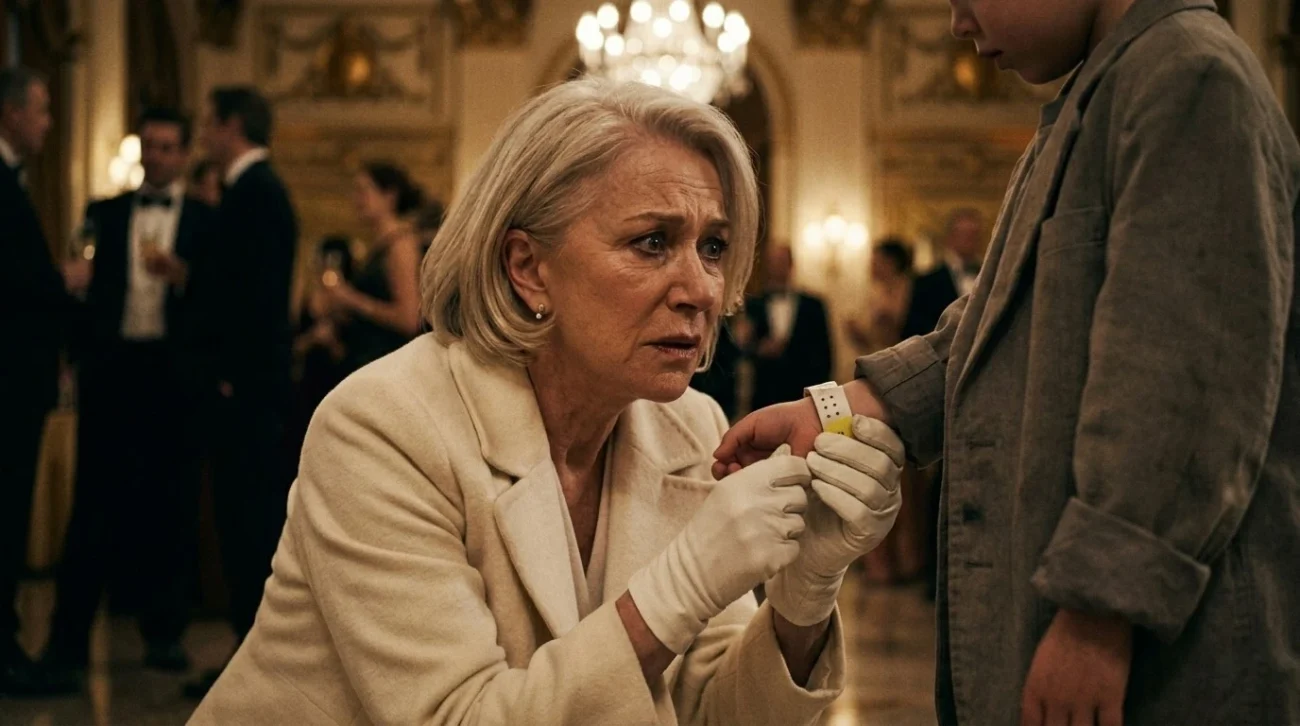
The boy raised his hand.
She saw it before she understood it: a thin strip of worn plastic, yellowish with age, the kind printed on a thermal printer that fades over years.
Her mouth kept moving. The words didn’t come out.
She stepped forward without meaning to. One step. Her heels clicked on the marble.
The boy held it steady. His hand wasn’t shaking now.
She leaned in close enough to read it.
Baby Lucas — Mother Pending
The room didn’t go quiet. The room had been quiet already. What happened was something else — a stillness that came from inside her chest and spread outward until even the air between them seemed to stop moving.
“…Where did you get that?” she whispered.
Her voice had changed. Something had cracked behind it.
The boy pulled his hand back and held the bracelet flat against his sternum, the way people hold things they’ve been told never to let go.
“My mom kept it,” he said. “In the lining of her coat.”
Diane Harrington-Cole did not move.
“Which coat,” she said. It wasn’t a question. It was something else — a reflex, a stall, the way a person speaks when their brain is racing too fast for their mouth to keep up.
“The green one,” he said. “She wore it every winter.”
“Where is she?”
The question came out softer than she’d intended. She heard it herself and almost flinched.
“She passed,” the boy said. “Six weeks ago.”
He said it plainly. Not dramatically. The way a child speaks about a death when they’ve had time to absorb it but not yet the language to process it.
“I’m sorry,” Diane said. The words felt thin and insufficient and absolutely untrue in her mouth.
The boy looked up at her. His eyes were dry now, but red-rimmed, the way eyes look when they’ve been crying consistently for several weeks.
“Before she died,” he said, “she told me something.”
Diane didn’t speak.
“She told me that the woman who left me—” he paused, and the pause was not for effect, it was simply him choosing the right words — “would recognize my name.”
The doorman had gone completely still. Two guests who had been moving toward the elevator had stopped without appearing to decide to stop.
Diane took one step back.
“My name,” the boy said, “is Lucas.”
She had told herself, over the years, that she had made a decision. Not a good one — she had never called it good, not even in her most self-forgiving moments. But a decision. Clean. Compartmentalized. The kind of thing that happened to very young, very scared women who were about to lose everything, and who made the only calculation their circumstances allowed.
She had paid for it, in her way. Quietly. She had given money, over the years, to causes she never spoke about publicly. She had written checks to organizations she would not name at dinner parties. She had done these things with the careful, private precision of a woman settling a debt she would never fully admit she owed.
She had told herself it was enough.
She had told herself it was resolved.
She had told herself, most importantly, that the boy — if he was alive, if he was fine — would never come looking. That the woman she had paid, so long ago, the woman who had agreed to take him and never ask for anything again—
“She kept her word,” Diane said, before she could stop herself. “She kept her word to me.”
The boy frowned slightly. “She kept her word to me too,” he said. “She told me if anything ever happened to her, I had to find you. That you could give me what she couldn’t.”
“Which is what,” Diane said. Her voice had gone flat. She was stalling again.
“A name,” the boy said simply. “My real name. My real birthday. My real papers.”
He said it matter-of-factly, the way you might ask for something you’re already pretty sure you deserve.
“She couldn’t get me documents,” he continued. “She never had them for me. She said you would know why.”
Diane closed her eyes for a moment. Just one moment.
She knew why.
“How did you get here?” she asked.
“Bus,” he said. “A lady at the shelter helped me look up the address.”
“You came from where?”
“Millbrook. It’s about two hours.”
She looked at him. Really looked at him, for the first time, without the armor of irritation or the distance of denial.
He had her father’s hairline. She hadn’t expected that. She hadn’t expected anything, hadn’t let herself form any expectation at all about what this moment would look like if it ever arrived, but she certainly hadn’t expected that — the way the hair grew back from his forehead in a slight widow’s peak, exactly like photographs of her father at seventy.
“You came here alone,” she said.
“Yes.”
“You’re eight years old.”
“Seven,” he corrected. “Eight in March.”
She breathed out slowly.
Behind her, she heard the doorman take a quiet step away. She heard the sound of the lobby settling back into its ordinary rhythms — the distant ping of an elevator, the soft-soled footfall of a bellhop, the muted murmur of guests returning to their own concerns.
“What’s your last name?” she asked.
“Whoever you want it to be,” he said. His tone wasn’t manipulative. He was simply repeating what he’d been told.
Something moved behind her sternum. She identified it, distantly, as the specific ache of a thing she had spent thirty years carefully not feeling.
“Come with me,” she said.
She took him to her private office on the second floor — a room most people in the building had never seen. Her assistant, Maria, was at the desk in the outer office and looked up with mild alarm at the sight of the small boy in the oversized jacket.
“Hold everything,” Diane said. “All of it.”
Maria nodded and asked no questions. She had worked for Diane for eleven years.
Diane closed the inner office door and gestured to the chair across from her desk.
The boy sat. He looked around the room with the same careful, absorptive attention he’d given the lobby, taking inventory without appearing to.
“How long were you waiting?” she asked.
“Since nine,” he said. “A man at the front told me to leave. I kept coming back.”
“How many times?”
“Four.”
She sat behind her desk and folded her hands on the surface and looked at him.
“Before I say anything else,” she said, “I need to ask you something directly.”
“Okay,” he said.
“Did anyone put you up to this? An adult? A lawyer? Someone who told you what to say?”
He shook his head. “Ms. Reyes at the shelter helped me find the address. That’s all.”
“Who told you about the bracelet?”
“My mom. Before she went to the hospital the last time. She showed me where she kept it and she made me repeat back what I had to say.” He thought for a moment. “She made me practice.”
Diane was quiet.
“She loved you,” he added, matter-of-factly, without a trace of cruelty. “She told me that. She said she was never angry at you.”
Diane pressed her lips together.
“She was wrong not to be,” she said quietly.
The next four hours were methodical and strange.
She called her attorney — Philip, who had been her family lawyer for twenty-two years — and explained the situation in two sentences. There was a silence on his end that she recognized as the sound of a careful man rapidly recalibrating.
“I’ll need to come in,” he said.
“Tomorrow morning,” she said. “Nine o’clock.”
She called her assistant back in and asked her to order food — something child-appropriate, she said, and was surprised to find she didn’t know what that meant. Maria returned fifteen minutes later with a grilled cheese sandwich and a small glass of orange juice, and the boy ate with the focused, unselfconscious efficiency of someone who had learned not to take meals for granted.
Diane watched him eat.
She asked him questions. His favorite subject in school. What the shelter was like. Whether he’d had friends at his last placement. He answered directly, without drama, occasionally asking clarifying questions of his own that surprised her with their precision.
“Are you going to let me stay?” he asked, at one point.
Not can I stay. Not please can I stay. Just the pragmatic question, stripped of appeal.
“I don’t know yet,” she said. “That depends on several things.”
“Like what?”
“Like what’s in your best interest,” she said. “Which I’m not yet qualified to judge.”
He seemed to accept this. He picked up the other half of his sandwich.
“She told me you were smart,” he said. “My mom.”
“She was generous.”
“She said you were the smartest person she’d ever met and the most scared.” He glanced up. “I’m not sure what that means exactly.”
Diane said nothing.
“Does it mean you’re brave now?” he asked.
Philip arrived the next morning with his junior associate and a leather document case.
He shook the boy’s hand, which Diane noticed. Not many men in Philip’s position would have. The boy shook back with the same small, grave formality.
The three adults sat at the conference table in Diane’s office while Lucas sat on the leather sofa with a library book Diane’s assistant had found in the break room — something about deep-sea fish.
Philip spread the documents out carefully.
“There are three ways to approach this,” he said, lowering his voice. “From a legal standpoint, the least complicated—”
“I don’t want the least complicated,” Diane said. “I want the most correct.”
Philip looked at her over his glasses. In twenty-two years she had never said anything like that to him in a legal context.
“All right,” he said. “Then we start with a DNA verification, which given the circumstances you’ve described will be straightforward, and from there we file for formal recognition of biological parentage, which in this state will—”
“How long?”
“If uncontested? Four to six months.”
“And in the meantime?”
“Emergency guardianship. Temporary, pending the full process. Given your resources and the existing documentation from the deceased foster mother, I don’t anticipate any complications.” He paused. “You understand that once the DNA confirms, this becomes a matter of public record.”
Diane looked across the room at the boy on the sofa.
He had apparently found something fascinating about anglerfish. He was holding the book very close to his face.
“Yes,” she said. “I understand.”
“It will be covered,” Philip said carefully. “By the press, I mean.”
“I know what you mean.”
“Your board—”
“My board will hear it from me directly,” she said. “Before it’s anywhere else.”
Philip nodded slowly. He began to make notes.
Across the room, Lucas looked up from his book.
“What are anglerfish?” he asked.
“Deep-sea predators,” Diane said. “They use a light on their head to attract prey.”
He considered this. “That’s clever.”
“It is,” she said. “It’s also how they survive.”
The DNA results came back in nine days.
Diane read the report alone, in her office, with the door closed. She did not need to read it carefully — the conclusion was in the first paragraph, stated plainly.
She sat for a while after.
Then she called her assistant and asked her to bring Lucas up.
He arrived still carrying the deep-sea fish book, which he had apparently been allowed to keep. He sat across from her with his hands in his lap.
“The results came back,” she said.
“Okay,” he said.
“They confirm what you told me.”
He nodded once, small and precise.
She had prepared something to say. Several things, actually — she had written them out the night before, at her kitchen table, which she almost never used. She had written and crossed out and rewritten until she had something that felt true without being theatrical.
Looking at him now, she set all of it aside.
“I owe you a great deal,” she said. “I know that. I also know that saying so doesn’t come close to the amount I actually owe you.”
He watched her without speaking.
“I can’t undo the time,” she said. “I can’t undo what happened before you came here, or who raised you instead of me, or what that was like. None of that is reversible.”
“I know,” he said.
“What I can offer is forward from here,” she said. “Whatever that’s worth to you.”
He thought about it — genuinely, visibly, the way a child thinks when they’re taking something seriously.
“Ms. Reyes says I’m hard to place,” he said finally. “Because I’m older.”
“You’re seven.”
“That’s older,” he said. “In the system, seven is older.”
Diane breathed in slowly.
“You won’t be in the system,” she said. “Not anymore.”
He looked at her.
“I’d like you to come live here,” she said. “With me. Formally. With all the paperwork and all the right people involved and everything done correctly.” She paused. “It won’t be perfect. I’m not good at this. I’ve never—” She stopped, started again. “I’m going to make mistakes. But I will not disappear again.”
The boy was quiet for a long moment.
“My mom,” he said. “The one who raised me. She used to say the only thing that matters is who shows up.”
“She was right.”
“She showed up,” he said. “Every day, even when it was hard.”
“I know.”
“Can I still keep the book?”
Diane looked at the deep-sea fish book in his hands.
“Yes,” she said. “You can keep it.”
The board meeting was three weeks later.
Diane addressed it herself, without notes, standing at the head of the long table in the forty-first-floor conference room. She told them clearly, sequentially, and without editorializing. She told them about Lucas. She told them about the decisions she had made thirty-one years ago and the consequences she had been carrying since. She told them that her son was now living in her apartment on the Upper East Side and that Philip’s office was processing the formal legal recognition and that she expected the news to reach the press within the week.
There was a long silence.
Robert Vance, who had been on the board since the company’s founding and who had never, in Diane’s experience, been rendered speechless, was speechless.
“Any questions,” she said. It was not phrased as a question.
“I have one,” said Sasha Okafor from the end of the table. She was the youngest member of the board and the one Diane trusted most. “Is he okay?”
Diane paused.
“He’s getting there,” she said. “He likes fish.”
The doorman’s name was Gerald, and he had worked the front entrance of the Harrington Grand for eleven years.
On the Monday morning following the board meeting, he arrived for his shift to find a sealed envelope in his locker. Inside was a formal letter informing him that his employment was being terminated, effective immediately, with severance equal to two months’ pay. The letter cited a violation of the hotel’s guest conduct policy — specifically, a recorded incident involving a minor visitor.
The camera above the entrance had been running, as it always was.
Gerald stood in the break room for a long moment with the letter in his hands.
Then he picked up his things and left.
Six months later, on a Tuesday in March, Diane took Lucas to the courthouse.
He wore a collared shirt that he had picked himself — dark blue, slightly too large, because he had asked for one he could grow into. Diane wore the cream coat. She had not planned to. She had put it on that morning and looked at herself in the mirror and decided to leave it on.
Philip met them on the steps.
“Ready?” he said.
Lucas looked up at Diane.
“Are you?” he asked.
She took his hand.
“Yes,” she said.
Inside, a judge reviewed the documentation, asked three questions, reviewed the answers, and signed the papers.
Lucas Allen Harrington-Cole.
His name, finally, on paper.
In the car afterward, he looked out the window at the city going past.
“Is it different?” Diane asked. “Having it official?”
He thought about it.
“It feels more real,” he said. “Like it’s not just something that might change.”
“It won’t change,” she said.
He looked at her.
“You kept showing up,” he said.
“Yes,” she said. “That’s the only thing that matters.”
He nodded once, satisfied.
Then he went back to looking out the window, watching the city, already at home in it.
Original fictional stories. AI-assisted creative content.
