
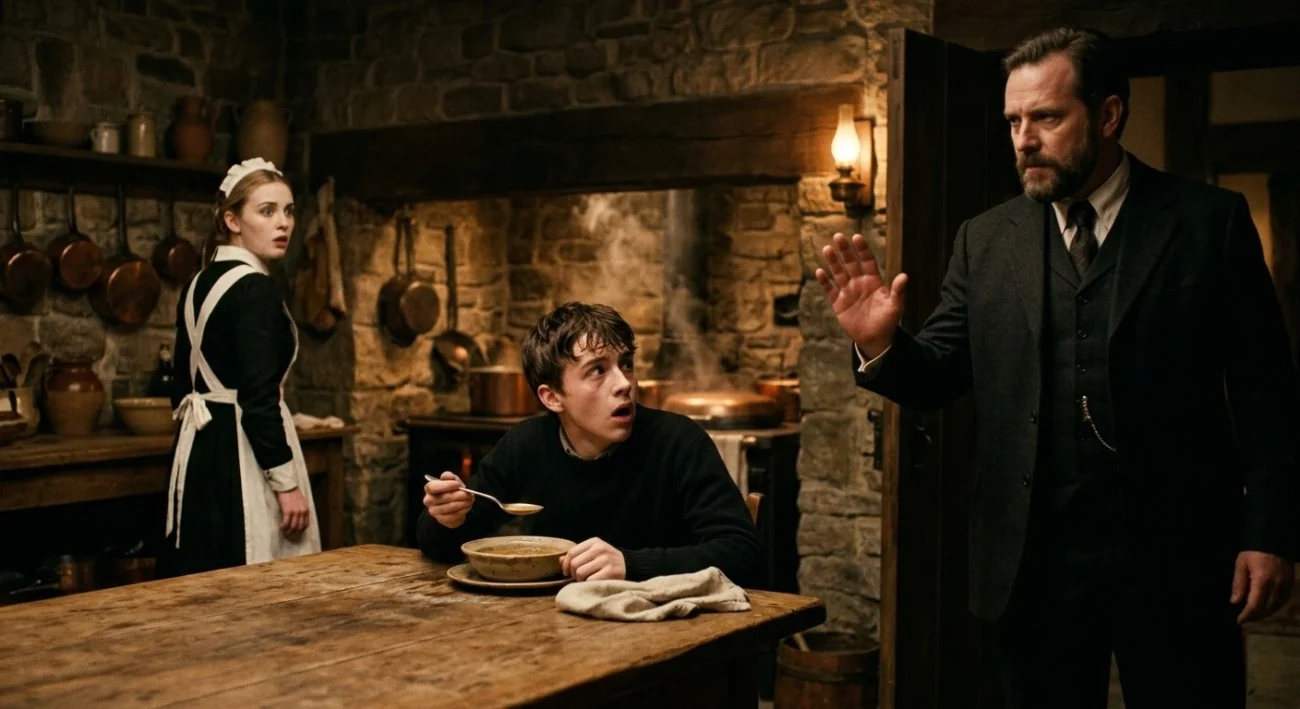
Claire Bennett had worked for William Harrington for three years without incident. She knew the rules: no guests, no exceptions, no excuses.
She broke every one of them in under ten minutes.
The boy was standing at the iron gate in bare feet, arms crossed tight against the cold. His shirt was torn at the shoulder. His lips were pale.
Claire set down her broom.
“Are you hungry?” she asked.
He didn’t answer. He just nodded.
She looked back at the empty driveway. Mr. Harrington wasn’t due until six. She had time.
“Come on,” she said. “Just for a few minutes.”
Inside the kitchen, she ladled beef stew into a bowl and set it in front of him. The boy gripped the spoon like someone might take it away and started eating without a word.
Claire leaned against the counter, watching him.
She was still watching when the front door slammed.
Her stomach dropped.
The footsteps echoed across the marble entry—slow, deliberate, growing louder until William Harrington filled the kitchen doorway in his charcoal overcoat, briefcase in hand, eyes sweeping the room.
He looked at the boy.
Then at the bowl.
Then at Claire.
She stepped forward before he could speak. “Sir, I know. I know I shouldn’t have. He was outside by the gate. No shoes. Shaking. I couldn’t just—”
“It’s fine, Claire.”
She stopped.
His voice was flat. Not angry. Something else entirely.
He hadn’t taken his eyes off the boy.
The boy had gone completely still, spoon suspended halfway to his mouth.
William set his briefcase down slowly, like he was afraid a fast movement might break something. He walked toward the table. Then—to Claire’s absolute shock—he lowered himself to one knee in front of the child.
“Where did you get that necklace?”
The boy blinked. He looked down at his own chest.
A silver locket had slipped out from beneath his shirt. Old. Scratched. The chain was thin and worn almost through.
“My mother gave it to me,” the boy said quietly.
“Can I see it?”
The boy hesitated—just for a second—then lifted the chain over his head and held it out.
William’s hands were not steady.
He turned the locket over once. Twice. His thumb found the clasp.
“What’s your name?” he asked.
“Thomas.”
William opened the locket.
Inside was a photograph. A young woman—early twenties, dark hair, laughing at the camera—holding a newborn. Behind the photograph, folded into quarters, was a note.
William unfolded it.
Claire watched his face change.
Whatever color had been there drained away in seconds.
His lips moved without sound. Then, barely a whisper: “Our son.”
Claire pressed her hand to her mouth.
“My mother is sick,” Thomas said. He said it plainly, the way children say hard things. “She told me to find the house with the tall iron gates if anything happened to her. She said to give the locket to a man named William Harrington.”
William looked up from the note. His eyes were red.
“How sick?” he asked.
“Really sick.” Thomas looked at the table. “She didn’t want me to go. She cried when she put me in the cab. But she said I had to.”
William stood. He folded the note once, carefully, and put it in his inside jacket pocket. Then he crouched again and looked Thomas directly in the eye.
“You’re not leaving this house tonight,” he said. “Do you understand me? You are home.”
Thomas stared at him for a long moment.
Then, very slowly, his chin started to tremble.
William pulled him into his arms. The boy went rigid for a second—then grabbed hold of his jacket with both fists and buried his face against his shoulder.
Claire turned away. She was crying.
She was still wiping her eyes when William spoke again—his voice low, controlled, urgent.
“Claire. Prepare the car.”
She turned back.
His expression had changed entirely. The grief was still there, but behind it was something harder. She’d seen that look before, during shareholder crises, during the lawsuit three years ago.
He was calculating.
“Where are we going?” she asked.
He held up the note so she could read the final line.
Hurry. They know where we are.
Claire drove. William sat in the back with Thomas asleep against his arm.
He’d made two phone calls before they pulled out of the driveway—one to his security team, one to a number Claire didn’t recognize. Both conversations were short. Both ended with “Get there first.”
He didn’t explain.
He didn’t need to.
“Who are they?” Claire asked, eyes on the road.
“People I should have dealt with seven years ago.”
“What did they want?”
“What everyone wants.” He looked out the window. “Leverage.”
The address was a narrow apartment building in East Boston, four stories, fire escape running up the front. The lights were on in a second-floor window.
William was out of the car before Claire had it in park.
“Stay with Thomas,” he told her.
“William—”
But he was already through the front door.
Claire looked at Thomas. The boy was awake now, watching the building with quiet, frightened eyes.
“Is that where she lives?” Claire asked.
He nodded.
“She’s going to be okay,” Claire said.
Thomas turned to look at her. Seven years old, barefoot, wrapped in a coat that was three sizes too big—one of William’s, from the back seat.
“How do you know?” he asked.
Claire didn’t have an answer.
Then the second-floor window lit up bright—voices, movement, the shadow of someone crossing in front of the glass.
Then silence.
Then William appeared in the doorway below.
He looked down at the car. He nodded once.
Claire exhaled.
Thomas was already climbing over the seat.
Elizabeth Bennett was thin. That was the first thing Claire noticed—thinner than the girl in the photograph, though her eyes were the same. Dark, alive, fierce with something that hadn’t given up yet.
She was sitting up in bed when Thomas ran through the door and threw himself against her.
“Hey,” she whispered, holding him. “Hey, hey. I told you to wait downstairs.”
“He found me,” Thomas said into her shoulder. “He was home early. His maid gave me stew.”
Elizabeth looked up.
William stood in the doorway.
Neither of them spoke.
Seven years compressed into three seconds of eye contact.
“You got my note,” she said finally.
“I got it.” He stepped inside. “Who threatened you?”
“My uncle.” Her jaw tightened. “He found out about Thomas two years ago. Said if I ever contacted you, he’d go to the press. Say Thomas was a scheme. A fraud. That I’d been sleeping around and was trying to pin a baby on you for the money.”
William’s expression didn’t flicker. “And you believed that would work?”
“I believed it would hurt you.” She looked at Thomas. “I believed it would hurt him.”
“Your uncle is currently being escorted out of his home by two federal investigators,” William said quietly. “He’s been under a financial fraud investigation for fourteen months. Tonight, they had enough. I gave them the final piece this morning—I just didn’t know why it mattered yet.”
Elizabeth blinked. “You didn’t know?”
“I didn’t know he was connected to you.” A pause. “I do now.”
The silence stretched.
Elizabeth looked at her son—then back at the man she’d spent seven years trying to forget.
“I’m sorry,” she said. “I should have trusted you.”
“Yes,” William said. “You should have.”
Another silence. Harder this time.
Then Thomas looked up from his mother’s shoulder.
“Are you my dad?” he asked.
William crossed the room. He sat on the edge of the bed. He looked at his son for a long moment.
“Yes,” he said. “I am.”
Thomas considered this with the seriousness of someone making a business decision.
“Okay,” he said.
He climbed out of his mother’s arms and into his father’s lap.
Two weeks later, Elizabeth’s doctors confirmed what the treatment had already suggested: the infection was bacterial, not what they’d originally feared. Aggressive antibiotics. Six weeks. Full recovery expected.
The uncle—Gerald Marsh—was indicted on eleven counts of wire fraud. His assets were frozen within forty-eight hours. He never made a call to the press.
William moved Elizabeth and Thomas into the east wing of the Harrington estate while she recovered. Thomas started at the local school in February. He made three friends in the first week.
Claire stayed on.
One evening, she was setting the table for dinner when Thomas appeared at her side with a folded piece of paper.
“What’s this?” she asked.
“I drew you something,” he said. “Because you gave me the stew.”
She unfolded it.
A crayon drawing: a small boy at a big table, a smiling woman holding a bowl, and outside the window—a pair of iron gates, wide open.
Claire set the drawing down on the counter.
She pressed her hand flat against it for a moment.
Then she went back to setting the table.
Original fictional stories. AI-assisted creative content.
