
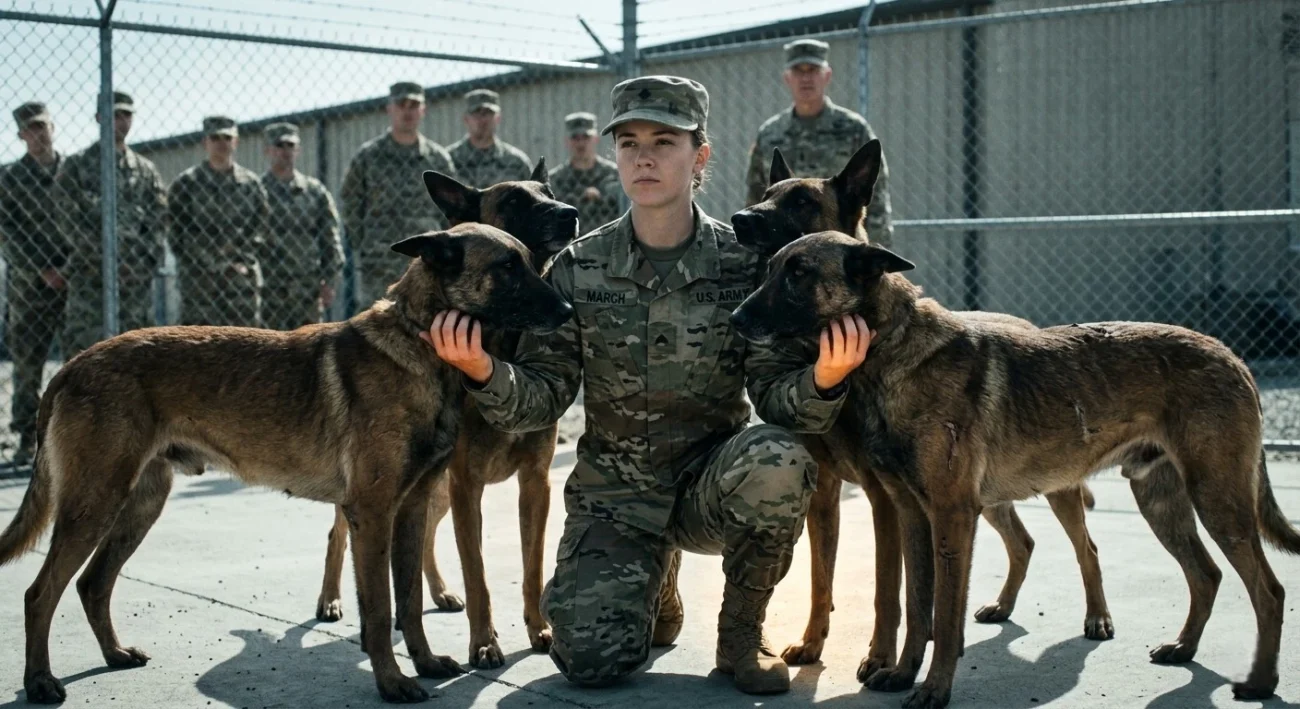
The gate slammed behind me.
That sound — steel on steel, sharp and final — hit my spine before my brain registered it. I’d heard worse. Doors locking in Kandahar. Hatches sealing underwater. But this one was designed to break me, and the man who designed it was standing two feet away, watching through chain-link with a smile he couldn’t quite contain.
Four military working dogs fanned out across the concrete pen. Every one of them over ninety pounds. Every one of them scarred.
I kept my hands loose at my sides.
“You ready, Lieutenant Brennan?” Lieutenant Colonel Dominic Kesler called from the fence. His voice carried that particular brand of amusement that men use when they’ve already written the ending.
I didn’t answer.
The dogs knew I was there. Their nostrils worked the air. The alpha — a black Belgian Malinois, massive, close-cropped ears pinned forward — locked his eyes on me and let a sound build low in his chest.
“This is the Black Squad,” Kesler said, louder now, clearly performing for the observation deck above us. “Four dogs pulled from active deployment. They’ve been assessed as non-rehabilitable. Protocol says we keep them quarantined.” He paused. “But you told Command that any dog can be reached. So here’s your chance to prove it.”
I heard the quiet approval from above. Generals watching. Career-defining moment, Kesler had told them. He meant mine. He meant its end.
I looked at the Malinois. He looked at me.
“This is not a test,” I said quietly. Not to Kesler. To the dog.
My name is Kira Brennan. Twenty-seven years old. Naval officer, K9 Innovation Team, Naval Special Warfare. My father was a SEAL who died in a training accident six weeks before I was born. I grew up with his photo on our kitchen wall and his name stitched into a flag I was never allowed to unfold.
I spent my whole life trying to deserve that flag.
Kesler had been trying to fold me back up since my first week on his base. Reassigned me to administrative work the month I outscored his entire unit on field evals. Blocked my promotion memo. Made sure I knew, in ways that left no paper trail, that I would never be seen as anything more than a female officer checking a diversity box.
When I presented my K9 research to Command — a six-month study showing that handler psychology directly influenced combat dog behavior — Kesler requested the live demonstration himself.
He chose the dogs. He chose the pen. He invited the general.
He thought he was destroying me. He was actually handing me the moment I’d been building toward my entire life.
The Malinois lunged.
It happened fast — a hundred pounds of pure aggression launched at my throat, teeth bared, paws tucked back for impact. Behind me, I heard Kesler’s breath catch. Not in fear. In anticipation.
I dropped my weight.
My boots hit the concrete like anchors. I widened my eyes, full and direct — not a challenge, a statement — and I roared from the floor of my chest.
“Sit.”
One word. The sound of it hit the concrete walls and came back amplified, layered, primal. It wasn’t volume that stopped the dog. It was frequency. Every handler knows that dogs don’t read words. They read certainty. They read posture. They read the presence behind the sound.
The Malinois froze in mid-air.
His momentum broke like a wave hitting a seawall. He dropped. Four paws on concrete, two inches from my boots. His chest heaved. His ears came back — not in submission yet, in confusion. He’d expected prey. He’d found something he didn’t have a category for.
I crouched slowly to his level.
“Easy,” I said. Low. Steady. “You’re home.”
His ears moved. Something shifted behind his eyes — that long, canine calculation, reading me the way dogs read everything: completely, honestly, without agenda. He let out a breath.
His haunches dropped. He sat.
One by one, like dominoes, the other three followed. Bellies to the floor. Heads tilted. Waiting.
The pen went silent.
I stood up slowly, ran my hand once along the Malinois’s spine — he leaned into it — and then I turned toward the fence.
Kesler’s smile was gone. His face was the color of old concrete. The hand against the chain-link had gone rigid, fingers white where they gripped the wire.
Above us, behind the observation glass, Major General Patricia Holt stood with her arms folded, watching. She had not been invited by Kesler. She’d heard about the demonstration from my research supervisor and come on her own.
I walked to the gate and pushed it open.
The dogs parted for me like water.
I stopped directly in front of Kesler. Close enough to speak at a normal volume.
“The Black Squad is ready for reassessment,” I said. “I’d like to formally request handler assignment and a rehabilitation timeline.”
Kesler said nothing. His jaw worked but produced no sound.
“Colonel.” My voice was quiet, measured, completely steady. “I need you to sign the reassessment form. Today.”
“You — ” He started. Stopped. His eyes flicked upward toward the observation deck. Back to me.
“You planned this,” he said, low and vicious. “You set me up.”
“No,” I said. “You set yourself up. I just showed up.”
General Holt appeared at my side forty minutes later, while I was still in the pen running a basic command sequence with the Malinois.
“Lieutenant Brennan.” She watched the dog sit, stay, release on my hand signal. “I’ve read your research. I want to talk about expanding your program.”
“Yes, ma’am.”
“I also want to talk about a complaint I’ve been reviewing.” She kept her eyes on the dog. “Concerning a pattern of conduct by a certain lieutenant colonel. The reassignment records. The blocked promotion memo.” She paused. “Your signature is on a suppressed request for formal review from eight months ago.”
I hadn’t known anyone had kept that record.
“Kesler is being transferred,” Holt said simply. “Effective Monday. Desk assignment. Fort Meade.”
She let that sit for a moment.
“How did you know,” she asked, “that you could stop that dog?”
I looked at the Malinois. He looked back at me, calm and attentive, his scarred muzzle resting on his paws.
“I didn’t know,” I said honestly. “I knew I wasn’t afraid of him. And dogs always know the difference.”
Holt nodded slowly. “So do generals.”
Three weeks later, I stood in front of the entire base in a ceremony I hadn’t expected and almost declined. The promotion certificate was in my hands before I’d fully processed it. Lieutenant Commander Kira Brennan.
Kesler wasn’t there. He was already at Fort Meade, processing paperwork in a building without windows.
The Malinois — who I had, against regulation and with Holt’s quiet permission, named Ghost — sat next to my left boot throughout the ceremony. Still. Attentive. Ears forward.
When the general pinned the rank to my collar, Ghost pressed his side gently against my leg.
I looked down at him.
He looked up at me.
And for the first time in twenty-seven years, the ghost I’d been chasing stopped running. Because the person he’d been waiting for had finally caught up.
Original fictional stories. AI-assisted creative content.
