
I pulled on my uniform—a plain white blouse with short sleeves and a navy knee-length skirt—and checked my phone. One new message from my supervisor: “Sterling gala tonight. $500 bonus if you keep your mouth shut and stay invisible.”
I needed that money. My daughter’s insulin wasn’t going to pay for itself.
The Sterling mansion felt like a museum. Marble everywhere. Gold trim. Crystal chandeliers that probably cost more than my annual salary. I pushed my cart through the service entrance, head down, ready to disappear into the background.
“You’re the new girl?” A woman in a designer suit blocked my path. Victoria Sterling. Richard Sterling’s sister. I’d seen her photo in magazines. “Just so we’re clear—you don’t speak to guests. You don’t make eye contact. You’re furniture.”
“Yes, ma’am.”
“Good. My brother’s making some ridiculous announcement tonight about his mute daughter. Stay out of the way.”
She clicked away on heels that cost more than my car payment.
I found my station near the ballroom entrance. The party was already in full swing. Politicians. Tech CEOs. Old money and new money pretending to like each other.
Then I saw her.
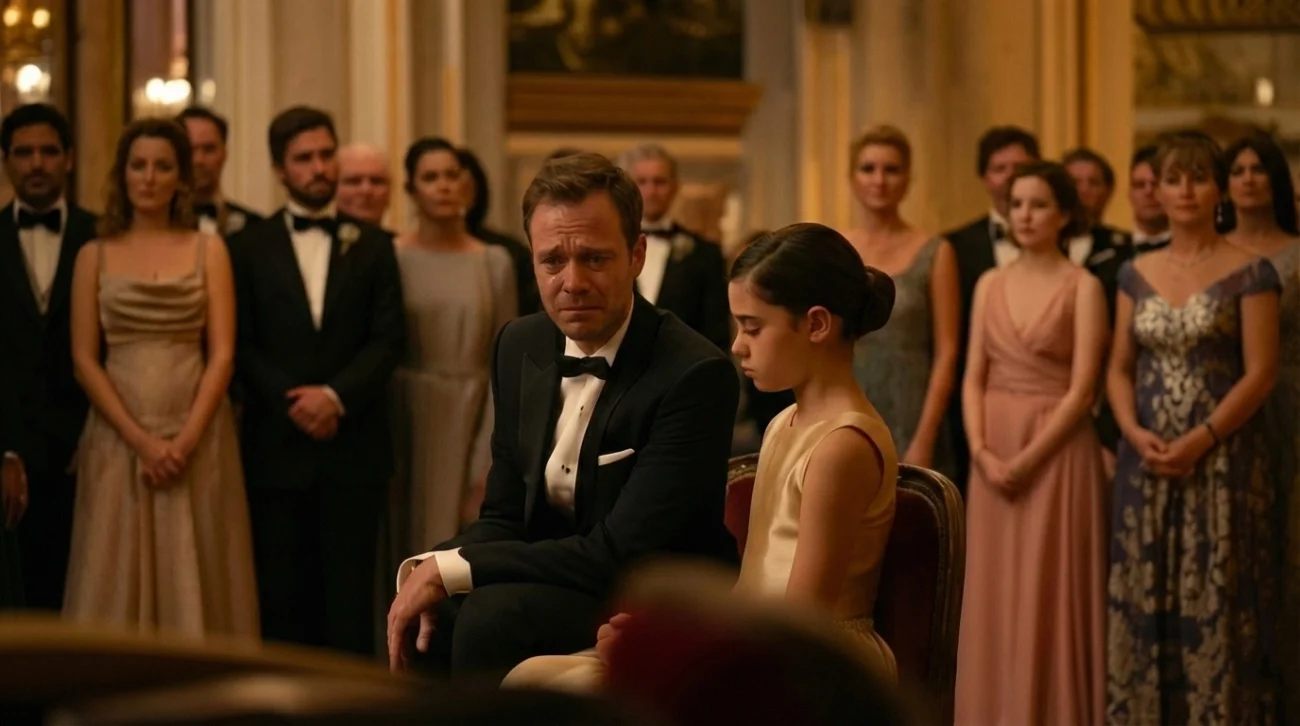
A little girl sat alone on a bench, wearing a fancy dress that looked like it was strangling her. She couldn’t have been more than eight. Her hands were folded perfectly in her lap, but her eyes… her eyes were screaming.
I recognized that look. I’d seen it in the mirror for years after my parents died.
“Ladies and gentlemen.” Richard Sterling’s voice cut through the noise. Tall. Handsome. Exhausted. “I won’t waste your time with pleasantries. Three years ago, my wife died in a car accident. My daughter Amelia hasn’t spoken a single word since.”
Whispers rippled through the crowd. I saw people exchanging glances—some sympathetic, most calculating.
“I’ve spent fifteen million dollars on specialists. The best doctors in the world.” His voice cracked. “None of them could reach her. So tonight, I’m making an offer. Anyone who can help my daughter speak again will receive ten million dollars. Cash. No questions asked.”
The room exploded into chatter.
“Richard, darling,” a woman in a red dress called out. “You can’t seriously expect—”
“I’m dead serious, Margaret.” He gripped the podium. “Ten million. To anyone who succeeds.”
A man in an expensive suit laughed. “Some things are just broken, Sterling. You can’t buy miracles.”
That word made my stomach turn. Broken.
“Then we’ll try first,” announced a woman stepping forward. Dr. Helena Frost, according to her introduction. Child psychologist to celebrities. She approached Amelia with a warm smile.
“Hello, sweetheart. I’m Dr. Frost. I’ve helped many children just like you.”
Amelia didn’t move. Didn’t blink.
“I brought you something special.” Dr. Frost pulled out a tablet showing animated characters. “Do you like cartoons?”
Nothing.
Dr. Frost tried for five minutes. Different approaches. Different tones. Amelia sat like a statue.
“I’m sorry, Richard,” Dr. Frost finally said. “She’s completely shut down. This will require months, possibly years of intensive—”
“Next,” Richard cut her off.
One after another, they failed. A speech therapist. A child actor who tried to make her laugh. A behavioral specialist with flashcards. Each one more confident than the last. Each one walking away defeated.
I kept cleaning, watching Amelia’s face stay blank through it all. But her hands—her hands were trembling.
“This is pointless,” Victoria Sterling announced loudly. “The child is damaged, Richard. Accept it and move on.”
“Don’t call her that,” Richard snapped.
“I’m calling it like I see it. Mother should’ve been driving that night, not Catherine. Maybe if you’d been home instead of—”
“Enough!” Richard’s shout silenced the room.
Victoria smiled coldly. “I’m just saying what everyone’s thinking.”
That’s when I saw it. Amelia’s lip quivered. Just slightly. Nobody else noticed. They were all watching Richard and Victoria.
But I saw.
My feet moved before my brain caught up. I stepped into the ballroom.
“Excuse me, who let the cleaning staff out?” A woman in diamonds pointed at me. “This is highly inappropriate.”
Laughter spread through the guests. Richard’s eyes locked on me—cold, dismissive. “Return to your station immediately.”
“I’m sorry, sir, but—”
“Security,” Richard called.
“Wait.” The word came out before I could stop it. “Your daughter isn’t broken. And she’s not damaged.”
The room went silent.
Victoria laughed. “Oh, this is rich. The maid is giving parenting advice.”
“I’m not giving advice,” I said, my voice shaking but steady. “I’m telling you what I see. She’s not silent because she can’t talk. She’s silent because every time she tries, someone tells her she’s doing it wrong.”
“That’s absurd,” Dr. Frost interjected. “I’ve spent thirty years—”
“Then you should know better.” I looked directly at Amelia. “She doesn’t need fixing. She needs someone to stop treating her like a broken doll.”
“Get her out of here,” Victoria demanded.
“No.” Richard held up a hand. His face had changed. “What makes you think you know my daughter?”
“Because I was her.” The words felt like they were being ripped out of me. “I didn’t talk for four years after my parents died. Foster care. Fourteen different homes. Everyone wanted to fix me. Nobody wanted to just… listen.”
“This is a waste of time,” Victoria said.
But Richard’s eyes were on Amelia. The girl was staring at me now. Really staring.
“What changed?” Richard asked quietly. “How did you start talking again?”
“Someone stopped asking me to.”
The ballroom was silent enough to hear a pin drop.
“There was a woman. Mrs. Rodriguez. She ran the group home I ended up in.” I kept my eyes on Amelia. “She never pushed me to talk. Never bribed me. Never treated me like I was less than whole. She just… existed near me. Made me feel safe enough to be silent.”
Amelia’s hands stopped trembling.
“One day I asked her why she never tried to make me talk like everyone else did.” I smiled at the memory. “She said, ‘Why would I? You’re already saying everything I need to hear.'”
“That’s the most ridiculous therapeutic approach I’ve ever heard,” Dr. Frost scoffed.
“It worked.”
“Security, please escort—” Victoria started.
“Wait.”
The voice was so small, so soft, that for a second I thought I imagined it.
But Richard’s face went white. His champagne glass slipped from his fingers and shattered on the marble floor.
Amelia stood up.
Every eye in the room locked on her. She took one step. Then another. She walked past the experts. Past the millionaires. Past her own father.
She stopped right in front of me.
“You see me,” Amelia whispered.
My throat closed up. “Yeah, sweetheart. I see you.”
“Everyone else sees broken.” Tears started rolling down her cheeks. “You see me.”
“That’s because you’re not broken. You never were.”
Amelia looked back at her father. Richard was frozen, his hand over his mouth, tears streaming down his face.
“Daddy?” Amelia’s voice got slightly stronger. “I’m sorry I stopped talking. I just… I didn’t know how to tell you it hurt.”
Richard dropped to his knees. “Baby. Oh my god, baby, I’m so sorry. I’m so sorry.”
Amelia ran to him. Richard wrapped his arms around her, sobbing into her hair.
The room erupted. Camera phones came out. People were crying. Victoria stood there, her face twisted in fury.
I started to back away, to fade into the background again. But Amelia turned and looked at me.
“Don’t go,” she said.
Two hours later, I sat in Richard Sterling’s private study. My hands wouldn’t stop shaking.
“I need to know everything,” Richard said. “Your name. Your background. Everything.”
“Evelyn Carter. Thirty-four. Single mom. I’ve been cleaning houses for six years.” I looked at my hands. “Before that, I worked retail. Before that… foster care until I aged out at eighteen.”
“And your daughter?”
“Emma. She’s seven. Type 1 diabetes. That’s why I work three jobs.”
Richard leaned back in his chair. “The woman you mentioned. Mrs. Rodriguez. Where is she now?”
“She died two years ago. Heart attack.”
“I’m sorry.”
“Me too.”
We sat in silence for a moment. Then Richard leaned forward. “I want to hire you.”
“You already hired me. I clean your house.”
“No. I want to hire you to work with Amelia. To help her heal.”
I laughed. Couldn’t help it. “Mr. Sterling, I don’t have any qualifications. I barely graduated high school.”
“You have something better than qualifications. You have understanding.” He pulled out a checkbook. “Name your price.”
“I don’t want your money.”
“Everyone wants money.”
“I want my daughter’s insulin. I want to stop working seventy hours a week. But I don’t want to be bought.” I stood up. “Your daughter spoke tonight because I wasn’t trying to win ten million dollars. I was trying to help a scared kid. The second you pay me, it becomes a transaction.”
Richard stared at me. “Then what do you want?”
“I want Amelia to be okay. For real. Not just talking, but actually healing.”
“How do I make that happen?”
“You stop treating her like a problem to solve.”
The next day, Richard called me. “Victoria is threatening to sue for custody. She’s claiming I’m unfit because I let ‘unqualified staff’ interact with Amelia.”
“That’s insane.”
“She’s hiring lawyers. Good ones.” His voice was strained. “I need to know—will you testify? Tell them what you told me last night?”
“About what?”
“About trauma. About selective mutism. About how healing actually works.”
I thought about my daughter. About the insulin we needed. About the three jobs I was barely holding together.
“Yes,” I said. “I’ll testify.”
The custody hearing happened two weeks later. Victoria’s lawyers came out swinging.
“Ms. Carter,” the attorney began, “you have no psychology degree, correct?”
“Correct.”
“No medical training?”
“Correct.”
“In fact, you’re a cleaning woman with a troubled past. Multiple foster homes. No stable relationships. A daughter born out of wedlock.” He smiled. “What makes you qualified to advise Richard Sterling on his daughter’s care?”
“I never said I was qualified.”
“Then why should this court listen to anything you have to say?”
I looked at Amelia, sitting next to her father. She was watching me with wide eyes.
“Because I lived it,” I said quietly. “I know what it’s like to have people talk about you like you’re not in the room. To have doctors and therapists treat you like a specimen instead of a person.”
“That’s not evidence-based care—”
“Evidence-based care failed Amelia for three years.” I turned to the judge. “Dr. Frost testified earlier about how ‘unreachable’ Amelia is. But Amelia spoke to me within minutes. Not because I’m smarter or more qualified. Because I wasn’t trying to fix her.”
“This is emotional manipulation,” Victoria’s lawyer said.
“No. It’s empathy. There’s a difference.”
The judge leaned forward. “Ms. Carter, if the court grants Mr. Sterling custody, would you be willing to continue working with Amelia?”
I looked at Richard. He was watching me with desperate hope.
“Yes, Your Honor.”
“Even without compensation?”
“Especially without compensation. The second this becomes about money, it stops being about Amelia.”
The judge ruled in Richard’s favor. Victoria lost custody. She left the courthouse spitting threats about appeals.
Richard caught up with me in the parking lot. “Thank you. I know what you risked by—”
“I didn’t do it for you.”
“I know.” He took a breath. “But I’m still starting that foundation. For kids like Amelia. And I need someone who actually understands trauma to run it.”
“I told you, I don’t want your money.”
“It’s not for you. It’s for your daughter.” He held out an envelope. “One year of insulin. Paid in full. Along with health insurance for both of you.”
I stared at the envelope. “Why?”
“Because you were right. I can’t buy miracles. But I can remove obstacles for people who create them.”
The foundation launched six months later. We called it “The Listening Project.” I didn’t run it—I didn’t have the credentials. But I trained the staff. Taught them what Mrs. Rodriguez taught me.
Amelia came to the center every week. Sometimes she talked. Sometimes she didn’t. Both were okay.
One afternoon, she found me in my office. “Can I ask you something?”
“Always.”
“Do you think my mom would be proud of me? For talking again?”
I knelt down to her level. “I think your mom is proud of you every single day. Talking or not talking. That doesn’t change.”
“Victoria said I killed her. Said if I hadn’t been crying in the car, Mom wouldn’t have been distracted.”
My blood went cold. “Victoria said that to you?”
Amelia nodded. “Before she left. When no one was listening.”
“When did this happen?”
“The day after Mom died. And lots of times after.”
Everything clicked into place. The silence. The walls. It wasn’t just grief. It was shame.
“Amelia, listen to me very carefully.” I took her hands. “You did not kill your mother. Car accidents are not caused by children crying. Your aunt lied to you.”
“But—”
“No buts. She lied. And she’s a cruel person who wanted to hurt you.”
Tears welled up in Amelia’s eyes. “Why would she do that?”
“Because some people are broken. And not in the way she called you broken. They’re broken where it matters—in their hearts.”
Amelia threw her arms around me. “I was so scared.”
“I know, baby. But you don’t have to carry that anymore.”
That night, I told Richard what Victoria had said to Amelia. His face went from shock to rage in seconds.
“I’ll destroy her,” he said quietly. “I’ll—”
“No.” I put a hand on his arm. “You’ll document it. You’ll make sure she never gets near Amelia again. But you won’t destroy her. Because Amelia doesn’t need to see more destruction.”
“She poisoned my daughter’s mind.”
“I know. And that’s unforgivable. But revenge won’t heal Amelia. Stability will.”
Richard closed his eyes. “How do you do this? Stay calm when I want to burn the world down?”
“Because I learned a long time ago that anger doesn’t fix trauma. Safety does.”
A year after the gala, Amelia gave her first presentation at school. She chose to talk about Mrs. Rodriguez—the woman who taught me to listen.
I sat in the back of the classroom, watching this little girl who’d been silent for three years stand up in front of her classmates.
“Mrs. Rodriguez never met me,” Amelia said. “But she changed my life anyway. Because she taught someone else that being quiet doesn’t mean being broken. And that person taught me.”
She looked back at me and smiled.
“My name is Amelia Sterling. And for three years, I didn’t talk. Not because I couldn’t. But because I was carrying a secret that felt too heavy to say out loud.”
The kids were silent, listening.
“My aunt told me I killed my mom. I was six years old, crying in the back seat, and my mom crashed the car. My aunt said it was my fault.” Her voice stayed steady. “I believed her for three years. Until someone helped me see the truth.”
I wiped my eyes.
“The truth is: grief makes us do things that don’t make sense. Like stop talking. Like blame ourselves. Like build walls so high nobody can reach us.” She gripped her note cards. “But the other truth is: walls can come down. Voices can come back. And secrets lose their power when we say them out loud.”
The classroom erupted in applause.
Later, in the car, Amelia asked, “Do you think Mrs. Rodriguez would be proud of me?”
“I think she’s cheering for you from wherever she is.”
“I wish I could’ve met her.”
“Me too, sweetheart.”
Amelia was quiet for a moment. Then: “Can I tell you something?”
“Always.”
“When I grow up, I want to do what you do. Help kids who are scared to talk.”
My heart swelled. “You’d be amazing at it.”
“Because I’ve been there?”
“Because you survived it. And you didn’t let it make you cruel.”
Two years later, the foundation served over 500 kids. Richard had stepped back from his company to run it full-time. I’d gotten my GED and was working on a psychology degree—not because I needed it, but because I wanted to understand the science behind what I’d learned through pain.
Emma, my daughter, was healthy. Her insulin was covered. She and Amelia had become inseparable.
One evening, all four of us sat on the Sterling mansion steps, watching the sunset.
“Do you ever think about that night?” Amelia asked. “At the gala?”
“Sometimes.”
“Everyone laughed at you. Victoria tried to have you removed. The lawyers tried to discredit you.” She looked at me. “Why did you keep fighting?”
“Because someone fought for me once. Even when I couldn’t fight for myself.”
Richard put his arm around his daughter. “I learned something that night.”
“What?”
“That the people society overlooks are often the ones who see the most. Because they know what it’s like to be invisible.”
Amelia leaned against me. “You’re not invisible anymore.”
“Neither are you.”
We sat there until the stars came out—four people who’d found family in the wreckage of trauma. A billionaire who’d learned humility. A girl who’d found her voice. A single mom who’d discovered her purpose. And a little girl who’d learned that diabetes doesn’t define her.
The world told us success means money, power, status.
But we learned different.
Success means seeing people. Really seeing them. Not fixing them. Not changing them.
Just witnessing them.
And sometimes, that’s enough to change everything.
Original fictional stories. AI-assisted creative content.

Beautiful story…commendable!
Amazing and touching story love it❤️❤️❤️🙏🙏🙏
Its a nice story love it❤️
Very touching story. We need to listen more
This story though me the reality of life