
The restaurant was the kind of place that made you feel like you’d earned something. White tablecloths. Candles that flickered just right. A wine list longer than most people’s ambitions.
Diane sat alone at her corner table, the way she always did—by choice, not loneliness. At thirty-four, she had perfected the art of looking like she needed nothing.
Her fingers brushed the stem of her glass. She was about to signal the waiter when she felt it.
A small hand. Touching her hair.
She spun around. “Don’t touch me.”
The words came out sharper than she intended. Several nearby tables went quiet. A couple glanced over.
Standing beside her chair was a boy. Maybe eight. No shirt. Bare feet on the polished floor. His skin was dusty and his jeans had a torn pocket held together by nothing. He should have looked afraid.
He didn’t.
He was staring at her like she was the answer to something.
“She has the same hair,” he said.
Diane blinked. “Excuse me?”
“Long. Dark. Straight,” he said carefully, like he was reciting something. “She told me to find a woman with hair like that. At this restaurant. On Thursday.”
“Kid.” She kept her voice low and controlled. “I don’t know who sent you, but—”
“My mom did.”
She stopped.
Something in his voice wasn’t right for a con. It wasn’t desperate or practiced. It was just… certain. The way kids are certain when they believe something completely.
“What’s your name?” she asked.
“Marcus.”
“Okay, Marcus.” She softened slightly. “Who is your mom?”
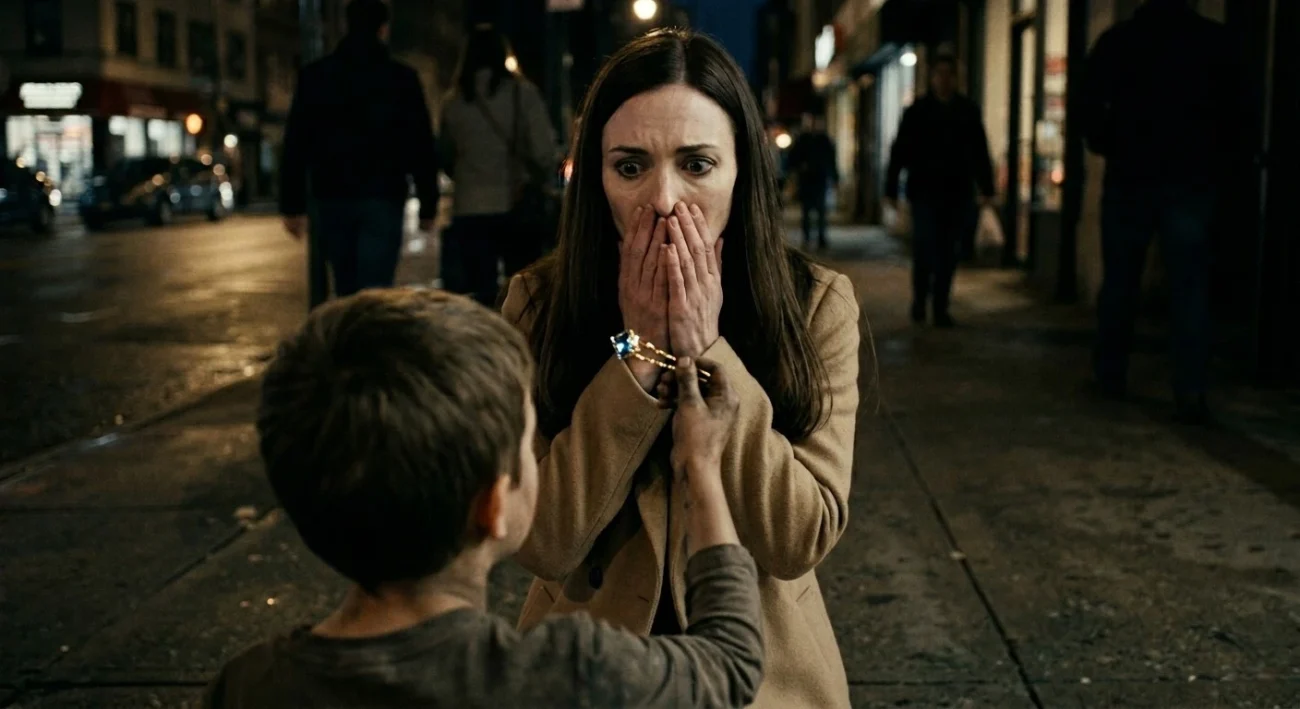
He reached into his torn pocket. His small fingers fished around for a moment, and she half-expected nothing.
Then he pulled it out.
A hairpin.
Gold. Art deco. A tiny inlaid blue stone near the clasp.
Diane’s glass hit the table.
She knew that hairpin. She had spent years not thinking about it—burying it under work and apartments and a career that kept her too busy to feel anything she didn’t want to.
Her hand moved on its own. She took it from him.
“Where did you get this?” Her voice had dropped to almost nothing.
“My mom kept it,” he said. “She said if I ever found you—” He faltered. “She said you’d believe me if I had it.”
Diane’s throat tightened. “What’s her name?”
The boy looked her straight in the eyes. “Anaya.”
The sound hit her like a physical thing.
She stood up so fast her chair scraped back and the couple at the next table flinched. She didn’t notice. She didn’t notice anything except the ringing in her ears and the hairpin she was gripping so hard the clasp bit into her palm.
Anaya.
Her younger sister. Gone for nine years.
No fight. No warning. One morning Diane had woken up to an empty bedroom and a family that would spend the next three years pretending it hadn’t happened. Her parents had eventually stopped saying the name out loud, like grief could be managed by omission.
Diane had never stopped looking. For two years she’d paid a private investigator. Nothing.
And now this boy was standing in front of her in a restaurant that cost four hundred dollars a seat, holding proof.
“Where is she?” she asked. “Right now—where is she?”
Marcus looked at the floor. “She’s sick.”
“How sick?”
He didn’t answer right away. That was its own answer.
“Take me to her,” Diane said.
“She didn’t want me to—”
“Marcus.” She crouched down to his level, and she was aware, vaguely, that the entire restaurant was watching. She didn’t care. “Please.”
He studied her face for a long moment. Then he nodded.
They left through the front door. Diane didn’t wait for the check.
She followed him down streets that changed fast. Within three blocks the restaurant could have been a different city. The pavement cracked. The lights thinned out. She walked on instinct because her heels were useless on the broken asphalt and her brain had stopped processing anything except forward.
Marcus never looked back to check on her. He just walked, fast and purposeful, turning corners without hesitation.
Finally, he stopped in front of a narrow building that had probably been a storage unit once. The door was a piece of wood propped shut.
“In here,” he said.
Diane pushed it open.
A single bulb hung from a wire. A plastic bag of groceries sat in the corner. A folding table. Two plastic chairs. And on a thin mattress on the floor, covered by a clean blanket that looked carefully washed—
A woman.
Thin. So thin.
Dark hair spread across a flat pillow. Skin pale in a way that had nothing to do with light.
But Diane knew that face. She had grown up next to that face. She had borrowed earrings from that face and stolen cereal from the shelf above it and once, when they were teenagers, cried into the shoulder beneath it.
“Anaya,” she whispered.
Anaya’s eyes opened.
For a second there was just confusion. Then they focused.
“Diane.” Her voice was hoarse and barely there. “You… you actually came.”
Diane was across the room before she’d made a decision to move. She dropped to her knees on the bare floor and grabbed Anaya’s hand with both of hers.
“Why?” she said. “Nine years. We looked everywhere. Mom—” Her voice cracked. “Mom wouldn’t say your name by the end. Do you know what that was like? Do you know what I thought happened to you?”
Anaya closed her eyes. “I know.”
“Then why—”
“Because I was a mess, Diane.” She opened her eyes again. “I was using. I owed people money. I did things I—” She stopped. “You had just gotten the job at Harmon. You were finally building something real. I thought if I stayed near you, I’d drag you down. The way I’d dragged everyone down.”
“That was not your decision to make.”
“I know that now.”
“You don’t get to decide what’s too much for me.”
“I know.”
Diane’s grip tightened on her hand. “And him?” She looked over her shoulder at Marcus, who had settled himself against the wall, watching both of them with careful eyes. “He’s yours.”
“He’s mine.” A faint smile crossed Anaya’s face. “He’s also the best thing I ever did.”
Marcus didn’t smile back. He just kept watching. Steady. Older than eight.
“When did this—” Diane gestured at Anaya’s condition. “How long have you been like this?”
“It came back in February.” Anaya’s voice was matter-of-fact. “The cancer. First time was five years ago. I handled it. This time—” She paused to breathe. “This time I needed help.”
“And you sent a child.”
“I sent the only person I trusted.” Anaya looked at Marcus. “He’s been taking care of me for two months. Walking to the pharmacy. Counting pills. Finding food.” Her voice caught for the first time. “He shouldn’t have had to do any of that.”
Marcus said, from the wall, “I didn’t mind.”
“I know, baby.” Anaya looked back at Diane. “I kept the hairpin in case. In case it got bad enough that I had to try. That I had to ask.”
Diane was quiet for a moment. The bulb overhead buzzed faintly. Outside, somewhere, a car passed.
“You didn’t have to ask,” she said finally. “You never had to ask.”
“You’re not going to lecture me more?”
“Oh, I’m absolutely going to lecture you more.” Diane squeezed her hand. “I have nine years of lectures ready. But first I’m getting you a doctor.”
She called three people in the next twenty minutes.
Her own physician. Her assistant. And a car.
Marcus sat on the mattress beside his mother while Diane paced the small room, phone pressed to her ear, arranging things with the flat efficiency she usually reserved for quarterly reports. Treatment facilities. Insurance logistics. A specialist she’d met at a fundraiser two years ago and never expected to need.
When she hung up from the last call, she sat down on the floor beside both of them.
“Marcus,” she said.
He looked at her.
“You did something very brave.”
He considered this. “Mom said you’d be mean at first.”
Diane almost laughed. “She’s not wrong.”
“She also said you’d fix it once you stopped being mean.”
Anaya made a sound that was half cough, half laugh. “I said no such thing.”
“You said she’d make it right.” He shrugged. “Same thing.”
Diane looked at him for a long moment. The dust on his knees. The worn-through soles of his sneakers. The complete lack of self-pity in his face.
“You’ve been carrying this alone for two months,” she said.
“We were okay.”
“You were not okay.”
He thought about it. “We were okay enough.”
That hit her somewhere she hadn’t expected. She looked away before she embarrassed herself.
Three weeks later, Anaya was in a treatment facility forty minutes from Diane’s apartment. A real one, with actual oncologists and a team and a nutritionist who argued with Anaya about protein twice a week, which Anaya complained about constantly and which Diane took as a good sign.
Marcus had a bed. Real sneakers. A school that didn’t know yet how sharp he was and would figure it out by October.
On his first morning in Diane’s apartment, he stood at the kitchen window and looked out at the city below.
“It’s loud,” he said.
“You get used to it,” Diane said.
“Mom said you’d say that.”
“Your mom apparently told you everything about me.”
He turned around. “She talked about you a lot. When it was bad.” He said it with the directness that had become familiar. “She said thinking about you made her feel like she’d made at least one good choice. Keeping the hairpin.”
Diane set down her coffee. “She said that?”
“Mostly she said it at night when she thought I was asleep.” He turned back to the window. “I wasn’t asleep.”
Diane stood there for a moment in her kitchen, in her quiet, ordered apartment that had always looked the way she’d built it to look, and felt something come loose that had been locked for a very long time.
“Marcus,” she said.
“Yeah.”
“I’m glad she kept it.”
He nodded like that was the obvious response. “Me too.”
The first Sunday Anaya was well enough to sit outside, they brought her a chair by the facility garden.
Marcus sat cross-legged on the grass. Diane sat in the other chair, close enough to be within arm’s reach.
They didn’t say much. The afternoon light came through the trees at an angle that made everything feel like it was holding still on purpose.
After a while, Anaya said, “I’m sorry. For all of it.”
“I know,” Diane said.
“I need you to actually forgive me. Not just—”
“I forgive you.” No pause. No condition. “I forgave you somewhere around the second block when I was following a barefoot eight-year-old through the dark.”
Anaya laughed. A real one. Weak, but real.
Marcus looked up from the grass. “I knew you’d find her.”
“You were pretty confident,” Diane said.
“Mom said you never quit anything.”
Anaya reached out and touched Diane’s arm. Diane looked down at her sister’s hand—thinner than it should be, but warm.
“We’re going to argue about so many things,” Anaya said.
“Constantly,” Diane agreed.
“And you’re going to be insufferable about paying for everything.”
“Absolutely.”
Anaya squeezed her arm. “Good.”
Diane reached up and touched the hairpin she’d worn in her hair that morning—back where it belonged, back where it had always been going—and didn’t say anything else.
Some things didn’t need a word. They just needed to be kept.
Original fictional stories. AI-assisted creative content.
