
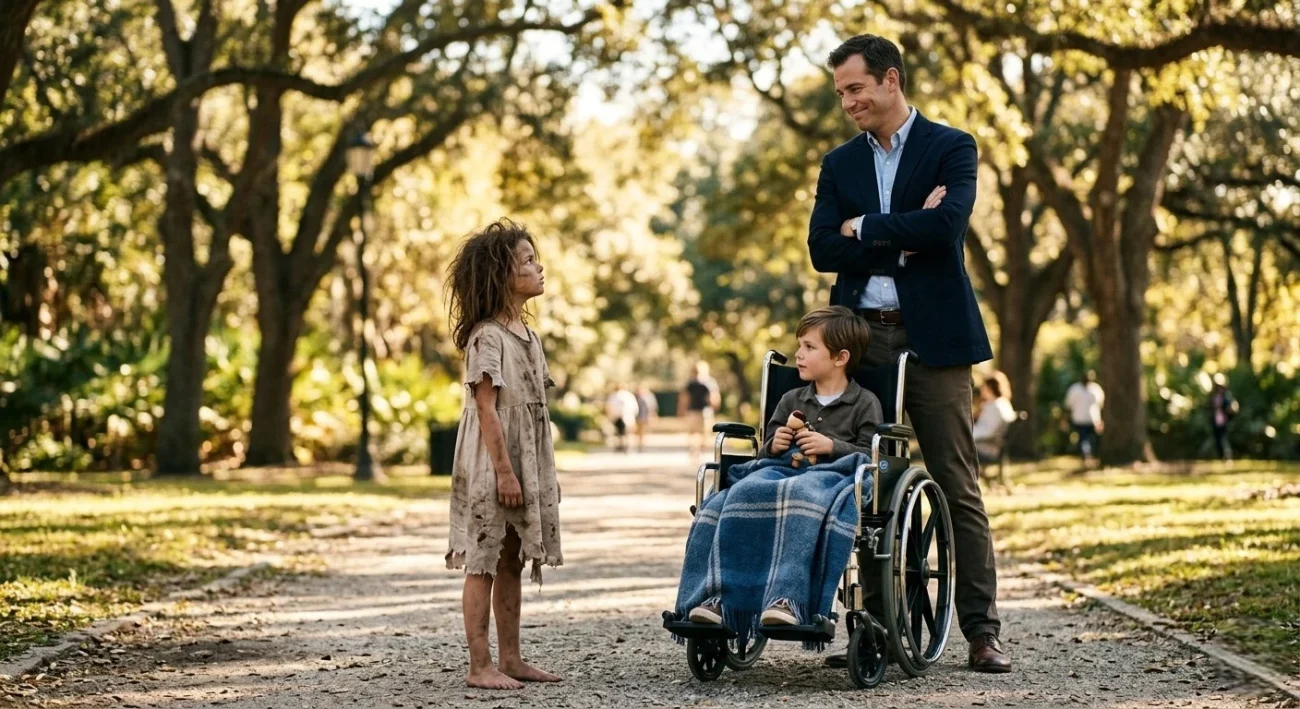
Ethan Cole had heard every pitch. Faith healers, neurologists with experimental protocols, a shaman his assistant had booked out of guilt. None of it worked. None of it would. The spinal contusion was permanent — three different doctors had said so using three different words that all meant the same thing.
So when a barefoot ten-year-old stepped out from behind a dry fountain and told him she could heal his son, he didn’t get angry. He almost laughed.
“Walk away, kid,” he said. “I’m serious.”
The girl didn’t move. She had faded braids and a dress two sizes too big, and eyes that looked at him like she already knew what he was going to say next.
“I’m not selling anything,” she said. “I’m not asking for money.”
“You asked me to adopt you.”
“That’s different.”
Noah had gone quiet in his wheelchair. He was watching her the way he watched things he hadn’t decided about yet — head tilted, hands still.
“What’s your name?” Noah asked.
She looked at him. Something in her posture shifted, softened.
“Mara.”
“I’m Noah.”
“I know.”
Ethan stepped between them. “That’s enough.” He kept his voice low, controlled. “I don’t know what your situation is, but this isn’t the place. There are shelters on Fifth—”
“I’ve been to all of them,” Mara said. She wasn’t arguing. Just stating it. “I’ve been in the system since I was four. Six placements. The last one—” She stopped. “It doesn’t matter. I’m not here to talk about me.”
“Then why are you here?”
She looked past him at Noah. “Because I saw him last Sunday. And the Sunday before. And I know what’s wrong.”
“The doctors know what’s wrong.”
“The doctors know what their machines say.” She finally looked back at Ethan. “That’s not the same thing.”
He stared at her for a long moment. She was ten years old and homeless and completely unblinking.
“You have thirty seconds,” he said. “Say what you came to say.”
Mara stepped around him like he wasn’t there and crouched down in front of Noah’s wheelchair. She didn’t touch him. She just looked at his legs.
“Does it feel like cold?” she asked. “From the knees down?”
Noah blinked. “…Yeah. Kind of. Like someone left a window open.”
“And sometimes you feel something. A flicker. Like your foot’s about to move. But then it doesn’t.”
Noah’s breath caught. He looked up at his father with an expression Ethan hadn’t seen in two years — raw, startled hope.
“How did you—” Noah started.
“It’s not severed,” Mara said. “The connection’s still there. It’s just—” She paused like she was choosing the right word. “Stuck.”
Ethan’s jaw tightened. “The MRI was clear. The contusion—”
“Show me his spine imaging,” she said.
“You’re ten.”
“I know what I’m looking for.”
He should have walked away. He knew that. But Noah was already asking quietly, “Dad. Please.”
And that word — please — was the one word Ethan Cole could never argue with.
He pulled up the MRI files on his phone. Three of them. He’d looked at them so many times he could describe every grey shadow. He turned the screen toward her.
Mara studied the images with an attention that made his skin prickle. She wasn’t performing. She wasn’t pretending. She was actually looking.
“Here,” she said, pointing to the lower thoracic. “That compression. The doctors said it was permanent because the inflammation never fully resolved. But the nerve roots aren’t damaged. They’re just—buried.”
“That’s not a medical term.”
“No.” She handed the phone back. “But I’m right.”
“And what? You’re going to fix it with your hands? You’re going to do what three specialists couldn’t?”
Mara was quiet for a moment. The afternoon light caught the side of her face and for a second she looked older than ten. Much older.
“I don’t know how it works,” she said. “I never did. I just know that sometimes I can feel where things are wrong and I can…” She made a small gesture with her hands that didn’t translate into words. “Push.”
“You’re describing a miracle.”
“I’m describing the only thing I have to offer.” She met his eyes. “You can say no. I’ll understand. But you asked me to say what I came to say.”
Ethan looked at his son.
Noah was gripping the armrests of his wheelchair. Not in distress. In anticipation.
“Dad,” he said. “What if she’s right?”
Ethan closed his eyes for one second.
Then he said, “Don’t touch him until I say so.”
He made three calls in the next twenty minutes. His personal physician. The lead neurologist on Noah’s case. His lawyer, out of pure habit.
The doctor said it was impossible. The neurologist said the same. His lawyer said, “If she hurts him, you’ll have grounds.”
None of them were there, watching this girl sit on the edge of the fountain with his son, not performing, not selling, just talking to him the way kids talked to each other when no adults were listening.
He walked over.
“My people say it’s impossible,” he said.
Mara nodded. “I know.”
“If you hurt him—”
“I won’t.”
“If you’re running some kind of—”
“Mr. Cole.” She looked at him steadily. “I have nothing. I don’t have a phone or a family or a place to sleep tonight. I’m not running anything.” A beat. “I just want a home. And the only thing I have to trade is this.”
The honesty of it stopped him completely.
He sat down on the bench beside the wheelchair. He felt tired in a way he hadn’t felt in a long time — not the exhausted tired, but the kind that came when you ran out of reasons to keep refusing.
“Okay,” he said. “Show me.”
Mara knelt on the gravel in front of Noah’s chair. She placed her hands flat on his knees — barely any pressure, just contact.
She closed her eyes.
For a moment nothing happened. A pigeon landed near the fountain. Wind moved through the trees. Ethan watched his son’s face.
Noah’s brow furrowed. He made a small sound — not pain, something else.
“I feel it,” he whispered.
“Don’t fight it,” Mara said. Her voice had changed — still quiet, but concentrated, like she was doing math in her head. “Just let it move.”
“It burns a little.”
“I know. That’s good.”
Ethan was on his feet without realizing it.
Then Noah gasped.
His left foot twitched under the blanket.
Ethan stared. His mouth went dry. That foot had not moved in two years. Two years of physical therapy, of electrical stimulation, of a specialist who had flown in from Berlin — and this girl, this homeless child with uneven braids and no shoes, had just—
Noah’s leg moved again. His knee bent. Slightly. Awkwardly. Like a machine powering on after a long shutdown.
“Oh,” Noah said. And started to cry.
Mara didn’t open her eyes for another thirty seconds. When she did, she looked drained. She sat back on her heels and breathed slowly.
“Both sides?” Ethan managed.
“The right will take longer,” she said. “A few sessions. Maybe a week.”
“Sessions.”
“If you’ll let me.”
Ethan Cole — who had negotiated billion-dollar acquisitions without blinking, who had buried his wife and kept going, who had spent two years being completely certain of everything that was and wasn’t possible — sat back down on the bench and put his face in his hands.
Not because he was sad.
Because he didn’t know what else to do with the feeling.
He called his estate manager that evening.
“Open the east guest suite,” he said. “And get Dr. Prentiss on standby. I need him available daily starting tomorrow.”
“Is this for a patient?”
“A kid. She’ll need a full medical workup.” He paused. “And clothes. She doesn’t have clothes.”
“Sir, is this a — are you taking in a child?”
“I’m exploring it.”
“Should I involve family services?”
He thought of what Mara had said. Six placements. The way she’d stopped before finishing that sentence.
“Yes,” he said. “And get me the best family law attorney in the state. I want to know what a private adoption looks like and how fast it can move.”
Over the next five days, Mara worked on Noah every afternoon in the garden.
Ethan watched the first three sessions. Then he stopped watching and started preparing. He commissioned a new medical workup through his neurologist — this time looking specifically at what Mara had pointed out on the imaging. The results came back on day four.
He read the report three times.
The neurologist’s note at the bottom said: The compression appears to have reduced significantly since previous imaging. Nerve root accessibility has improved in a way we cannot clinically account for. Recommend continued monitoring.
Cannot clinically account for.
Ethan had that line printed out and put it in a folder. He didn’t know why. It felt like evidence of something he hadn’t named yet.
On day six, Noah stood up.
Not for long. Not without holding the back of the garden chair. But he stood — on his own two feet, with his own legs carrying his weight — and he looked at his father across the garden with that expression that Ethan had been afraid he would never see again.
Pure, clear, unguarded joy.
Ethan walked to his son, wrapped both arms around him, and didn’t say a single word.
Behind them, Mara sat on the garden step, watching. She looked tired. She also looked like she was trying very hard not to cry, because she had taught herself not to, and some lessons are very hard to unlearn.
The family law attorney filed the petition ten days after Mara had appeared at the fountain.
It moved faster than anyone expected. The family services investigation confirmed everything Mara had said — six placements, a record of neglect, no living relatives willing to take custody. The judge expedited the hearing given the circumstances.
Mara sat beside Ethan in the courtroom in a blue dress that still had the tags on it because she’d refused to let the estate manager cut them off until she was sure she was staying.
The judge looked at her over his glasses.
“Do you understand what this proceeding means, young lady?”
Mara looked back at him, steady as ever.
“It means I’d have a family,” she said.
The judge signed the papers.
Three months later, Noah walked across the living room on his own.
Not just a few steps. All the way across. He stopped at the window and looked out at the garden, and then turned around and walked back.
Mara was sitting on the couch doing homework. She looked up when he reached her, and held out her fist.
He bumped it with his.
“Told you,” she said.
“You told my dad.”
“I told you first.”
He grinned. “Yeah. You did.”
Ethan stood in the doorway, watching the two of them, and thought about the word impossible — how many times he’d said it, how firmly he’d believed it, and how thoroughly one barefoot girl with uneven braids had turned it to dust.
He had given her a home.
She had given him his son back.
There was no word for that. So he didn’t try to find one. He just turned off the hallway light, walked into the room, and sat down with his family.
Original fictional stories. AI-assisted creative content.
