
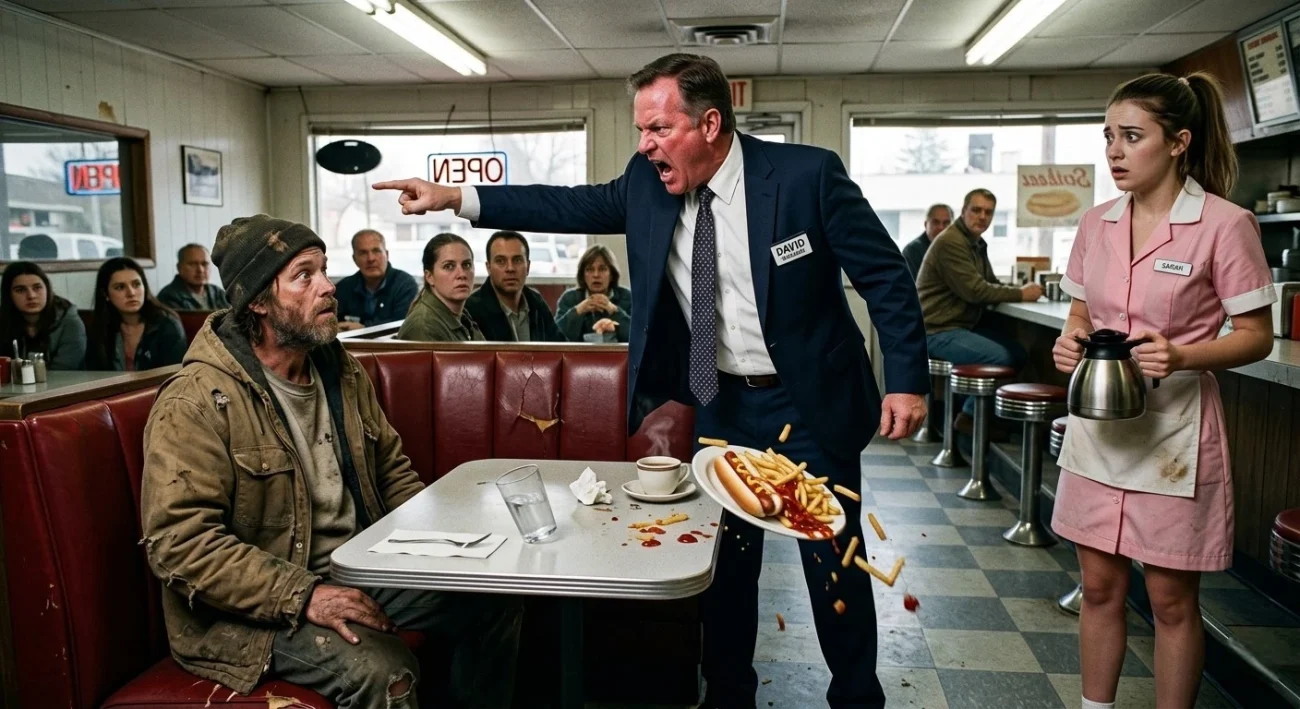
The bell above the door at Sal’s Route 66 Diner didn’t ring so much as wheeze — a tired little sound that matched everything else about the place. The checkerboard floors had given up being black and white somewhere around 1987 and settled into a uniform grey. The neon sign outside flickered on the word “OPEN” like it was having second thoughts.
Arthur stepped inside.
He was wearing a canvas jacket so caked with mud it had formed its own geological layers. A knit cap pulled low over his forehead. Three days of stubble. Hands roughened with prop-grade grime from the kit his assistant had packed the night before.
He looked like a man the highway had chewed up and spit out.
He slid into a corner booth.
The vinyl seat cracked under him. He set both hands flat on the table — carefully, the way a man does when he’s deciding whether a surface will hold — and stared at the laminated menu without reading it.
The coffee came first.
Sarah set it down without ceremony, the way seasoned waitresses do when they’ve long since stopped performing cheerfulness. She was twenty-six, maybe twenty-seven, with the kind of tired that doesn’t come from a bad night’s sleep but from a thousand bad mornings in a row.
“Anything else?” she asked.
“Just the coffee for now,” Arthur said. His voice was quiet, a little rough around the edges. He’d practiced that, too.
Sarah nodded and moved on.
He sat with the cup between both hands and watched.
The morning rush — such as it was — had thinned to a handful of regulars. A truck driver in the far booth working through a Grand Slam. Two women in scrubs splitting a muffin. A retired couple sharing a newspaper in companionable silence.
Nobody looked at Arthur.
That was the first data point.
In a well-run establishment, a server checks on every customer within ninety seconds of seating. Sarah had clocked him the moment he walked in and made a judgment call — coffee first, no fuss — and she’d been right. In a poorly run establishment, he would have been asked to leave already.
He made a note of it mentally.
The diner smelled of burnt coffee and old grease and something underneath both — a faint sweetness, like pie that had been in the warmer since Tuesday. The fluorescent light overhead buzzed at a frequency that would give you a headache by noon if you worked under it every day.
Arthur had bought this franchise eight weeks ago as part of a nine-location acquisition. He hadn’t seen the inside of a single one of them in person.
That was the second data point.
He turned his coffee cup in slow circles and listened.
From the kitchen, sound carried clearly — the clang of pans, a radio playing classic rock at low volume, someone arguing about a ticket order. The ticket system was handwritten. He’d seen that from the menu station. No digital display. He filed that away.
Sarah appeared again.
She set a plate down in front of him. Two hot dogs, a small paper cup of mustard, a handful of fries on the side.
Arthur blinked.
“I didn’t order—”
“Kitchen made an extra batch this morning,” she said, not quite meeting his eyes. “Happens sometimes. They just go in the trash otherwise.” A small shrug. “Seemed like a waste.”
It wasn’t true. He knew it wasn’t true.
He looked at the plate. Then at her.
“Thank you,” he said.
She nodded once and walked away before it could become anything more.
Arthur brought his palms together just briefly — not a prayer exactly, more like a punctuation mark — and picked up a hot dog.
He had eaten at eleven Michelin-starred restaurants in the last two years. He had a chef on retainer at his apartment in Chicago.
This was the best thing he’d tasted in months.
He was halfway through the second hot dog when the kitchen door swung open hard enough to bang against the wall.
Whittaker came out like a weather system.
He was mid-forties, the kind of man who wore a suit in a diner not because the corporate handbook required it but because the suit was the only thing between him and the acknowledgment that he wasn’t as important as he believed. His name badge said MANAGER in capital letters above the franchise logo.
He spotted Arthur’s booth from fifteen feet away and his face went the particular shade of red that comes from a specific cocktail: entitlement, disgust, and fear of what other customers might think.
He crossed the diner in eight steps.
“Hey.” He didn’t lower his voice. “Hey, you.”
Arthur looked up.
“You can’t be in here,” Whittaker said. “We don’t — this isn’t a shelter. You understand me?”
“I’m a customer,” Arthur said pleasantly. “I have coffee.”
“Sarah.” Whittaker turned without waiting for Arthur to respond. “Sarah, did you seat this man?”
Sarah came around from the counter. Her jaw was set. “He came in and sat down. I served him.”
“I can see that.” Whittaker turned back to the booth. “Sir, I need you to leave. You’re making other customers uncomfortable.”
Arthur looked around the diner.
The truck driver had stopped eating. The women in scrubs were watching. The retired couple had put down their newspaper.
None of them looked uncomfortable.
They looked like they were waiting to see what would happen next.
“I don’t believe I am,” Arthur said.
Whittaker leaned in closer. Up close, you could see the thing underneath the authority — something wound very tight, something that didn’t like being disagreed with in his own establishment.
“I’m not asking,” he said. “I’m telling you. Get up.”
“I have food.”
“About that.”
What happened next took less than three seconds.
Whittaker reached across the table, grabbed the plate, and in one sharp motion, pitched it underhand toward the floor beside the booth.
The hot dogs hit the grey checkerboard with a sound that was somehow both small and enormous.
The mustard cup bounced twice.
The fries scattered.
The diner went completely silent.
Not the normal restaurant lull between conversations. The kind of silence where every single person holds their breath at exactly the same moment.
“There,” Whittaker said. “Now you don’t have food. Now you leave.”
Arthur looked at the floor.
He looked at the ruined hot dogs — the ones Sarah had slid onto a plate without being asked, the ones she’d lied about to preserve his dignity, the ones she’d given out of some stubborn private conviction that it mattered.
He looked at Whittaker.
And then, slowly, Arthur reached up and pulled off the knit cap.
He set it on the table.
He unzipped the canvas jacket — the one his assistant had spent forty minutes distressing with actual mud from a construction site — and folded it over the back of the booth.
Underneath was a suit. Black, precisely tailored, the kind of fabric that absorbs light rather than reflecting it. A white shirt, collar crisp. No tie — he’d learned years ago that ties made people look at your throat instead of your eyes.
He reached into the interior breast pocket and produced a badge.
Not the laminated franchise manager badge that Whittaker wore.
A small, heavy rectangle of matte black metal. Laser-etched. Four letters across the top: NEXG. And below that, one word: CEO.
He set it on the table next to the knit cap.
Then he looked at Whittaker.
“I acquired this franchise eight weeks ago,” Arthur said. His voice had changed — not louder, but cleaner. The roughness gone. The cadence of a man accustomed to rooms going quiet when he spoke. “I’ve been conducting an unannounced operational review. This location specifically has had three formal complaints filed in the last quarter. Poor service metrics. High staff turnover. One health code advisory.”
Whittaker had not moved. His face had gone from red to something closer to chalk.
“I came in today,” Arthur continued, “to see how this location treats its most vulnerable customers.” He glanced at the floor. “Now I know.”
“I — you — I didn’t — “
“You threw food on the floor,” Arthur said. “In front of a full dining room. In a franchise that depends on repeat business and word-of-mouth.”
“I thought you were—”
“A homeless man.” Arthur let that sit for a moment. “Yes. You did. And you believed that gave you the right to do what you just did.” He stood. He was taller than he’d seemed hunched in the booth. “It didn’t.”
Whittaker’s mouth was opening and closing.
“Mr. Whittaker.” Arthur picked up his badge and slipped it back into his pocket. “You’re terminated, effective immediately. HR will be in contact within twenty-four hours regarding your separation package. Please surrender your keys and your badge to the assistant on shift and exit the premises.”
The room was still not breathing.
Whittaker stared. “You can’t — you’re not — I need to see—”
“You’ve seen,” Arthur said simply.
He turned.
Sarah was standing three feet away, a coffee pot in one hand, watching him with an expression that was not quite shock and not quite relief but something in the middle — the look of a person who has been waiting for something to make sense for a very long time.
Arthur reached into his breast pocket again.
He produced a second badge.
This one was the franchise manager badge — the same laminated format as Whittaker’s, except the name field was blank. He’d had three of them printed before he walked in this morning, one for each of the locations he’d be visiting this week.
He held it out.
Sarah didn’t move.
“You made a call this morning,” Arthur said. “You saw a person who needed something, and you made a quiet decision to help him, without asking permission and without making a show of it. That’s judgment. That’s exactly what I need managing this location.”
“I’m a waitress,” Sarah said.
“Not as of this morning.”
She looked at the badge. “I don’t have a degree in—”
“I’m not hiring your degree,” Arthur said. “I’m hiring the decision you made at seven forty-three this morning when you put two hot dogs on a plate for a stranger.” He held the badge out steadier. “The operational stuff is trainable. What you did isn’t.”
Sarah set the coffee pot on the nearest table.
She took the badge.
She looked at it for a moment — just a moment — and then she pinned it to her uniform, right over the little embroidered Sal’s logo on her left breast pocket.
From the back of the diner, someone started clapping.
It was the truck driver.
Then the women in scrubs.
Then the couple with the newspaper.
And then, from the kitchen doorway — the line cook, still holding a spatula, and two of the other servers who’d drifted out to see what the commotion was — all of them, one after another, picking up the rhythm.
It wasn’t a standing ovation. It wasn’t dramatic. It was the sound of people who’d been watching someone get treated wrong for a long time, finally watching the math come out right.
Whittaker stood in the middle of it all, not looking at anyone.
“Keys and badge,” Arthur said to him, without turning around. “Leave them with Sarah.”
Three hours later, Arthur sat at a table in the back office — a converted storage room with a folding table, a router blinking on a shelf, and stacks of paper supply orders going back two years — and went through the books with a regional operations manager he’d called in from the city.
Sarah knocked on the door frame.
“You want more coffee?” she asked.
“Please,” Arthur said.
She came in, refilled his cup, and started to leave.
“Sarah.”
She stopped.
“The hot dogs,” he said. “You paid for those yourself?”
A pause. “The kitchen was going to throw them out.”
“Sarah.”
Another pause. “Yeah,” she said. “I paid for them.”
“How often do you do that?”
She shrugged, but it wasn’t a dismissive shrug — it was the shrug of someone who has never been asked and doesn’t quite know how to answer. “When I can.”
Arthur nodded. He wrote something on the notepad in front of him — a number — and slid it across the table.
“That’s your starting salary,” he said. “As manager. Benefits package comes through HR next week. And I’m adding a discretionary fund to this location’s budget — two hundred dollars a month, manager’s judgment, no questions asked. Use it however you think is right.”
Sarah looked at the number.
She looked at him.
“Why?” she said. Not suspiciously. Just — genuinely wanting to know.
“Because systems work the way the people inside them decide they work,” Arthur said. “I can write all the policies I want. At the end of the day, a diner runs on whether the person holding the coffee pot gives a damn.” He capped his pen. “You do. That’s worth compensating.”
Sarah was quiet for a moment.
“Whittaker was here for six years,” she said.
“I know.”
“He did this — not always with food on the floor, but — he did this. Regularly.”
“I know that too,” Arthur said. “It’s in the complaint records. I should have looked at them more carefully eight weeks ago when I bought this location.” He met her eyes. “That’s on me. I’m sorry it took this long.”
Sarah absorbed that.
“Okay,” she said finally.
“Okay,” he agreed.
She picked up the coffee pot and walked out.
The operations manager across the table waited until her footsteps had faded, then looked at Arthur.
“You always this direct?” he asked.
“When it costs me less than the alternative,” Arthur said, and turned back to the books.
Six weeks later, Sal’s Route 66 Diner — location seven — posted its highest single-month revenue in four years.
Sarah had renegotiated the supplier contract for coffee beans, switched to a digital ticket system (her cousin’s company, whom she’d vetted and insisted Arthur’s procurement team evaluate independently), and hired two additional morning servers.
The health code advisory was resolved in the first week.
Staff turnover dropped to zero.
The discretionary fund, in its first month, paid for three meals for a woman who’d come in soaking wet from the rain with a toddler and an empty wallet, a set of warm socks left anonymously at the trucker’s table by the window, and a birthday cake for the line cook who’d worked at Sal’s for eleven years and never had one.
Arthur saw the fund report in his weekly operations digest.
He forwarded it to his board with one line of annotation:
This is what accountability looks like when it’s done right.
Whittaker filed an unlawful termination complaint three weeks after his firing.
His lawyer withdrew the case two days before the hearing, after reviewing the security footage from the diner’s ceiling cameras — four angles, high definition, time-stamped — showing exactly what had happened to those hot dogs.
He did not receive a settlement.
He did receive a letter, drafted by Arthur’s legal team, notifying him he was prohibited from managing a food service establishment in the state for thirty-six months pending a franchise standards review.
Arthur never went back to the diner in disguise.
He went back twice more as himself — once to check on the supplier transition, once just for coffee.
Both times, Sarah was behind the counter.
Both times, the coffee was excellent.
Both times, he left a twenty-dollar tip and did not make a production of it.
The neon sign outside still flickered on the word “OPEN.”
But now it felt like it meant it.
Original fictional stories. AI-assisted creative content.
