
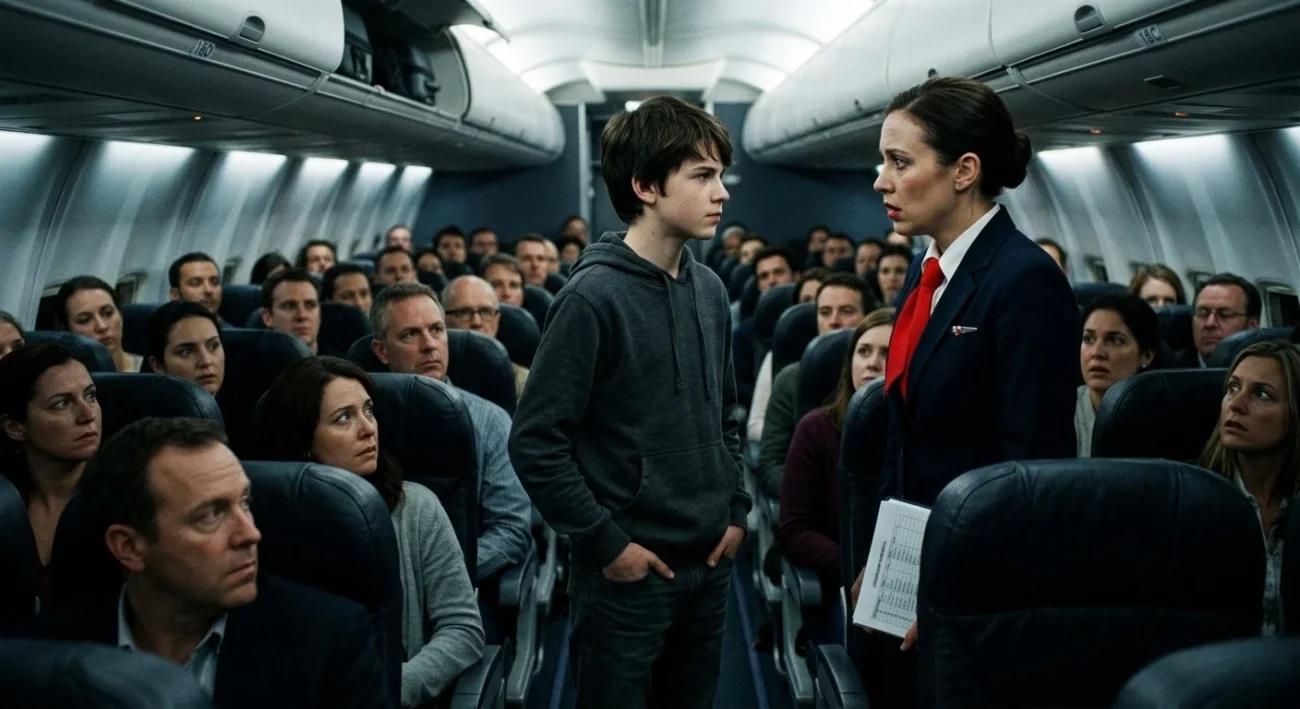
At 34,000 feet, the first sign wasn’t loud. It never is.
It was the coffee.
Daniel watched it creep across the tray table of the man in 18A—slow, deliberate, like it had somewhere important to be. The man himself hadn’t moved. Hadn’t reached for napkins. Hadn’t cursed.
He was just… still.
Daniel, twelve years old, hoodie two sizes too big, earbuds half-in, noticed.
He’d been noticing things his whole life. His mom said it was a gift. His teachers called it distraction. His classmates just called him weird.
Right now, sitting in 22C with a half-eaten bag of pretzels and a science fair project in the overhead bin, Daniel watched a man’s head tilt forward and thought: That’s not sleep.
“Ma’am.”
He tried to flag the flight attendant—Emily, badge slightly crooked—as she passed with a drink cart.
She smiled without looking. “Be right with you, honey.”
She wasn’t.
Two rows ahead, a woman screamed.
Not a big scream. More like a sharp intake of breath that became a sound no one wanted to hear at 34,000 feet.
“He’s not responding—someone help—he’s not—”
The cabin shifted instantly. That particular electricity that moves through a crowd when something real is happening.
Emily dropped the cart.
She pushed through, kneeling beside the man in 18A, pressing two fingers to his neck. Her training took over—her face did not. Daniel could see the exact moment the fear registered.
“Is there a doctor on this flight?” she called out, voice steady but tight. “Please, if anyone has medical training—”
Heads turned. People scanned each other, silently willing someone else to stand.
“This is a life-or-death situation,” Emily said, louder.
A baby started crying in first class.
No one stood.
Daniel’s hand tightened on his armrest.
He knew what he was looking at. His mom had shown him the signs twice, maybe three times, during what she called “dinner table medicine”—the habit cardiologists develop of seeing symptoms everywhere. Gray skin, not blue. Irregular breathing. The specific way the body collapses when the heart loses its rhythm.
Ventricular tachycardia, she’d said once, scrolling through a case study while he ate cereal. Heart’s firing too fast, then too wrong. If you ever see that, the skin goes gray. Blue means oxygen. Gray means electrical.
He’d asked why it mattered.
She’d looked at him like the answer was obvious: Because knowing the difference saves time.
Daniel stood up.
“I can help.”
His voice was smaller than he intended. He cleared his throat and said it again: “I can help.”
Emily turned.
The cabin turned.
The reaction was immediate and unkind.
“Sit down, kid.”
“Is this serious right now?”
“Someone find an actual adult—”
Emily was already striding toward him, and her expression was not encouraging.
“This is not a game,” she said, voice low but sharp. “We are in a real emergency.”
“I know.” Daniel met her eyes. “He’s having ventricular tachycardia. Or close to it.”
She stopped. “What?”
“His skin’s gray, not blue. That means his heart’s still firing, just not right. If it was an occlusion, he’d be blue—oxygen deprivation. Gray means electrical.”
The man in 15B, who’d been leaning across the aisle with his phone, slowly lowered it.
Emily stared at Daniel for a long moment. Something moved through her expression—not belief, exactly, but the shadow of it.
“You’re twelve,” she said.
“I know.”
“Who told you that?”
“My mom.” He pulled the card from his backpack. Laminated, worn at the corners from living inside a front pocket. “She’s a cardiologist. She brings me to simulations. I’m not allowed to touch patients, but she quizzes me. Like, constantly.”
Emily took the card.
CPR & AED Certified — Pediatric Advanced Life Support Observer.
Current date. Legitimate institution.
She turned it over once, twice. Her jaw was tight. Daniel could see her running the math—protocol versus this man’s heartbeat. Liability versus the next forty minutes.
Forty minutes to the nearest airport. The captain had just confirmed it.
“Fine,” Emily said, handing the card back. Her voice had changed—not warm, but functional. Decisive. “You talk. I act. You don’t touch him.”
“Understood.”
They moved fast.
“Lay him flat,” Daniel said, following at Emily’s shoulder. “Elevate his legs—blood to the core. Get the oxygen mask on, full flow.”
Emily worked without hesitation. The man—fifties, suit jacket, wedding ring—was eased into the aisle with help from two passengers who’d stood without being asked.
“Check his pulse again,” Daniel said. “Count the beats. Tell me what you feel.”
“Rapid,” Emily said, pressing her fingers to his neck. “Irregular. Skipping.”
“That’s consistent.” Daniel looked at the AED unit a flight attendant was already unzipping from the overhead compartment. “If it drops or stops, we’ll need that.”
“We?” Emily glanced up sharply.
“I’ll guide you through it.”
She held his gaze for one second. Then she nodded.
The AED pads went on. The machine powered up with a sound that made three passengers flinch. Its voice filled the cabin, calm and synthetic:
ANALYZING HEART RHYTHM. DO NOT TOUCH THE PATIENT.
No one breathed.
NO SHOCK ADVISED.
Daniel exhaled. “Okay. That’s good. It means his rhythm’s unstable but not in full arrest. We have time.”
“How much time?” Emily asked.
“Not much. But some.”
A flight attendant crouched beside him, voice hushed. “Are you actually—do you actually know what you’re doing?”
Daniel looked at the man on the floor. “I know what my mom taught me. That’s all I’ve got.”
The minutes that followed felt underwater. Slow and airless.
Daniel talked Emily through position adjustments, through the oxygen rate, through watching for the specific color changes in the man’s lips and fingernails that would signal what came next. A passenger named Reyes—who turned out to be an EMT, too nervous to speak up initially—joined them, and the three of them formed an unlikely team in the aisle of seat rows 17 through 19.
Reyes kept looking at Daniel sideways.
“You’re twelve?” he said at one point.
“Almost thirteen,” Daniel said.
“Your mom know you’re this…”
“She’s the reason I’m this.”
Reyes laughed once, short and disbelieving, then went back to work.
The AED shrieked at minute eleven.
Not the voice prompt. The alarm—three sharp tones that meant the rhythm had crossed into dangerous territory.
Daniel’s voice sharpened instantly.
“Shock now.”
Emily’s hand hovered. One fraction of a second.
“Emily.” Daniel looked her dead in the eye. “NOW.”
She pressed the button.
The man’s chest jolted. The cabin gasped collectively—one sound, one breath.
Silence.
Then a ragged inhale.
The man breathed.
Not well. Not cleanly. But he breathed.
Someone in 23D started crying. Openly, without apology. Someone else started clapping and then stopped, embarrassed by the sound of it against the quiet.
Emily sat back on her heels. Her hands were shaking.
Daniel stood very still in the aisle, his heart hammering so hard he could feel it in his palms. He pressed them into his pockets—an old habit. His mom always said: Don’t let them see the shake. It scares people. Save the shake for after.
He was saving it.
The plane landed eleven minutes later.
Emergency crews were on the tarmac before the wheels fully stopped—three paramedics and a gurney, lights cutting through the gray afternoon. The man from 18A was taken off first, oxygen mask in place, eyes flickering open as they lifted him.
His wife, who’d been in the window seat beside him—silent with shock through the whole ordeal—gripped Daniel’s arm as she passed him in the aisle.
She didn’t say anything.
She didn’t have to.
The jet bridge was chaos. Passengers bunching up, phones out, voices overlapping.
“—just a kid, I swear—”
“—knew exactly what—”
“—could not believe—”
Daniel kept his head down and moved with the crowd, backpack straps tight, science fair project tucked under one arm.
Emily caught him before he reached the gate.
“Hey.” She stepped in front of him, and her voice had changed completely from the woman who’d told him to sit down. “I owe you an apology.”
“You don’t,” he said.
“I do.” She crouched slightly, eye level. “I dismissed you because of how you looked. That was wrong. I almost made a catastrophic mistake because of an assumption I made in about two seconds.”
Daniel shrugged. “I’m used to it.”
That landed on Emily like a stone.
“You shouldn’t have to be,” she said.
He looked at her for a moment—really looked, the way he looked at things when he was filing them away.
“My mom says the fastest way to prove yourself is just to know your stuff,” he said. “So I know my stuff.”
“You do.” Emily straightened. “What’s your name?”
“Daniel.”
“Daniel.” She extended her hand, formally, like he was a colleague. “Thank you.”
He shook it. “Tell the guy in 18A to go easier on the sodium.”
Emily blinked.
Daniel almost smiled. “Dinner table medicine.”
He walked through the gate.
The story broke that night—a passenger’s video, shaky and vertical, catching the moment Daniel stood up and said I can help while the whole cabin told him to sit down. It had no soundtrack except the ambient hum of the engines and the sound of someone nearby whispering oh my God.
By morning it had fourteen million views.
By afternoon, it had a name: The Kid in 22C.
Interview requests flooded in. News anchors used words like hero and extraordinary and remarkable.
Daniel sat in a hospital waiting room in his too-big hoodie, eating vending machine crackers, while his mom—Dr. Patricia Osei-Mensah, cardiologist, the woman who had quizzed him over cereal and dragged him to simulations and explained ventricular tachycardia while he was trying to watch TV—stood at the desk, talking to the man’s care team.
When she came back and sat beside him, she didn’t say anything for a long time.
Daniel ate a cracker.
“They said he’ll be okay,” she told him.
“I figured.”
She looked at him sideways. “I heard you told them to watch his sodium.”
“It was an educated guess.”
His mom laughed—a real one, sudden and warm and slightly undone. Then she put an arm around him and didn’t let go.
“You scared me,” she said quietly.
“I know.”
“You did exactly right.”
“I know.”
“Don’t get cocky.”
“I’m not.”
She pulled him closer.
In the man’s room, one floor up, Robert Hale—fifty-four, father of two, sales director, guy who always skipped his cardiology follow-ups because he was too busy—woke up to his wife’s face and the soft beeping of a monitor.
He didn’t know the name of the boy who’d kept him alive. He didn’t know he’d been the subject of a viral moment. He didn’t know about the fourteen million views or the news anchors or the hashtag.
He just knew he was breathing.
His wife took his hand. “There was a boy,” she told him. “On the plane. He stood up when everyone else sat down.”
Robert blinked at the ceiling. “How old?”
“Twelve.”
He was quiet for a moment.
“Someone believed him?” he asked.
His wife smiled, and her eyes were wet. “Eventually.”
Robert closed his eyes. The monitor beeped. The afternoon light came through the blinds in long, even bars.
He breathed in.
He breathed out.
At 34,000 feet, panic whispers. And sometimes a kid who knows too much about sodium and cardiac rhythms stands up in the aisle while the whole plane tells him to sit down—and he doesn’t.
That’s the whole story.
Robert Hale was alive because Daniel Osei-Mensah knew his stuff—and one flight attendant, rattled and racing the clock, chose to listen long enough to find out.
Original fictional stories. AI-assisted creative content.
