
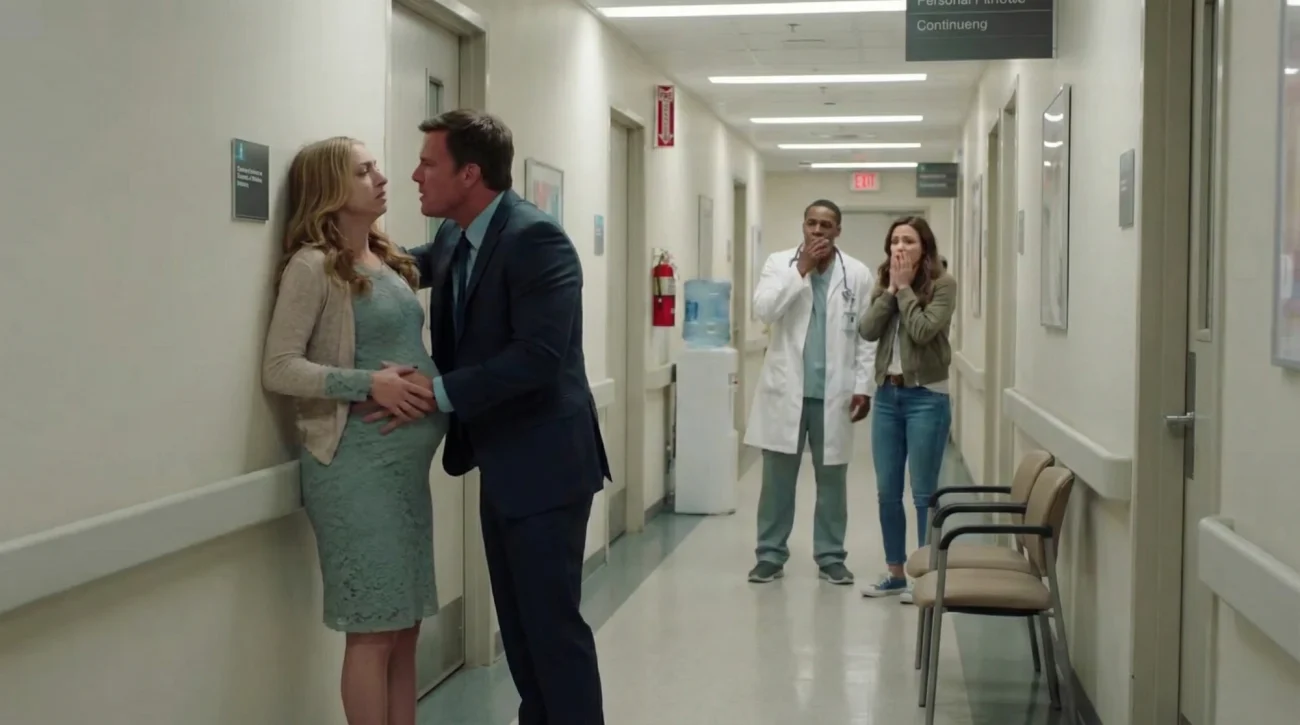
Mara Ellison had learned to count things.
The number of steps from the elevator to the waiting room: fourteen. The number of times Trent had grabbed
her wrist hard enough to leave a mark this month: three. The number of days until her due date: thirty-one. The
number of years since she’d seen her father: six.
She was counting ceiling tiles when the receptionist appeared.
“Mrs. Ellison? We’re ready for you.”
Trent stood before Mara could. “I’ll be with her.”
“Doctor’s policy is—”
“My wife is eight months pregnant.” Trent’s voice dropped to the register he used when he wanted to sound
reasonable and threatening at the same time. “I go where she goes.”
The receptionist looked at Mara. Mara looked at the floor.
They walked down the corridor together, Trent’s hand on her shoulder like a hand on a leash. The clinic smelled
like citrus and money. The hallway was wide and quiet, lined with framed botanical prints, recessed lighting so
soft it felt like being underwater.
Mara had chosen this clinic precisely because it was Trent’s kind of place—discreet, expensive, the kind of
facility that didn’t ask questions. She had not known, when she made the appointment, whose name was on the
brass plaque at the entrance.
She had not thought to check.
A door opened twenty feet ahead.
The man who stepped out was tall, silver-haired, wearing a white coat and the particular stillness of someone
who had spent decades absorbing bad news and choosing not to flinch. He was speaking to a nurse, holding a
tablet, nodding at something on the screen.
Then he looked up.
Mara stopped walking.
“Keep moving,” Trent said quietly.
Her legs didn’t. Six years collapsed in a single second. She was twenty-four again, standing in this same man’s
kitchen, telling him she was in love and that she didn’t need his opinion. She was twenty-five, blocking his
number. She was twenty-six, pretending she didn’t miss him. She was twenty-nine, eight months pregnant,
standing in his hallway with a bruise on her wrist she’d covered with a cardigan.
Dr. Adrian Hale stopped walking too.
“Mara,” he said. Just her name. Like a question and an answer at the same time.
Trent’s grip tightened. “We’re here for an appointment.”
Dr. Hale’s eyes moved—slowly, deliberately—from Trent’s face to his hand on Mara’s shoulder, then down to
the edge of the cardigan where it had slipped. The faint yellow-green shadow near her wrist.
His expression didn’t change. But something behind his eyes did.
“Mara,” he said again, softer. “Are you safe?”
Trent laughed—the easy, dismissive laugh he used at dinner parties when someone said something naive. “She’s
fine. She’s emotional. Third trimester hormones.”
Mara’s throat felt like concrete. She had answered this question in her head a thousand times. She had rehearsed
the lie until it was automatic. She’s fine. She’s clumsy. She’s sensitive. She’s dramatic.
But her father was looking at her the way he used to when she was seven and had scraped her knee and was
trying not to cry in front of her friends—like he already knew and was just waiting for her to be ready to say it.
“No,” Mara said. The word came out small, barely a breath.
Trent’s hand went rigid on her shoulder.
“What?”
She swallowed. Her heart was hammering so hard she could feel it in her teeth.
“I’m not safe.”
The hallway went absolutely still. A nurse who had been walking toward them stopped mid-stride. A man in a
visitor badge looked up from his phone. The receptionist at the far end raised her head.
Trent’s face went through three changes in two seconds—shock, calculation, rage—like watching a mask fall off
in stages.
“You’re embarrassing yourself,” he said, low and controlled. “You’re being hysterical in a medical facility in
front of strangers and you’re going to regret—”
“Get your hand off her,” Dr. Hale said.
Trent turned to face him fully. “Excuse me?”
“Your hand.” Dr. Hale’s voice was even. “Remove it.”
“You don’t have any idea who you’re—”
Trent’s hand snapped across Mara’s face.
The sound cracked in the corridor like a gunshot. Mara’s head turned with the force. For one suspended second
everything was white and ringing, and she tasted copper, and she thought, distantly, that this was the first time
he had ever done it where someone else could see.
Then sound came back.
“Security.” Dr. Hale’s voice cut through the ringing. Not loud. Not panicked. Absolute. “Security to hallway C.
Now.”
Two guards came fast—faster than Mara would have expected, as though the building itself had been waiting
for permission.
Trent stepped back, raising his hands, switching registers again. Reasonable. Calm. Victimized.
“She’s hysterical,” he said. “This is a family matter. She’s been under enormous stress, she’s pregnant, she said
something that upset me—”
“You struck her,” Dr. Hale said.
“I barely—”
“In front of twelve witnesses and two security cameras.” Dr. Hale stepped between Trent and Mara—not
dramatically, just moved into the space like it was always his. “This is assault. In my clinic. On my patient.”
Mara’s knees went soft. Her father’s hand caught her elbow—gentle, automatic, the same way he used to steady
her when she was learning to ride a bike and didn’t know he was still holding on.
“I’ve got you,” he said quietly.
“He’s going to—” She couldn’t finish the sentence.
“I know.” Dr. Hale signaled to a nurse without looking away from Trent. “Exam Three. And get Dr. Vasquez.”
As the nurse guided Mara toward a door, she heard Trent’s voice rise behind her, the careful control finally
cracking.
“That’s my child. You can’t—she’s my wife—you have no right to—”
“You have the right to remain silent,” one of the guards said pleasantly. “The police are already on their way.”
Exam Three was clean and quiet and smelled like antiseptic. Dr. Vasquez—a compact woman with reading
glasses pushed up on her head—appeared within four minutes, checked Mara’s blood pressure (high, but not
dangerous), ran a quick fetal monitor check (baby’s heartbeat steady and strong, indifferent to the drama), and
documented the bruising on Mara’s wrist with a camera and clinical precision.
“How long?” she asked, not unkindly.
Mara stared at the ceiling. “The hitting? About eighteen months. The rest longer.”
“The rest.”
“The…controlling things. The reading my phone. The choosing who I could see.” She paused. “I thought that
was just how he loved me.”
Dr. Vasquez made a note. “Do you have somewhere safe to go?”
Mara thought about it. Six years ago she would have said her parents’ house. Then she had married Trent, and
the answer became nowhere, and she had stopped thinking about the question.
“I don’t know,” she said.
The door opened and her father came in.
He looked older than she remembered. Of course he did—six years did that. There were more lines around his
eyes, more silver in his hair. But his hands were the same. Surgeon’s hands, steady and large, that had always
seemed capable of fixing things.
He pulled a chair to the side of the exam table and sat down without asking permission, the way parents do
when they’ve stopped waiting to be invited.
For a long moment neither of them spoke.
“Dad,” Mara said finally. Her voice cracked on the word.
“I know,” he said. “I know.”
“I should have—”
“Mara.” He shook his head. “Not right now. Not today.” He paused. “There will be time for all of that. I promise
you there will be time.” He glanced at the monitor, at the small steady line of the baby’s heartbeat. “Right now
we need to talk about something else.”
Mara wiped her face with the back of her hand. “What?”
Dr. Hale folded his hands on his knee, the same gesture he used to make when she was a teenager and he was
about to tell her something she wasn’t going to want to hear.
“When Trent came in before you—before I saw you in the hallway—he was already here. Did you know that?”
Mara frowned. “What do you mean?”
“He came in about forty minutes before your appointment. Said he was your husband. Asked to see whoever
was handling your file.” Dr. Hale’s voice was careful and controlled. “He told the intake coordinator he was
concerned about paternity.”
The room went very quiet.
“I don’t understand,” Mara said.
“He claimed—to my staff—that he had reason to believe the child might not be his.” Dr. Hale watched her face.
“He was attempting to request a prenatal paternity test without your knowledge or consent. Which is not
something we can do, legally or ethically. The coordinator flagged it and brought it to me.” He paused. “That’s
why I was in the hallway.”
Mara stared at him. Something cold was moving through her.
“Why would he—” She stopped.
Because she knew why. She had always known, buried under six years of careful not-knowing.
There had been a week, almost two years ago. A conference in Boston. Trent traveling for business. An old
friend—not a boyfriend, never more than an almost, a night that had felt like an exit from a life she hadn’t yet
admitted was a trap—
She pressed her hand to her mouth.
“Mara.” Her father’s voice was quiet. “Is there something I need to know?”
“I don’t—” She shook her head. “I don’t know. I don’t know if it’s possible. I was with someone, once, before I
knew I was pregnant, and I never—I never let myself think about it because if I thought about it then I’d have to
think about leaving, and leaving meant—”
She couldn’t finish.
Dr. Hale nodded slowly. “Okay.” He stood up. “Here’s what’s going to happen. Dr. Vasquez is going to complete
your examination and get you stable. We are going to complete documentation on everything—the bruising, the
slap, the incident in the hallway, the unauthorized access attempt to your medical file. All of it gets documented,
all of it is date and time stamped.”
“And the paternity test?”
“That is entirely your decision. But if you want it—for your own clarity, for whatever comes next—we can do it
today. Non-invasive, completely safe for the baby.” He paused. “Whatever the result is, it belongs to you. Not
him.”
Mara looked at the monitor. The small, steady line. The baby, unhurried and unaware, floating through all of
this in a different kind of quiet.
“Do it,” she said.
The police arrived at 3:47 PM.
Trent, by that point, had been in the lobby for forty minutes, alternating between demanding to see his wife and
calling his attorney. Security had been patient and immovable in the way that only security employed by a man
like Dr. Adrian Hale could be—which is to say, they had heard every version of “do you know who I am” and
had long since developed an immunity.
The officers were efficient. The clinic’s head of security met them with printed stills from two camera angles.
The intake coordinator provided a written statement about Trent’s unauthorized attempt to access a patient’s
medical file. Dr. Vasquez provided photographs.
Trent was arrested in the lobby of the clinic he had always assumed was beneath him, in front of the receptionist
who had tried to tell him he couldn’t go into his wife’s appointment, while his attorney’s phone rang and rang on
the other end and no one answered.
Mara didn’t watch it happen. She heard it—the shift in tone from Trent’s voice from belligerent to suddenly,
sharply afraid—from Exam Three, where she was eating crackers the nurse had brought and staring at the
ultrasound image of her daughter that Dr. Vasquez had printed out on a whim.
Her daughter. Thirty-one days out. Already looking, in the grainy gray image, like she had an opinion about
things.
“He’s been arrested,” her father said from the doorway.
Mara nodded.
“The paternity results will take a few days. I’ve rushed them.” He paused. “My attorney has already made
contact. Given the documented abuse, the assault in the clinic, and the unauthorized medical file access—which
is a separate legal issue involving HIPAA violations—his attorney is going to have a very difficult week.”
“He said the baby was his,” Mara said. “He said it in the hallway. Screaming about how the baby was his.”
“I heard.”
“He was so sure.” She turned the ultrasound image over in her hands. “He was wrong about so many things. I
wonder if he was wrong about that too.”
Her father crossed the room and sat beside her, not in the chair this time but on the edge of the exam table, close
enough that his arm was warm against hers.
“Whoever’s name is on that test,” he said, “she has a grandfather. That part doesn’t change.”
Mara felt the tears come then—finally, fully, after years of holding them in at precisely the wrong moments and
shedding them in bathrooms and parking lots where no one would see and there would be no consequences for
it. They came in the right place, at last.
She leaned her head against her father’s shoulder the way she hadn’t since she was nine years old.
He didn’t say anything. Just put his arm around her and let her cry.
The paternity results came back on a Thursday.
Mara was staying in her father’s guest room by then—temporarily, she told herself, though temporary was
beginning to feel permanent in all the best ways. The house smelled like the coffee her father made too strong
and the particular kind of quiet that came from being somewhere safe.
She opened the results on her phone, sitting on the edge of the bed, sunlight coming through the curtains.
She read them twice.
Then she called her father into the room.
He read them without expression—the doctor’s face, trained and still.
“Trent Ellison,” he read, “is excluded as the biological father.”
Mara exhaled.
She hadn’t known, until that moment, how much of her had been bracing for the other answer. How much space
she had given over to dreading the version of the story where Trent had that hold on her, that legal thread, that
excuse to be part of every day of her daughter’s life.
“What do I do now?” she asked.
Her father set the phone down. “Now your attorney files this with the divorce proceeding. It eliminates his
paternity claim, eliminates his custody argument, and combined with the criminal assault charge and the HIPAA
violation complaint, it leaves him essentially no leverage.” He paused. “He’ll try to fight it. He’ll spend money
on it. He’ll make it ugly for a while.”
“And then?”
“And then it ends.” He said it the way he said everything—simply, without ornamentation, like a man who had
seen enough outcomes to know which ones were which. “And you’ll be on the other side of it.”
Mara looked at the ultrasound image she’d taped to the wall above the dresser. Her daughter, twenty-nine days
out now, done with whatever opinion she’d been forming and apparently ready to express it.
“I’m sorry,” Mara said quietly. “For the six years.”
Her father was quiet for a moment. “You believed someone who told you I would hurt you. That’s not a moral
failure. That’s what those people do.”
“I should have—”
“Mara.” He said her name the way he had in the hallway. Like a question and an answer. “You got out. That’s
the part that matters.”
Three months later, on a Tuesday in April, Mara’s daughter arrived—seven pounds, four ounces, and apparently
furious about it.
She had her mother’s jaw. She had, it turned out, her biological father’s eyes—a man Mara had called the night
after the test results and who had gone very quiet on the phone for a very long time before saying he needed to
sit down.
He was not ready, he said.
He was also, it turned out, not unwilling.
That was another story, one that was just beginning and would need its own time to find its shape.
The day Mara came home from the hospital, her father was waiting on the front steps with coffee and a
handmade banner that read WELCOME HOME in block letters that were slightly crooked in a way that made
her suspect he had made it himself rather than ask anyone for help.
She stood on the walk holding her daughter, looking at her father standing there with his terrible banner and his
too-strong coffee, and thought about all the versions of this moment she had almost never gotten to have.
“She needs a name,” her father said, coming forward, hands already reaching carefully for the baby with the
automatic certainty of a man who had held a thousand of them and never dropped one.
“I know.” Mara let him take her. Watched his face change, that same controlled stillness replaced by something
unguarded and immediate.
“What about Adrian?” Mara said. “For a middle name.”
Her father looked up from the baby’s face.
“That’s a fine name,” he said, and his voice was not entirely steady, and that was fine too.
Trent Ellison pleaded guilty to assault in the third degree fourteen weeks later. He was ordered to pay
restitution, complete a batterer’s intervention program, and was permanently barred from contact with Mara or
her daughter under the terms of the restraining order. His attorney had not, in the end, had a good week—or the
several months that followed it. The HIPAA violation complaint resulted in a separate civil suit that cost Trent’s
legal team more time and money than any of them had expected.
He sold the apartment. He left the city.
Mara didn’t watch any of it happen. She had a daughter to introduce to the world, and a father to relearn, and a
life to rebuild from scratch in the particular way that only becomes possible once you finally, fully let go of the
one that was trying to destroy you.
It was, by any measure, enough
Original fictional stories. AI-assisted creative content.
