
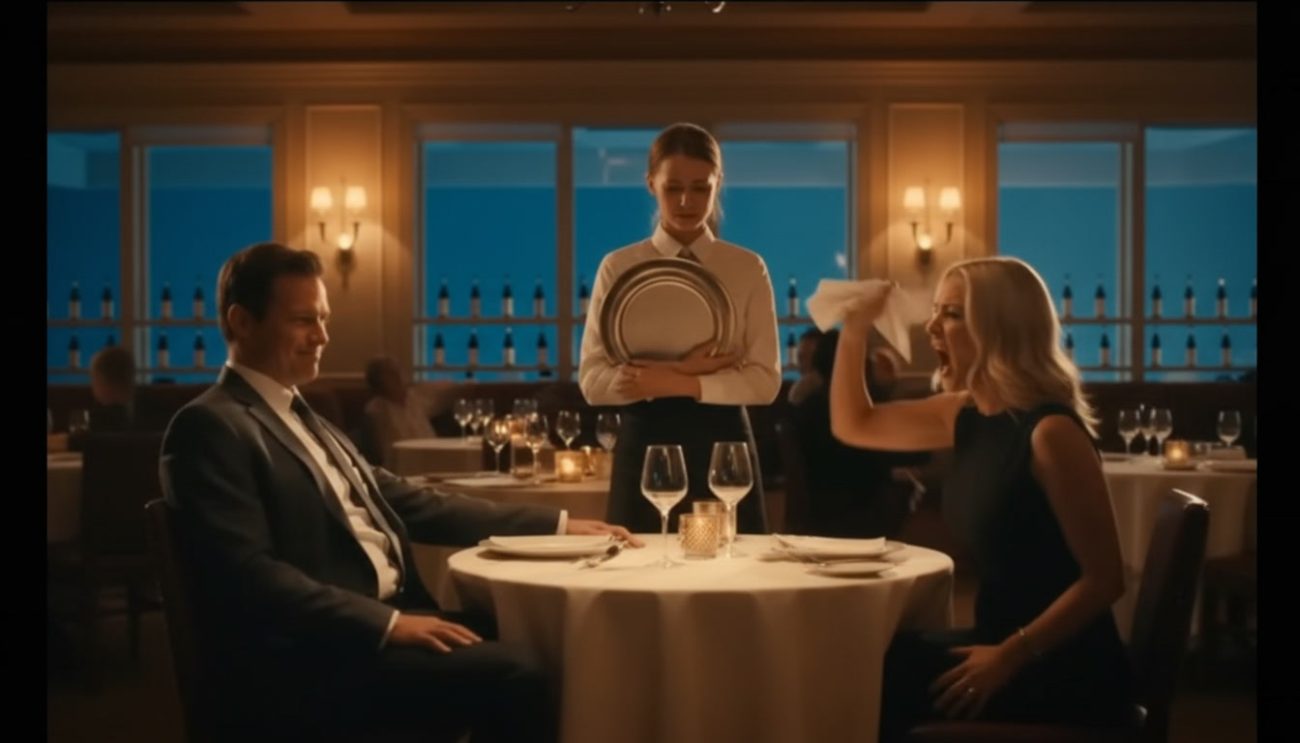
TSophie hadn’t eaten since morning. She couldn’t afford to. Not the food at Amara, anyway — a single appetizer here cost more than her whole grocery run for the week.
But she wasn’t here to eat. She was here to survive.
Three months on the job. Upscale restaurant in downtown Chicago. White tablecloths, dim amber lighting, wine lists thicker than textbooks. The kind of place where people dropped four hundred dollars on a Tuesday and didn’t blink.
Sophie was twenty-three. Brunette hair in a tight ponytail. Crisp uniform. Comfortable shoes — the only smart purchase she’d made in the last year.
Everything else had been a disaster.
Her mom died fourteen months ago. Ovarian cancer. Slow. Expensive. Sophie had dropped out of nursing school in her second year to be at the bedside full-time. She didn’t regret it. She’d do it again.
But when it was over, there was nothing left. No degree. No savings. No apartment — the landlord didn’t accept “my mother just died” as rent.
For two months, Sophie lived in her car. A 2009 Honda Civic parked in the back corner of a Walmart lot. She used a gym membership for showers. She applied to every restaurant, café, and diner within twenty miles.
Thirty-seven applications. Thirty-seven.
Most didn’t call back. The ones that did took one look at her résumé — the two-year gap, the “currently between residences” — and said they’d be in touch. They never were.
Then she found Amara.
James Whitfield, the owner, interviewed her himself. He sat across from her in the empty dining room on a Tuesday afternoon while she tried to keep her hands from shaking.
He looked at the résumé. Tapped the gap with his finger.
“Two years blank. What happened?”
“My mother was sick. I took care of her.”
He looked up. Held her eyes. “That’s not a gap. That’s a job. A harder one than most people will ever work.”
He hired her on the spot.
Then he did something she didn’t expect. He handed her an envelope. Inside: an advance on her first paycheck — enough for a deposit on a studio apartment.
“Pay me back when you can,” he said. “No rush.”
She paid it back in six weeks. Every cent. She left the cash in an envelope on his desk with a note that said “Thank you.” Two words. She couldn’t think of bigger ones that would fit.
James found it, read it, and pinned the note to the corkboard in his office next to the health inspection certificate and a photo of his late wife. He never mentioned it. Sophie noticed it one day when she brought him a coffee. She didn’t mention it either. Some things don’t need words.
Now she was pulling doubles on weekends, saving for tuition, rebuilding the life that cancer had taken apart piece by piece. She was good at the job — better than good. Regulars requested her by name. She memorized allergies, birthdays, wine preferences, which couples were celebrating and which were fighting. She once talked a man out of proposing at table six because she overheard his girlfriend on the phone saying she wanted to break up. She saved him the worst night of his life without him ever knowing.
Linda, the floor manager, had already hinted at a promotion. “Shift lead by summer,” she’d said. “If you want it.”
Sophie wanted it. She wanted everything. She wanted it so badly it scared her sometimes — the hunger to build something after losing everything.
Tonight was Friday. Every table full. Sophie had a six-top celebrating an anniversary, two four-tops of quiet business dinners, and table twelve — a round table near the center of the room.
Table twelve sat down at 7:45.
Sophie knew trouble the second they opened their mouths.
The woman — Diana — was mid-forties, blonde, pearl earrings, black dress that cost more than Sophie’s monthly rent. She didn’t look at Sophie when she received the menu. She spoke past her, to her husband.
“God, I hope this place is better than it looks.”
The husband — Richard — was slim, clean-shaven, slicked-back blond hair, charcoal suit, gold watch. He smiled the way people smile when they know they’re being watched.
“If it’s not, I know people.”
Sophie kept her voice even. “Welcome to Amara. Can I start you off with something to drink?”
“Sparkling water,” Diana said, still not looking at her. “Cold. Not room temperature like the last place.”
“Of course. I’ll be right back.”
Sophie brought two glasses. Ice cold. Topo Chico. Lemon wedges. Perfect.
Diana took one sip.
“This isn’t Pellegrino.”
“We carry Topo Chico, ma’am. It’s our house—”
“I didn’t ask what you carry. I said sparkling water. Pellegrino is sparkling water.”
“Let me check if we have it in the back.”
They didn’t. They’d never carried Pellegrino. It wasn’t on the menu. Sophie returned to the table.
“I’m sorry, ma’am. We don’t carry that brand, but I’d be happy to offer—”
“Then why didn’t you say that instead of wasting our time?”
Sophie swallowed the heat rising in her chest. “I apologize. Can I take your dinner order?”
Richard didn’t look up from his phone. “Wagyu. Medium rare. If it comes out medium, I send it back.”
Diana tossed her menu across the table so it slid toward Sophie’s hands. “Salmon. Grilled. No butter, no oil, no sauce. Plain. Think you can handle that?”
“Absolutely.”
Sophie keyed in the order. Moved on. Served the six-top their champagne. Ran a card for table four. Refilled waters. Smiled. Smiled. Smiled.
Twenty minutes. Food came up. She checked both plates herself. Wagyu — perfect sear, pink center, textbook medium rare. Salmon — grilled, clean, no butter, no oil.
She delivered them. “Wagyu, medium rare. And the grilled salmon, plain. Enjoy your meal.”
She turned to leave.
“Excuse me.”
Sophie stopped.
Diana was holding her fork like a scalpel, pointing at the plate.
“What is this?”
Sophie looked. A single sprig of dill. A garnish. The kitchen put it on every plate.
“That’s just dill, ma’am. A garnish. I can remove—”
“I said plain. Does this look plain to you? Does it?”
“I apologize. Let me have the kitchen—”
“Don’t reheat it. I want a new one. From scratch.”
Sophie took the plate to the kitchen. Marco, the line cook, stared at her.
“She’s sending back a forty-dollar fish because of dill?”
“Just make it again, Marco. Please.”
Seven minutes. New plate. Not a speck of garnish. Not even a drizzle of oil. Sophie carried it out and set it down.
Diana cut a piece. Chewed. Slowly. Deliberately.
“It’s dry.”
Sophie’s jaw tightened. “Would you like me to—”
“No. Forget it.” Diana pushed the salmon away and pulled her husband’s half-eaten wagyu toward herself. “I’ll eat his. At least someone in that kitchen can cook a steak.”
Richard watched the whole performance without saying a word. He hadn’t complained once about his food. He’d eaten in silence while his wife went to war.
Sophie cleared the rejected plate. “Is there anything else I can get you?”
“Competence,” Diana muttered.
Sophie walked to the service station. Set the plate down. Pressed her palms flat on the counter. Her hands were shaking — not from fear, from the effort of holding herself together.
Linda appeared beside her. “Table twelve?”
Sophie nodded.
“You’re doing everything right. Two more courses and they’re gone. Hang in there.”
Sophie took a breath. Went back out.
Dessert. She brought the crème brûlée — their order, not a comp. Diana picked at it. Richard checked his watch twice.
Then the check.
Sophie placed the leather folder on the table. “Whenever you’re ready. No rush at all.”
Richard slid his card in without looking at the total. Sophie took it to the register.
The machine beeped. Red text on the screen.
DECLINED.
Sophie’s stomach dropped. She ran it again. Same result. She tried a third time, willing the screen to change. Red. Declined. Red. Declined.
Her mouth went dry. She knew how this worked. The machine wasn’t broken. The card was empty. And now she had to walk back to a table that had spent the entire evening treating her like furniture and tell them their money wasn’t real.
She looked at Linda across the room. Linda gave her a small nod — you’ve got this.
Sophie walked back to the table. She kept her voice low, leaning in so the neighboring tables couldn’t hear. She was protecting them. Even now, after everything, she was protecting their dignity.
“Sir, I’m sorry — the card didn’t go through. Would you like to try another one?”
Richard’s eyes snapped to her. The smugness cracked for just a second — a flicker of panic. Then it hardened into something worse: humiliation turned outward.
“Run it again.”
“I ran it twice, sir. It’s not—”
“Then your machine is broken.”
“I can try a different card if you—”
Diana leaned forward, and something in her finally snapped. She slammed her napkin onto the table. Her voice carried across the dining room — she didn’t care anymore.
“What kind of service is this? Are you stupid? Where did they even find you?”
The room went quiet. Forks stopped. Conversations died. Every head within thirty feet turned toward table twelve.
Sophie stood there, tray pressed against her chest, chin trembling.
Richard leaned back in his chair. He adjusted his cufflink — a practiced, deliberate motion. His voice was calm, low, dripping with condescension. He didn’t yell. He didn’t need to. The contempt was surgical.
“Don’t worry about the card. I’m going to call the owner of this restaurant personally.” He looked Sophie dead in the eyes. “And you’re fired.”
Sophie blinked. Her vision blurred. She pressed the tray harder against her chest like a shield.
The six-top had stopped celebrating. A woman at the bar set down her glass. A busboy froze mid-step.
Nobody moved.
Two tables away, a man had been eating alone all evening. Tall. Broad-shouldered. Mid-fifties. Silver-gray hair, short beard. An impeccable navy three-piece suit. A half-finished glass of red wine beside a steak he’d barely touched for the last ten minutes — because he’d been listening.
He’d heard every word. The water. The dill. The salmon. Every quiet cruelty.
Now he set his napkin down. Slowly. He pushed back his chair. He stood.
His walk was unhurried. Deliberate. The kind of walk that belongs to a man who owns the ground beneath his feet.
He crossed the dining room and stopped beside Sophie. He placed a steady hand on her shoulder. Not aggressive — certain. The way someone stands next to something they refuse to let anyone damage.
He looked directly down at Richard.
The room held its breath.
“I am the owner of this restaurant.” His voice was low, steady, absolute. “She stays.”
Richard’s hand froze on his cufflink.
A pause. A deliberate beat of silence. Then a sharp grin spread across James’s face — almost playful, almost amused — and his voice rose, savoring every syllable.
“But you two… can get lost.”
The silence was so complete you could hear ice settling in a glass three tables over.
Diana’s mouth opened. Nothing came out. Richard’s smug mask collapsed — what was underneath was small, red, and completely powerless.
Someone at the bar let out a single, quiet laugh. Then another person. Then a low murmur of approval rippled through the room.
James wasn’t done. His voice dropped back to conversational — calm, almost friendly, which somehow made it worse.
“Your card declined, by the way. Four hundred and twelve dollars. Dining and dashing is a misdemeanor in Illinois. I could call the police.”
He let that hang for two full seconds.
“But I won’t. I’m comping your entire meal — every cent — so you have absolutely no reason to ever walk through that door again.”
He reached into his jacket, pulled out a business card, and placed it on the table. Slid it toward Richard with one finger.
“That’s my card. In case you still want to call the owner.”
A woman at the six-top covered her mouth. The busboy exhaled. Someone near the bar clapped once, caught himself, then clapped again.
Richard grabbed Diana’s arm. “Let’s go.”
“Richard, I—”
“Let’s GO.”
They stood. Diana snatched her clutch, knocking over a water glass. Neither of them looked back. They walked to the exit with the stiff posture of people pretending fifty pairs of eyes weren’t watching them leave.
The door closed.
The restaurant exhaled. Conversations returned. Forks moved. The world turned again.
James looked at Sophie.
She was crying. Not from the couple — from the pressure that had been building all night finally cracking open.
“Mr. Whitfield, I’m so sorry, the card, I should have handled it differently—”
“Sophie.” Firm and soft at the same time. “You did everything right. The water, the fish, the card — none of that was your fault. You were professional when they gave you every reason not to be.”
He paused.
“That’s why you’re my best employee. Not because you never have a bad night. Because when you do, you don’t take it out on anyone else.”
He squeezed her shoulder once and let go.
“Take fifteen minutes. Linda’s got your tables.”
Sophie pushed through the staff door and sat on a milk crate beside the walk-in fridge. The fluorescent light buzzed above her. The air smelled like cold steel and lemon.
She pressed her palms over her eyes and cried.
Not because of them. Not because of the dill or the water or the declined card or the word “stupid” ringing in her ears.
Because six months ago she’d been sleeping in a car. Waking up at 5 AM to move before the lot security noticed. Brushing her teeth in a gas station bathroom. Eating peanut butter out of the jar for dinner.
And tonight, in a room full of strangers, a man had stood beside her — not behind her, not in front of her, but next to her — and told the world she was worth keeping.
Her mother would have liked James. She would have said, “That’s a good man, Sophie. You remember what that looks like. They’re rare.”
Marco found her ten minutes later, holding a plate — crème brûlée, extra caramelized sugar on top, still warm from the torch.
“From James. He said you earned it.”
Sophie laughed through the tears. Cracked the sugar with a spoon. It was perfect.
She went back to the floor. Finished her shift. The six-top left a forty-percent tip after watching the whole thing. A couple at the bar flagged her down just to say, “You handled that with more grace than we could have.”
At the end of the night, she was wiping down table twelve — the table that almost broke her — when her cloth caught on something underneath the place setting where James had been sitting earlier that evening.
An envelope. Cream-colored. Her name on the front in neat, careful handwriting. The pen had pressed hard, like the writer meant every stroke.
She stared at it for a long moment. The empty restaurant hummed around her — the soft tick of the cooling kitchen, a dripping faucet somewhere in the back, the distant hum of the city through the walls.
She picked it up and opened it.
A check. Five thousand dollars. Made out to her. And a note on Amara letterhead, folded once:
“For your tuition. Finish what you started. You’re going to be a great nurse — I’ve never been more sure of anything. Don’t let anyone make you believe otherwise. — J.W.”
Sophie sat down slowly in the empty restaurant. Chairs stacked on tables around her like a silent audience. Candles out. Kitchen dark and quiet. Just her, the envelope, and the echo of the night.
She read the note four times. Then a fifth, because the tears made the words swim and she needed to be sure — absolutely sure — that it was real.
She thought about her mother. About holding her hand in the hospital bed and promising — promising — she would finish school.
She thought about the parking lot. The backseat. The thirty-seven applications.
She thought about a man who read a gap on a résumé and called it a job.
Sophie folded the note, pressed it against her chest, and put it in her apron pocket.
Then she smiled. A real one — the kind that starts deep in the chest and takes over the whole face until you can’t stop it.
She stood. Turned off the last light. Locked the front door.
And drove home — to her own apartment, with her own key — to study for the exam that would change her life.
The couple would forget this night in a week. They’d find another restaurant, another waitress.
But Sophie would remember it forever.
Not the insults. Not the dill. Not the card.
The hand on her shoulder. The voice that said “She stays.” The man who stood up because it was right.
No one was going to make her feel small. Not tonight. Not ever again.
She had a job. She had a plan. She had someone in her corner.
That was everything.
Original fictional stories. AI-assisted creative content.

I am a BSN-RN of 49 years. As I was in school many years ago I had to work just to survive. My Dean called me into her office and told me “We have never had a student graduate from this program that insisted on working and I do not intended on it occurring now!” I replied, “ you have never had a student like me.” over the next years. She made my life hell as I studied completed. Clinical’s, and completed my research projects.. I graduated and went to Raleigh North Carolina for State boards the first week of July. I passed on the first attempt and was the first male RN to be hired at the hospital in my hometown. Over the next 49 years, I worked in the emergency department., became a nurse educator, Supervisor. Manager., and director. During that time I completed two fellowships in emergency nursing and emergency medical services received numerous awards. and in 2022. I retired and now enjoy life on the beach in Florida. I never forgot the words that hateful Dean told me and what she put me through as I completed my education, received my license, and had a great career for the next 49 years. Those words and actions only made me determined to reach my goals.