
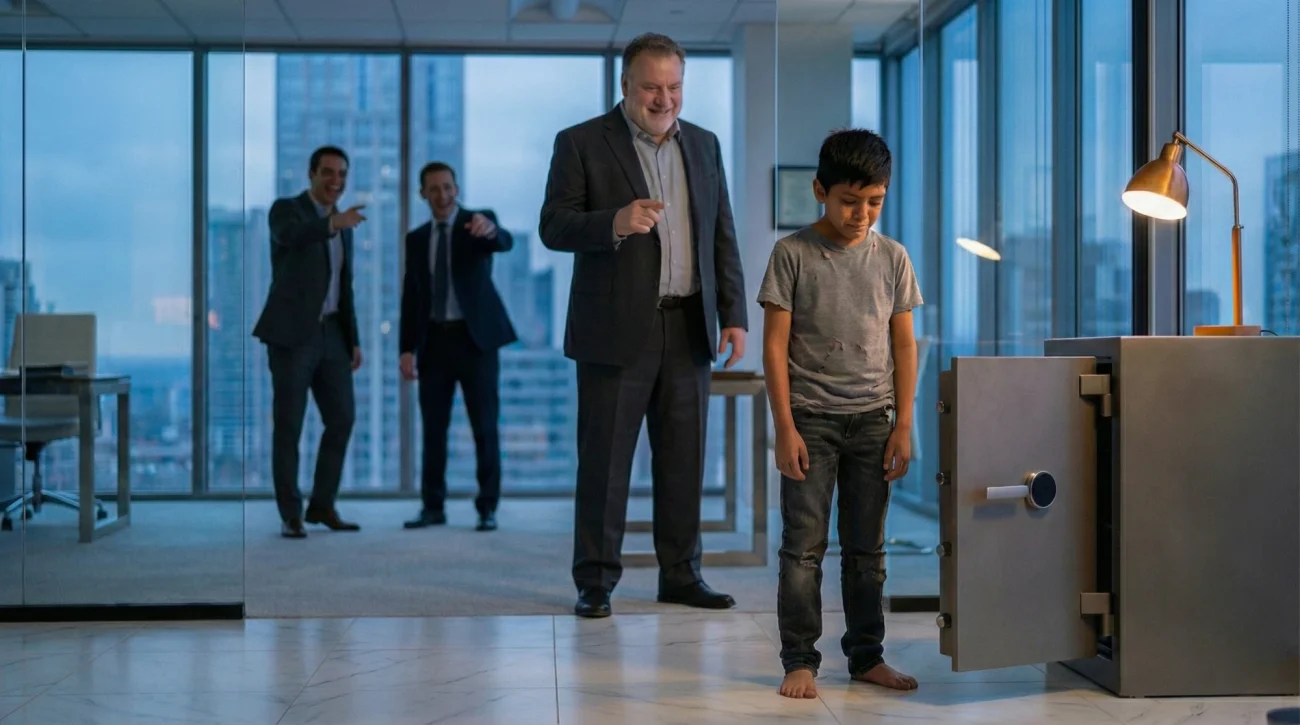
The boy’s name was Diego.
He had learned that much about himself — his name, how to read, how to count. His mother, Elena, had taught him at night by candlelight in their one-room apartment, using newspaper scraps and the backs of receipts.
He was eleven years old and standing on Italian marble that cost more than his entire life.
“So,” Mateo Sandoval said again, louder this time, performing for his audience. “You understand what 100 million dollars means?”
Diego looked up at the man. Not with fear. With something much worse for Mateo — patience.
“Yes, sir,” Diego said. “It means you have more than you need.”
A beat of silence.
Rodrigo Fuentes — the real estate magnate — let out a short laugh, unsure if the boy had just insulted their host. Gabriel Ortiz’s smile tightened slightly at the corners.
Mateo blinked, then grinned wider. “Smart mouth. I like it.” He waved a hand toward the safe. “Then go ahead. Open it. Hundred million is yours.”
Elena pressed herself harder against the wall. Her mop trembled. “Diego, no — baby, we’re leaving—”
“Let him try,” Mateo said sharply, cutting her off without looking at her. “Or are you afraid he’ll actually do it?”
The room laughed again. But softer this time.
Diego stepped toward the safe. It was a Swiss model — matte titanium, about the height of a refrigerator, with a digital keypad, a biometric palm reader, and a mechanical combination dial that required a specific sequence only Mateo knew. Three redundant systems. It had been featured in a financial security magazine two years ago as the most secure private safe in the Western Hemisphere.
The boy stood in front of it for a long moment.
“Can I ask you something?” Diego said, without turning around.
Mateo spread his arms. “The floor is yours, street rat.”
“When’s the last time you opened it yourself?”
Leonardo Márquez frowned. “What kind of question is—”
“Last Tuesday,” Mateo said, cutting him off, amused. “Why?”
Diego nodded slowly. “Did you use the palm reader or the dial?”
“Both. You need both plus the code. That’s the point.” Mateo glanced back at his associates. “Three-factor. It’s elegant.”
“And the biometric plate,” Diego said, still studying the safe. “It’s scratched. Right here.” He pointed to the lower-left corner of the palm sensor. “Fingernail scratch. Recent.”
Mateo’s smile flickered. “So?”
“So when you use the palm reader, your hand tilts left to avoid the scratch. You’re right-handed, but you favor the left side of the pad.” Diego turned now, looking directly at Mateo. “That means the sensor has a calibration offset. The factory default for this model is two centimeters off-axis tolerance. With that scratch causing avoidance drift—” he paused, “—the sensor is probably reading you as authorized even when you’re slightly misaligned.”
The room had gone quiet.
“I’ve seen this safe before,” Diego continued. “Not this one. A photo of it. In a magazine my mother found in the recycling from this building. She brought it home because the pages were clean enough to practice writing on.”
Elena’s hand had stopped trembling. She stared at her son.
“I read the whole magazine,” Diego said simply.
Mateo’s jaw was tight now. “You read a security magazine. At eleven.”
“I read everything I can find.” Diego turned back to the safe. “The combination dial — this series uses a haptic feedback mechanism. When you pass through the correct number, there’s a 0.3-second micro-resistance. You can feel it if your hand is still enough.”
“That’s not public knowledge,” Mateo said slowly.
“It was in a footnote. Page 47.”
Rodrigo Fuentes stood up from his chair.
Diego placed his hand on the dial and began turning it — slowly, methodically, with his eyes closed.
The room held its breath.
Click.
He moved to the palm reader. He pressed his own small hand flat against it, but instead of waiting for rejection, he used two fingers on the calibration strip along the edge — a maintenance access point, visible only as a slight seam in the titanium — and held it for exactly four seconds.
A small green light blinked.
Then Diego entered a sequence on the keypad — not the code, but the factory diagnostic bypass, a six-digit sequence printed in the magazine in a sidebar about manufacturer recalls.
The safe made a sound like a held breath being released.
The door swung open.
Silence.
Absolute, total silence.
Inside the safe: stacks of documents, hard drives, and banded cash in multiple currencies. But also — visible on top — a manila folder labeled with the names of three offshore accounts and a hand-written note in Mateo’s own handwriting that read: Vargas settlement — do not file.
Elena’s name. Her settlement.
Mateo’s face had gone the color of old ash.
“What is that?” Gabriel Ortiz said, voice low and dangerous, leaning forward. “Mateo. What settlement?”
Elena stepped away from the wall. Her mop fell to the floor with a clatter that nobody laughed at.
“Three years ago,” she said quietly, “I was injured on this floor. A chemical spill. My right hand. I couldn’t work for four months.” Her voice was steady now. Steadier than it had been all night. “Mr. Sandoval’s legal team offered me a settlement and told me to sign an NDA. Then they said the paperwork was lost. Then they stopped returning my calls.”
“How much?” Rodrigo asked, still staring at Mateo.
“Eighty thousand dollars,” Elena said.
“She had a lawyer?” Leonardo asked.
“She couldn’t afford one,” Diego said. “She had me.”
He reached into his torn shirt pocket and pulled out a folded piece of paper — a photocopy of the original settlement offer, with Mateo’s legal team’s letterhead, dated three years ago.
“I found it in the recycling,” Diego said. “Same batch as the magazine.”
The room broke.
Not loudly. Not with shouts. It broke the way expensive things break — with a quiet, irreversible crack.
Gabriel Ortiz pulled out his phone. “I’m calling my attorney.”
“As am I,” said Rodrigo, already standing.
“This meeting is over,” Leonardo said flatly.
Mateo grabbed Diego’s arm. “Now you listen to me—”
“Don’t.” Elena’s voice was iron. She stepped between her son and the man who had made her invisible for eight years. “Don’t you touch him.”
Mateo released the boy’s arm like it had burned him.
Three days later, a labor attorney filed suit on Elena’s behalf — pro bono, after Diego’s story was shared in a local community forum by a paralegal who had been at that building servicing a different client and witnessed the open safe.
Two weeks after that, the three business associates cooperated with a financial crimes investigation that had been quietly building against Sandoval Enterprises for eighteen months. The offshore account folder from the safe became exhibit one.
Mateo settled Elena’s original claim for four hundred thousand dollars — five times the original offer, with a penalty multiplier for suppression. He paid it in eleven days. His attorneys advised him that fighting it would cost more.
Elena used part of the settlement to move into a two-bedroom apartment with a real kitchen table and a lamp bright enough to read by without straining.
Diego used the table every night.
He was reading everything he could find.
He always had been.
Original fictional stories. AI-assisted creative content.
