
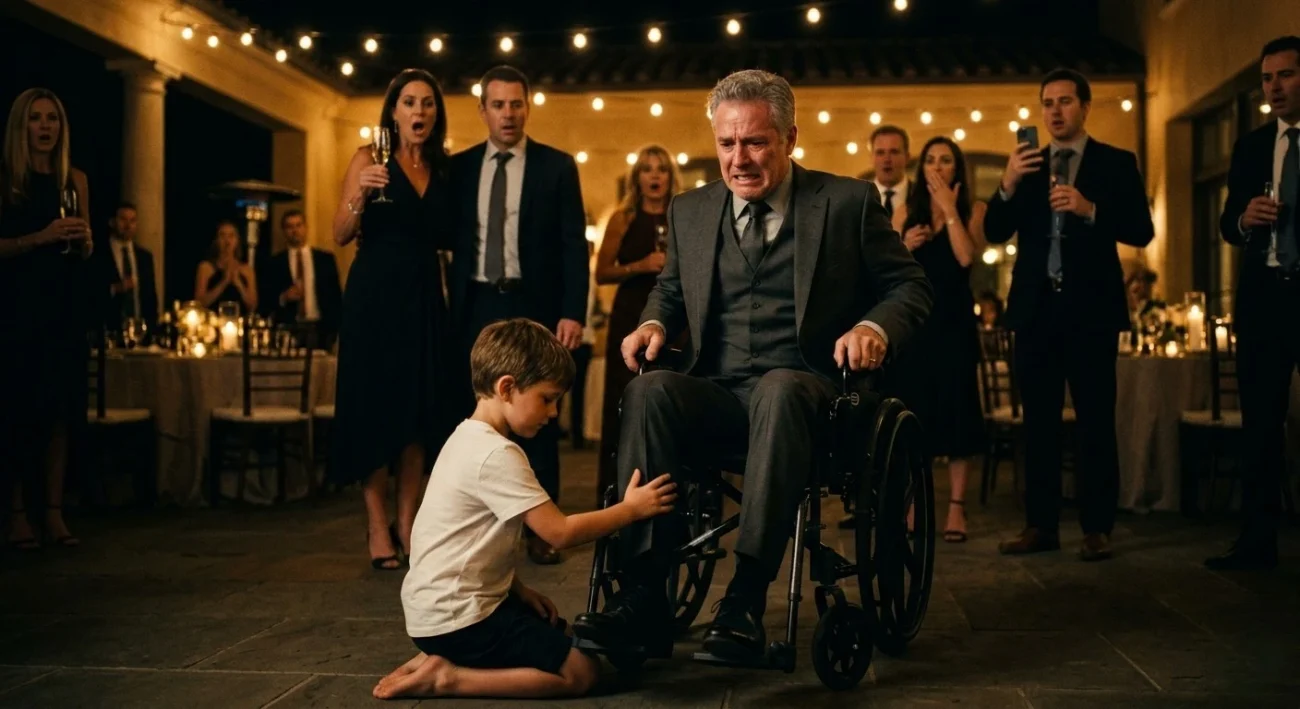
The party was the kind Preston Whitmore threw every summer — two hundred guests, a live quartet, catered by people who didn’t advertise prices. The terrace of his Malibu estate stretched out over a cliff above the Pacific, strung with warm lights that made everything look like a painting.
Preston sat in the center of it all, as he always did.
His wheelchair was custom — matte black titanium, built by the same company that made his cars. He’d been in it for eleven years. A ski accident. Spinal compression. Partial paralysis from the T10 down. The best doctors in four countries had told him the same thing: nothing more could be done. He’d accepted it. Moved on. Built a second fortune just to prove the chair didn’t define him.
Tonight he was relaxed. Wine in hand. Laughing at something his CFO had said.
That’s when he noticed the boy.
He appeared from nowhere — slipping between the catered tables, moving through the crowd like he belonged there. Maybe eight years old. Maybe nine. Barefoot. Wearing a faded gray T-shirt and cargo shorts three sizes too large, cinched at the waist with what looked like a piece of rope.
Nobody stopped him.
Later, guests would struggle to explain why.
He walked directly to Preston’s wheelchair. Stopped. Looked up.
“Sir,” he said. “I can help your leg.”
A beat of silence.
Then laughter — soft, confused, good-natured. The kind that bubbles up at an unexpected joke at a garden party. Preston’s CFO pressed his lips together. Someone behind Preston snorted.
Preston looked the boy up and down. The bare feet. The rope belt. The absolute, unblinking calm on his face.
“You?” Preston said. He kept his voice warm — he was a gracious host. “How long will that take?”
“Just a few seconds.”
The laughter spread, louder this time. Real now. His business partner Stacy actually touched her forehead. The catering staff near the bar exchanged glances. Three phones lifted.
Preston leaned forward slightly in his chair. His expression shifted — still amused, but something colder moving underneath it. He was a man who didn’t like being the punchline, even when he was laughing.
He reached for the leather-bound checkbook he kept on the table — old habit, old money. He set it in front of the boy.
“Fix it,” he said. “I’ll give you a million dollars.”
The laughter didn’t stop all at once. It faded in segments — the closest guests first, then the outer ring, then the people in the back who’d been watching on their phones and caught the shift in energy before they understood it.
Something had changed.
The boy wasn’t scared.
That’s what silenced the room, faster than anything Preston had done. A child confronted with that much wealth, that many eyes, that level of dismissal — and he just stood there. Hands loose at his sides. No fidgeting. No glancing around for an adult.
He stepped forward.
He kneeled beside the wheelchair.
Gently — with both hands, careful as a doctor — he placed his palms along the outside of Preston’s right thigh.
“Count with me,” the boy said quietly. “One.”
Preston opened his mouth. He was going to say something cutting. Something that would bring the laughter back and reset the dynamic. He had a gift for that.
He didn’t get the word out.
Because his foot moved.
It wasn’t dramatic. No surge of light. No sound. Just — a small lateral twitch. The kind of involuntary movement a sleeping person makes.
Except Preston hadn’t had any movement below his waist in eleven years.
His wine glass tipped and hit the table. Nobody moved to catch it.
“…what,” Preston said. Not a question. Just the word, stripped of everything.
The boy said, “Two.”
Preston’s leg moved again. Stronger. A clear rotation at the ankle, his foot lifting half an inch off the footrest and coming back down.
Preston grabbed the armrests of his wheelchair. His knuckles went white.
“Stop,” he said. His voice came out wrong — too thin. “Stop, what are you — what is this—”
“Three,” the boy said.
The leg lifted.
Not a twitch. Not a reflex. The knee bent. The foot came up six inches, eight inches, and hovered.
Preston made a sound that wasn’t language.
Guests near the front stumbled backward. Someone dropped a glass. Stacy had both hands over her mouth, eyes wide above them. The phones were everywhere now, shaking because the hands holding them were shaking.
“Four,” said the boy.
Preston shoved himself forward in the chair. His hands found the armrests, the wheels, the edge of the footrest — instinctive, like a body remembering something his mind hadn’t caught up to yet.
“Don’t touch me,” he said — and there was no performance in it anymore, no party host management. Just raw, barely controlled panic. “Don’t — what did you do to me, what did you —”
“Try to stand,” the boy said.
“I can’t stand.”
“Try.”
Stacy took a step forward. “Preston—”
“Stay back,” he snapped at her.
He looked down at his legs. At his feet, flat on the footrests. At his hands, braced on the chair arms. Eleven years of muscle memory and medical certainty told him this was impossible. Eleven years of being careful. Of not hoping. Of making his peace.
He pushed.
His legs responded.
Shaking — badly, visibly, like a man who’d been bedridden for a year — but they responded. His feet hit the terrace stone. His calves contracted. He rose from the chair inch by inch, arms trembling, breath coming in gasps.
He got to his feet.
He stood.
No one spoke.
Preston stood in the center of his terrace, above his ocean, surrounded by the two hundred most powerful people he knew, tears running unchecked down his face.
He’d cried once in the last decade. At his father’s funeral. He’d made sure no one saw it.
He didn’t care who saw this.
“How,” he said. Just the word. To the boy, who was still kneeling on the stone beside the empty wheelchair, hands folded in his lap, utterly calm. “How did you do that.”
The boy looked up at him. “My mother prays for people,” he said. “She taught me to listen for when they need it.”
A long silence.
Stacy sat down hard in the nearest chair. Someone near the back started crying — a soft, helpless sound. The quartet had stopped playing at some point and no one had noticed.
“Where is your mother?” Preston said.
“She’s sick,” the boy said simply. “That’s why I came tonight. I heard you helped people.”
Preston stared at him for a long moment.
Then he turned to the nearest person — his personal assistant, Marcus, standing three feet away with his phone frozen in his hand.
“Call the hospital,” Preston said. “My hospital. Tell them I’m sending someone tonight and I want every resource they have on the case.”
Marcus didn’t move immediately. He was still in shock.
“Marcus.” Preston’s voice was steady. The old authority. But something else underneath it now. “Now.”
Marcus moved.
The boy’s name was Eli. His mother’s name was Diane. She’d been in a state clinic forty minutes away for six weeks — a tumor, aggressive, and the treatment she needed wasn’t covered and she was out of options.
Preston’s medical team had her transferred that night.
He stood in the hospital hallway at 2 AM — still in his party clothes, his wheelchair abandoned in the trunk of his car like a piece of luggage he no longer needed — and watched through the window while Eli sat at his mother’s bedside, holding her hand.
Stacy appeared beside him.
“The doctors say she has a real chance,” she said quietly. “With the right treatment. Sixty percent.”
Preston nodded. He didn’t say anything for a moment.
“He didn’t come there for money,” Preston said. “He came there because he thought I could help.”
“I know.”
“He was at a party full of billionaires and he walked up to me.” He paused. “Why me?”
Stacy looked through the glass at Eli, whose eyes were closed now, head bowed, lips moving slightly.
“Maybe,” she said, “he knew you’d be the one who understood what it meant to have something returned to you.”
Preston didn’t answer.
But he stayed in that hallway until 4 AM. And when Eli finally fell asleep in the chair beside his mother’s bed, Preston told the night nurse to put a cot in the room.
Six months later, Diane was in remission.
She and Eli attended the opening of the Whitmore Children’s Medical Foundation — a new wing of the hospital, funded entirely by Preston, dedicated to covering treatment costs for families who couldn’t afford it.
At the ribbon cutting, a reporter asked Preston what inspired the initiative.
He looked over at Eli, who was eating a granola bar near the entrance and watching the crowd with the same mild, unimpressed calm he’d had on that terrace.
“A kid reminded me,” Preston said, “that the point of having everything is knowing what to do with it.”
Eli glanced over at him. Made brief eye contact. Gave a small, satisfied nod.
Like he’d known all along it would end this way.
Original fictional stories. AI-assisted creative content.
