
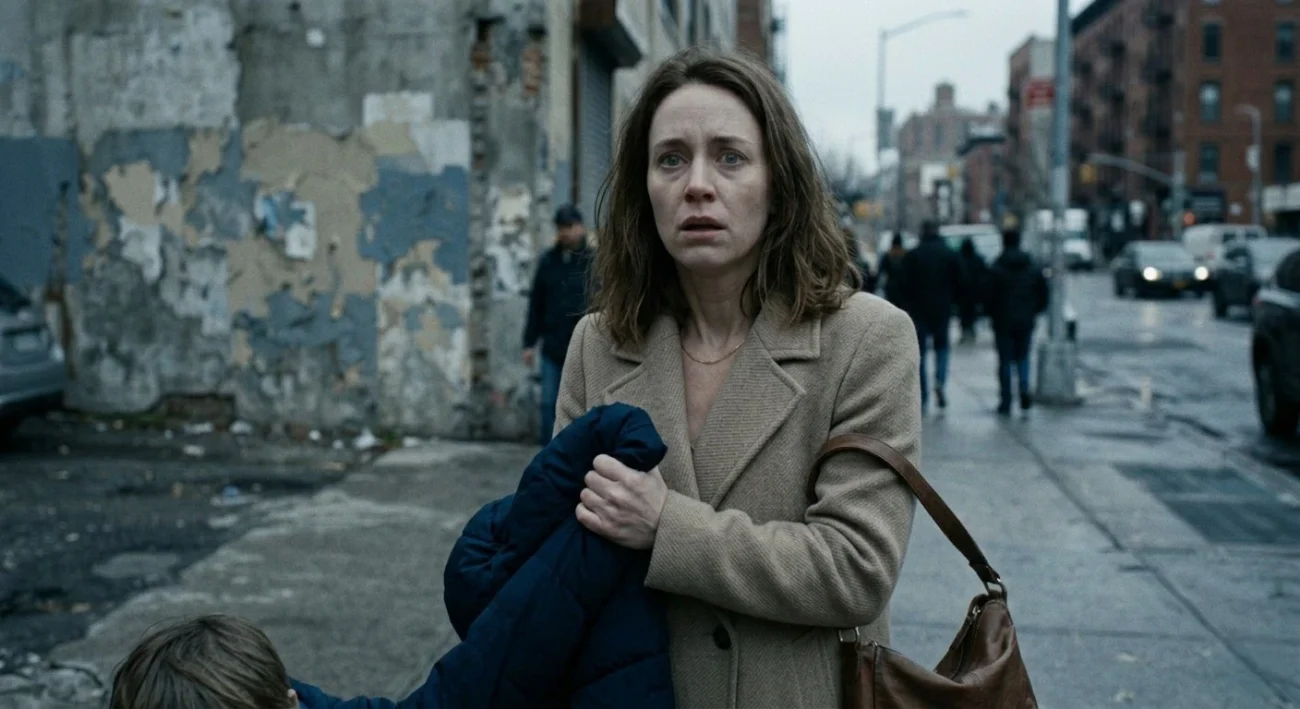
The city doesn’t stop for cold. It doesn’t stop for hunger, and it doesn’t stop for an eight-year-old boy curled against a cracked wall with nothing left to hide behind.
His name was Marcus — though he’d almost forgotten it. He’d been on the street long enough that people had stopped feeling like a category he belonged to. They moved around him the way water moves around a stone. He’d learned not to make eye contact. Easier that way.
He had thirty-seven cents in a cup by his knee. He’d counted it four times.
A businessman in a gray coat stepped over his legs without breaking stride. A woman glanced down, then at her phone, then away. Two teenage boys laughed at something on a screen and passed close enough that Marcus felt the wind from their jackets.
No one stopped.
Then running footsteps.
Not the quick, nervous footsteps of someone avoiding him. These stopped.
Marcus looked up. A boy — same age, clean camel coat, cheeks still pink from warmth — was already crouching, already tearing a wrapped loaf of bread in half with both hands, already holding it out like it was the most natural thing in the world.
“Here. You look hungry.”
Marcus stared at the bread. Then at the boy. He didn’t take it immediately — kindness, he’d learned, sometimes cost more than it gave.
“I can pay you back,” Marcus said, without believing it.
“I don’t want anything back.” The boy pushed the bread closer. “Just take it.”
Marcus took it.
The first bite cracked something open in his chest. His eyes burned. He tried to chew without making a sound, but his shoulders shook — just once, then again, then he couldn’t stop it.
“Thank you,” he whispered. His voice had gone ragged and small. “I — thank you.”
The boy in the camel coat didn’t look away or laugh or make it weird. He just set the other half of the bread beside Marcus’s cup and sat down on the frozen pavement next to him, right there on the sidewalk in his clean coat, like it was a perfectly reasonable place to be.
Then he leaned forward and wrapped his arms around Marcus’s shoulders in a hug that was total and uncalculated.
“You’re safe,” the boy said quietly. “Okay? You’re safe now.”
Marcus buried his face in the clean coat and wept. Eight years of being invisible, eight years of being stepped over and around — all of it broke loose at once.
The heels came fast.
Hard, expensive, the sound of someone accustomed to having emergencies resolved at a distance. A woman burst through the glass door of the building behind them — silk scarf, leather bag, three shopping bags abandoned in the lobby because her focus had collapsed into a single point.
Her son. Hugging a street child. On the dirty sidewalk.
“James!” Her voice cut through the street noise like a knife. “James, get away from him — now.“
James — that was the boy’s name, apparently — looked up. Not guilty. Confused.
“Mom, he’s cold. He doesn’t have anywhere to go.”
“James, stand up.” She was already moving toward them, already reaching for her son’s arm, already calculating the fastest way to close this scene — when she stopped.
Her heel scraped concrete.
She’d seen the boy’s face.
Not the tear-streaked, dirty face of a stranger. Something older than that. Something that punched directly through eight years of practiced forgetting and found the place she’d locked away.
The shape of his nose — her father’s nose.
The narrow scar just above the left eyebrow — he’d fallen off a kitchen chair at two years old, and the ER doctor had said it would fade, and it hadn’t, not entirely.
The silver chain at his neck — a tiny oval locket she’d clasped there herself, tiny fingers trying to open it at the hospital, the clasp too small, her laughing, her saying not yet, baby, you’ll get it when you’re older—
Her hand went to her mouth.
Marcus looked up from the broken hug. The woman was staring at him with an expression he didn’t have a word for — like someone watching something fall in slow motion. Like someone who’d been holding a breath for eight years.
He studied her face. The shape of something familiar in the line of her jaw. The color of her eyes.
Something in his memory clawed toward the surface. A smell. A voice. Something warm and enormous that had disappeared one night and never come back, and he’d eventually stopped expecting it to, the way a body learns to live with a missing piece.
“Mom?” The word came out before he understood he was saying it.
The woman collapsed.
Not dramatically — not the movie version. Her knees just gave, and she went straight down to the sidewalk in her silk and leather and dropped her bag without noticing. Her whole face was breaking apart in real time, every layer of composed, managed, expensive distance dissolving at once.
“Marcus.” It wasn’t a question. It came out like something she’d been holding so long it had fused to her ribcage. “Marcus, oh god — Marcus—“
She reached for him. He didn’t pull away — some animal part of him had already recognized her before his mind caught up, and he let himself be pulled in, and for a moment all three of them were on the sidewalk in the cold, and the city kept moving around them like nothing was happening.
Then James said:
“…Then who am I?”
His voice was careful and very quiet. Not panicked. Eight years old and already doing the math.
The woman pulled back. She looked at her son — James, the boy she’d raised for eight years, the boy whose first word she’d recorded, whose heights she’d marked on the kitchen doorframe, whose nightmares she’d sat up with — and her expression was something that didn’t have a clean name.
“James,” she said. “Come here.”
He didn’t move. His eyes were going back and forth between them — the woman who was his mother, the stranger who apparently also was.
“I need you to listen to me,” she said. “Both of you.”
Three weeks earlier, Detective Reyes had reopened a file labeled Harmon, Marcus — Missing Persons — Age 2 — Unsolved.
He hadn’t expected it to go anywhere. Eight-year-old cases rarely did. But a routine DNA update to the national registry had flagged a match — partial, anomalous — to a child welfare record filed four months prior for a boy picked up near the Riverside transit center. No guardian. No documentation. Age estimated at seven to eight.
Reyes had pulled the welfare record.
He’d stared at the intake photo for a long time.
Then he’d called the mother.
Her name was Claire Harmon, and she’d spent eight years living two lives simultaneously.
In one life, she’d cooperated with every search, attended every support group, kept Marcus’s bedroom door closed but not locked. She’d lit candles on his birthday. She’d made herself get up and function because the alternative was that the wrong version of the story became permanent.
In the other life, she’d rebuilt. Remarried, briefly. Miscarried. Found James — not found, exactly. James had been placed with her by an agency eleven months after Marcus disappeared, an emergency placement that became a legal adoption because no one came forward and Claire was there and capable and had too much love with nowhere to put it. She’d never stopped looking for Marcus. She’d also never stopped being James’s mother.
She hadn’t known how to explain to James that both things could be true at once.
She hadn’t expected the explanation to arrive on a frozen sidewalk with bread crumbs on its coat.
“You’re my son,” Claire told James. “That has never once been a question.” She took his hand. “And Marcus is my son too. He was taken from me when he was two, and I’ve been looking for him every single day since.”
James looked at Marcus. “You got stolen?”
Marcus wiped his face. “I don’t — I don’t really remember much. I remember a car. I remember being cold for a long time.”
“Did someone bad take you?”
“I think so.” Marcus looked at Claire. “Who? Do you know who?”
Claire’s jaw tightened. She’d known the answer to that question for six years. She’d just never been able to prove it to a standard that law enforcement would act on.
“Yes,” she said. “And now that you’re here, I can.”
The man’s name was Derek Harmon — her ex-husband, Marcus’s biological father. They’d divorced when Marcus was eighteen months old, a separation so jagged it had required a restraining order. Derek had contested custody and lost. The court had given Claire full legal custody with supervised visitation — supervised, because three different people had testified to his instability, and the judge had agreed.
Derek had appeared to accept this. He’d shown up for his supervised visits. He’d sent birthday cards. He’d seemed, to everyone watching, to be doing the work of being a reasonable person.
Then Marcus had vanished from his daycare on a Tuesday morning.
Two witnesses had seen a man matching Derek’s description near the parking lot. The car plates came back to a rental under a name that took three days to trace to Derek’s brother’s girlfriend. By the time the trace completed, Derek was in Mexico.
He’d stayed out of the country for four years. He’d returned quietly. Claire’s attorneys had found him twice, but without Marcus — without physical proof that Marcus was alive and had been with Derek — the kidnapping charge had a ceiling. Derek had hired better lawyers. Delays, continuances, jurisdictional complications. The system ground slowly while Derek lived in a rental in Phoenix and coached Little League.
“I need you to tell the detective what you remember,” Claire told Marcus, on the sidewalk. “Everything. The car. The people you were with. The places you stayed. Everything you remember from before the street.”
“Will it help?” Marcus asked.
“It’ll be enough,” Claire said. “I promise you. It’ll be more than enough.”
It was.
Marcus’s testimony — cross-referenced with transit records, a shelter intake log from Tucson dated three years prior, and a single photograph Marcus had somehow kept in his jacket lining since age four: himself and a man he called “Uncle Ray” outside a motel in Flagstaff — gave Detective Reyes everything he needed.
Derek Harmon was arrested fourteen days after the sidewalk reunion. His brother’s girlfriend cooperated in exchange for immunity. The full timeline of Marcus’s movement across five states over eight years was reconstructed in court with enough precision that Derek’s attorney’s motions for dismissal were denied three times in succession.
Derek received twelve years.
His attorney called it excessive.
The judge, who had read the shelter intake logs, said nothing and signed the order.
James still had his bedroom with the height marks on the doorframe.
Marcus got the room next to it — same hallway, same morning light through the east windows, same smell of coffee from downstairs at seven a.m. It took him six weeks to stop sleeping with his jacket on. It took him four months before he stopped startling when the front door opened.
But he slept in the room. He came downstairs for breakfast. He let Claire teach him how to use the coffeemaker, and how to run the dishwasher, and how to work the deadbolt so he could come and go as he pleased.
One morning he came down and found James at the kitchen table, two glasses of orange juice already poured.
“I saved you the window seat,” James said, not looking up from his cereal. “You like the window seat.”
“I do,” Marcus said.
He sat down. The light came through the glass and lay across the table in broad warm strips. He drank his juice and James ate his cereal and Claire’s footsteps crossed the ceiling above them as she moved through the morning.
Marcus set down his glass.
“Hey,” he said.
“What,” James said, still reading the cereal box.
“Thanks. For the bread. That day.”
James looked up. Something moved across his face — not embarrassment, not pride exactly. Something simpler.
“You would’ve done it for me,” he said.
Marcus thought about that for a moment.
“Yeah,” he said. “I would’ve.”
James nodded and went back to his cereal. Marcus turned to the window. Outside, the city moved the way it always did — forward, relentless, faces passing each other in the cold.
He watched it for a while.
Then he finished his juice, and went upstairs to get ready for his first day of school.
Original fictional stories. AI-assisted creative content.
